
Best Calcium Hypochlorite for Aquaculture: High Chlorine Content and Superior Performance
Introduction
In the rapidly expanding global aquaculture industry, maintaining optimal water quality stands as one of the most critical factors determining operational success. Pathogen control, disease prevention, and biosecurity measures require reliable, effective, and cost-efficient disinfection solutions. Among all available options, calcium hypochlorite with high available chlorine content has emerged as the preferred choice for professional aquaculture operations worldwide.
This comprehensive technical guide explores why high-chlorine calcium hypochlorite represents the optimal disinfection solution for aquaculture applications. We examine technical specifications, performance data, industry standards, and practical application guidelines to help B2B buyers make informed procurement decisions for their aquaculture facilities.
Understanding Calcium Hypochlorite for Aquaculture Applications
Chemical Composition and Properties
Calcium hypochlorite, chemically represented as Ca(ClO)₂, is a powerful oxidizing agent widely utilized in water treatment and disinfection processes. The compound’s effectiveness stems from its ability to release hypochlorous acid (HOCl) when dissolved in water, which serves as the primary disinfecting agent.
Key Chemical Specifications:
| Parameter | Specification |
|---|---|
| CAS Number | 7778-54-3 |
| Molecular Formula | Ca(ClO)₂ |
| Molecular Weight | 142.99 g/mol |
| EINECS Number | 231-908-7 |
| UN Number | 2880 |
| Hazard Class | 5.1 (Oxidizing Agent) |
| HS Code | 28281000 |
Available Chlorine Content: The Critical Differentiator
The available chlorine content represents the most important quality parameter when selecting calcium hypochlorite for aquaculture use. Products are typically categorized into three grades:
Standard Grade (30-38% Available Chlorine)
- Traditional bleaching powder formulation
- Lower stability and shorter shelf life
- Higher impurity content including calcium chloride and calcium hydroxide
- Suitable for basic disinfection applications
Technical Grade (65% Available Chlorine)
- Enhanced stability and performance
- Reduced insoluble matter content
- Cost-effective for medium-scale operations
- Industry standard for most aquaculture applications
High-Purity Grade (70-75% Available Chlorine)
- Maximum disinfection efficiency
- Superior storage stability (less than 2% decomposition over 210 days under normal conditions)
- Minimal residue and sediment formation
- Recommended for intensive aquaculture systems and hatchery operations
Technical Performance Parameters
Disinfection Efficiency Data
Research and field studies have demonstrated the exceptional disinfection capabilities of high-chlorine calcium hypochlorite in aquaculture environments:
Pathogen Reduction Rates:
| Pathogen Type | Contact Time | Chlorine Residual | Reduction Rate |
|---|---|---|---|
| Vibrio species | 15 minutes | 1-3 ppm | >99.9% |
| Aeromonas hydrophila | 20 minutes | 2-5 ppm | >99.99% |
| Pseudomonas aeruginosa | 15 minutes | 1-3 ppm | >99.9% |
| Escherichia coli | 10 minutes | 0.5-2 ppm | >99.99% |
| White Spot Syndrome Virus (WSSV) | 30 minutes | 5-10 ppm | >99.9% |
Physical and Chemical Properties
Appearance and Form:
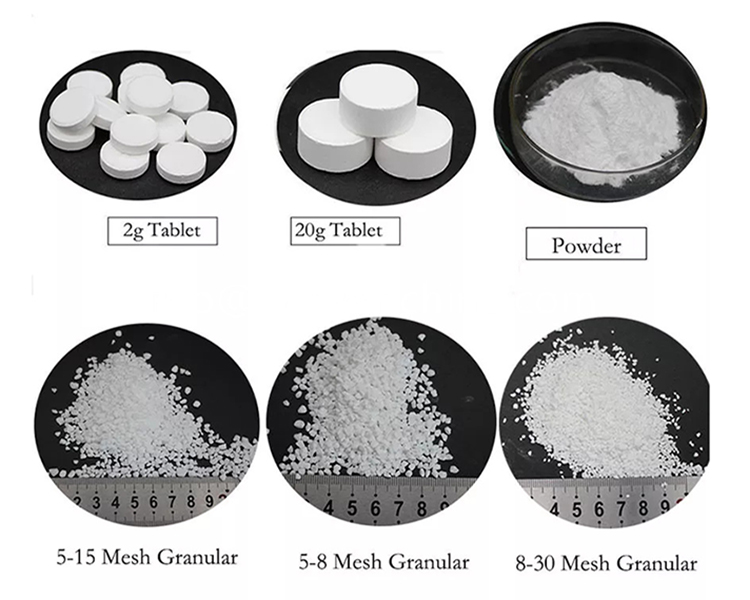
- White granular or tablet form
- Free-flowing powder with minimal dust generation
- Characteristic chlorine odor
Solubility Characteristics:
- Highly soluble in water
- Solution appears yellow-green and translucent
- Alkaline pH in solution (pH increases with concentration)
Stability Performance:
- Superior stability compared to traditional bleaching powder
- Decomposition rate under normal storage: <1.87% over 210 days
- Enhanced resistance to moisture absorption
- Maintains potency when stored in cool, dry conditions away from direct sunlight
Industry Standards and Compliance
International Quality Standards
High-quality calcium hypochlorite for aquaculture must comply with recognized international standards:
GB/T 10666-2008 (Chinese National Standard)
This standard specifies technical requirements for calcium hypochlorite products including:
- Minimum available chlorine content specifications
- Moisture content limits
- Insoluble matter restrictions
- Heavy metal contamination thresholds
WHO Guidelines for Drinking Water Quality
The World Health Organization provides guidance on chlorine-based disinfectants including:
- Maximum residual chlorine levels for safe aquatic environments
- Contact time requirements for effective disinfection
- Safety margins for aquatic organism protection
FAO Aquaculture Development Guidelines
The Food and Agriculture Organization recommends:
- Proper dosing protocols for pond preparation
- Residual chlorine management before stocking
- Environmental discharge considerations
Safety and Handling Standards
Transportation Classification:
- UN 2880: Calcium hypochlorite, dry
- Class 5.1: Oxidizing substances
- Packing Group: II or III depending on chlorine content
Storage Requirements:
- Temperature: Below 30°C recommended
- Humidity: Relative humidity below 75%
- Separation: Keep away from organic materials, acids, and reducing agents
- Ventilation: Adequate airflow in storage areas
Application Guidelines for Aquaculture Operations
Pond Preparation and Disinfection
Pre-Stocking Treatment Protocol:
- Drain and Clean: Completely drain the pond and remove organic debris
- Calculate Dosage: Based on pond volume and target chlorine concentration
- Dissolution: Pre-dissolve calcium hypochlorite in water before application
- Distribution: Apply evenly across the entire pond surface
- Contact Time: Allow minimum 48-72 hours before neutralization
- Neutralization: Use sodium thiosulfate to dechlorinate before stocking
- Verification: Test residual chlorine levels (must be <0.1 ppm before stocking)
Recommended Dosage Rates:
| Application Purpose | Dosage (g/m³) | Target Chlorine Residual |
|---|---|---|
| Pond sterilization | 20-50 | 10-20 ppm |
| Equipment disinfection | 100-200 ppm solution | 50-100 ppm |
| Water treatment (ongoing) | 1-5 | 0.5-2 ppm |
| Disease outbreak control | 10-20 | 5-10 ppm |
Water Quality Management
Ongoing Disinfection Protocol:
For recirculating aquaculture systems (RAS) and intensive culture operations, maintaining appropriate chlorine residuals helps control pathogen buildup:
- Continuous Treatment: 0.1-0.5 ppm residual chlorine
- Batch Treatment: 1-3 ppm with 2-4 hour contact time
- Emergency Treatment: 5-10 ppm for disease outbreak situations
Important Considerations:
- Always monitor chlorine levels before and after treatment
- Consider organic load when calculating dosage requirements
- Account for chlorine demand from ammonia, nitrites, and organic matter
- Ensure adequate aeration during and after treatment
Advantages of High-Chlorine Content Formulations
Economic Benefits
Cost Efficiency Analysis:
Higher chlorine content products offer significant economic advantages:
| Product Grade | Available Chlorine | Relative Dosage | Cost per kg Active Chlorine |
|---|---|---|---|
| 35% Grade | 35% | 2.86x | Baseline |
| 65% Grade | 65% | 1.54x | 46% savings |
| 70% Grade | 70% | 1.43x | 50% savings |
Additional Economic Factors:
- Reduced transportation costs (less product volume required)
- Lower storage space requirements
- Decreased handling and labor costs
- Extended treatment intervals possible
Operational Advantages
Performance Benefits:
- Faster dissolution rates
- More consistent chlorine release
- Reduced sediment formation in ponds
- Lower calcium buildup in water systems
- Enhanced stability during storage
Safety Improvements:
- Reduced dust generation during handling
- More predictable reaction rates
- Better packaging integrity
- Improved shelf life reduces waste
Quality Selection Criteria for B2B Buyers
Manufacturer Evaluation Checklist
When sourcing calcium hypochlorite for aquaculture applications, consider the following criteria:
Production Capabilities:
- Manufacturing capacity and consistency
- Quality control systems and certifications
- Batch testing and documentation
- Production method (sodium process vs. calcium process)
Product Specifications:
- Available chlorine content verification
- Moisture content specifications
- Insoluble matter limits
- Heavy metal testing results
- Particle size distribution
Supply Chain Reliability:
- Consistent supply availability
- Lead time and delivery performance
- Packaging options (drums, bags, tablets)
- Technical support availability
Documentation Requirements
Ensure suppliers provide complete documentation including:
- Certificate of Analysis (CoA) for each batch
- Safety Data Sheet (SDS) compliant with GHS standards
- Quality certification documents
- Transportation classification documentation
- Storage and handling guidelines
Environmental and Sustainability Considerations
Environmental Impact Management
Responsible aquaculture operations must consider environmental impacts of disinfection practices:
Discharge Management:
- Neutralize chlorine before water discharge
- Monitor downstream water quality
- Comply with local environmental regulations
- Implement proper waste treatment protocols
Residue Minimization:
- Use precise dosing calculations
- Avoid over-treatment
- Consider alternative treatments when appropriate
- Implement integrated pest management approaches
Sustainable Sourcing
Best Practices:
- Select manufacturers with environmental management certifications
- Consider packaging recyclability
- Optimize order quantities to reduce transportation emissions
- Implement proper storage to minimize product degradation
Frequently Asked Questions (FAQ)
Q1: What is the optimal available chlorine content for aquaculture calcium hypochlorite?
A: For most aquaculture applications, 65-70% available chlorine content offers the best balance of performance, stability, and cost-effectiveness. High-intensity operations and hatcheries may benefit from 70-75% grade products for maximum efficiency and minimal residue.
Q2: How long does calcium hypochlorite remain effective in storage?
A: High-quality calcium hypochlorite with 65-70% chlorine content maintains over 98% of its potency when stored properly for up to 210 days. Storage conditions significantly impact shelf life—keep in cool, dry conditions away from direct sunlight and moisture.
Q3: What safety precautions should be taken when handling calcium hypochlorite?
A: Always wear appropriate PPE including gloves, eye protection, and respiratory protection when handling. Avoid contact with organic materials, acids, and reducing agents. Ensure adequate ventilation in storage and handling areas. Follow all SDS guidelines and local safety regulations.
Q4: How do I calculate the correct dosage for my aquaculture pond?
A: Dosage calculation requires knowing pond volume, target chlorine concentration, and product chlorine content. General formula: Dosage (kg) = Pond Volume (m³) × Target ppm × 100 / Product Chlorine Content (%). Always conduct small-scale tests before full application.
Q5: Can calcium hypochlorite be used in active aquaculture systems with fish present?
A: Calcium hypochlorite should NOT be used directly in systems with fish present except under specific veterinary guidance. For ongoing water treatment in occupied systems, use much lower concentrations (0.1-0.5 ppm) with careful monitoring, or consider alternative disinfection methods.
Q6: What is the difference between calcium hypochlorite and sodium hypochlorite for aquaculture?
A: Calcium hypochlorite offers higher available chlorine content (65-70% vs. 10-15%), better stability, longer shelf life, and lower transportation costs. Sodium hypochlorite is liquid form with shorter shelf life but easier dosing. Calcium hypochlorite is generally preferred for aquaculture applications.
Q7: How do I neutralize chlorine after pond disinfection before stocking?
A: Use sodium thiosulfate at a ratio of approximately 1:1 by weight with the chlorine applied. Alternatively, allow natural dissipation through aeration and sunlight exposure over 5-7 days. Always verify residual chlorine levels are below 0.1 ppm before introducing aquatic organisms.
Q8: What certifications should I look for when purchasing calcium hypochlorite?
A: Look for manufacturers with ISO 9001 quality management certification, products complying with GB/T 10666-2008 or equivalent standards, proper hazardous materials transportation certification, and complete SDS documentation following GHS guidelines.
*For detailed product specifications, bulk pricing, and technical consultation on calcium hypochlorite solutions for your aquaculture operations, professional suppliers can provide customized recommendations based on your specific requirements and operational scale.*For detailed product specifications, bulk pricing, and technical consultation on calcium hypochlorite solutions for your aquaculture operations, professional suppliers can provide customized recommendations based on your specific requirements and operational scale.
Contact us for product inquiries and technical support: https://envochemical.com/contact-us/
