
Here is the article written according to your requirements.
Best Calcium Hypochlorite for Drinking Water Purification: Eco-Friendly and Efficient
Introduction
Access to clean and safe drinking water remains a fundamental challenge for many industries and communities worldwide. As a professional in the chemical industry, I understand that selecting the right water treatment solution is not just about compliance; it is about ensuring public health and operational efficiency. Among the myriad of disinfectants available, Calcium Hypochlorite (Ca(OCl)₂) stands out as a powerful, stable, and versatile agent for potable water purification.
In this article, we will explore why Calcium Hypochlorite is considered the best choice for drinking water disinfection, focusing on its eco-friendly attributes, high efficiency, and safety profile. We will also provide a comprehensive guide on its application, dosage, and handling to help B2B clients make an informed decision for their water treatment needs.
Why Calcium Hypochlorite is the Top Choice for Water Disinfection
When it comes to purifying drinking water, the primary goal is to eliminate pathogenic microorganisms such as bacteria, viruses, and protozoa. Calcium Hypochlorite has earned its reputation as the “best” option for several compelling reasons:
High Available Chlorine Content
Unlike liquid bleach (Sodium Hypochlorite), which typically contains only 10-12% available chlorine, Calcium Hypochlorite is a solid compound that can contain up to 65-70% available chlorine. This high concentration means that a small amount of the granular or tablet form can treat a massive volume of water, making it highly cost-effective for large-scale operations.
Superior Stability and Long Shelf Life
One of the major drawbacks of liquid chlorine is its rapid degradation. Calcium Hypochlorite, however, is remarkably stable when stored properly. It does not lose its potency quickly, allowing for long-term storage without significant loss of efficacy. This stability is crucial for emergency preparedness and remote locations where supply chains might be unreliable.
Eco-Friendly Formulation
Modern Calcium Hypochlorite is designed with environmental responsibility in mind. It breaks down into harmless byproducts—primarily water, oxygen, and a small amount of residual lime (calcium hydroxide)—which are non-toxic and do not bioaccumulate in the environment. This makes it an eco-friendly choice compared to older, more hazardous chemical treatments.
Applications in Drinking Water Systems
The versatility of Calcium Hypochlorite allows it to be used across various stages of the water treatment process.
Municipal and Community Water Supplies
For municipal water treatment plants, Calcium Hypochlorite is used for primary disinfection. It is particularly effective in:
- Taste and Odor Control: It helps oxidize organic compounds that cause unpleasant tastes and smells.
- Algae Control: It prevents the growth of algae in reservoirs and storage tanks.
- Residual Protection: It provides a stable residual chlorine level in the distribution system, ensuring water remains safe as it travels through pipes to the consumer.
Emergency and Disaster Relief
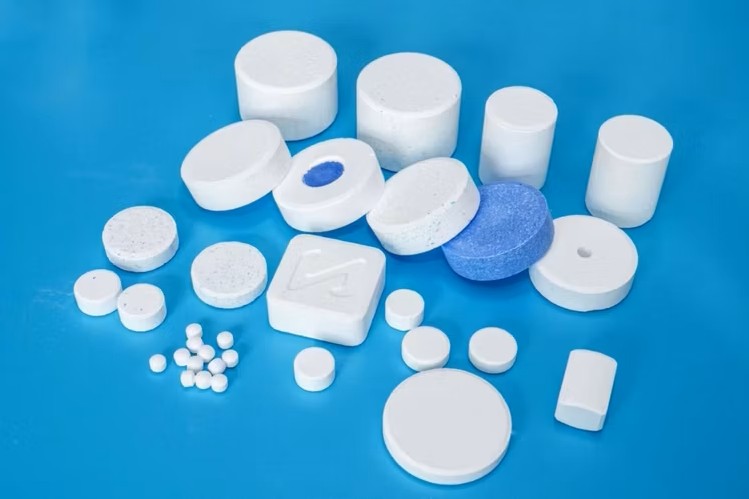
In situations where the regular water supply is compromised (such as after earthquakes or floods), Calcium Hypochlorite tablets are the go-to solution. These tablets are easy to transport, require no refrigeration, and can rapidly disinfect contaminated water sources to make them potable.
Private Wells and Rural Systems
For private well owners and rural communities, Calcium Hypochlorite offers a simple shock chlorination method. It is used to decontaminate wells, cisterns, and pipelines, effectively killing coliform bacteria and other pathogens that may infiltrate groundwater.
The “Eco-Friendly” Advantage: A Closer Look
The term “eco-friendly” is often used loosely, but in the context of Calcium Hypochlorite, it holds specific scientific merit.
Reduced Carbon Footprint
Because Calcium Hypochlorite is a solid, it is much lighter and more compact to ship than liquid chlorine solutions, which are mostly water. This reduces transportation fuel consumption and associated greenhouse gas emissions.
Non-Toxic Breakdown
The chemical reaction of Calcium Hypochlorite in water is straightforward: $$Ca(OCl)_2 + 2H_2O \rightarrow 2HOCl + Ca(OH)_2$$
The Hypochlorous acid (HOCl) kills the microbes, while the Calcium Hydroxide (Ca(OH)₂) simply increases the water’s pH slightly, which can be easily adjusted if necessary. There are no persistent organic pollutants (POPs) left behind.
Safety for Handlers
While all chemicals require careful handling, modern granular Calcium Hypochlorite is formulated to be less corrosive and easier to manage than gaseous chlorine. It eliminates the risks associated with high-pressure gas cylinders, making it safer for plant operators and the surrounding community.
Best Practices for Usage and Dosage
To achieve the best results with Calcium Hypochlorite, precise dosing and proper dissolution techniques are essential.
Proper Dissolution
Calcium Hypochlorite should never be added directly to a main water supply in large quantities. It must first be dissolved in water to create a “mother liquor” or stock solution. This solution is then fed into the water stream using chemical dosing pumps.
Recommended Dosage
The required dosage depends on the initial contamination level of the water (known as the chlorine demand). As a general guideline:
- For Clear Water: 1-2 parts per million (ppm) of available chlorine is sufficient.
- For Turbid or Contaminated Water: 3-5 ppm may be required.
- Shock Chlorination: For cleaning storage tanks or wells, concentrations of 50-200 ppm are used temporarily.
Safety Precautions
While eco-friendly, direct contact with the dry powder should be avoided. Always wear:
- Chemical-resistant gloves
- Safety goggles
- A dust mask (when handling powder)
Store the chemical in a cool, dry, and well-ventilated area away from acids, ammonia, and flammable materials.
Conclusion
Choosing the best Calcium Hypochlorite for drinking water purification is a decision that balances efficacy, safety, and environmental responsibility. Its high available chlorine content ensures that water is disinfected thoroughly, while its solid form and stable nature make it a practical and eco-friendly solution for B2B operations ranging from municipal plants to industrial facilities.
If you are looking for a reliable partner to supply high-purity Calcium Hypochlorite or need technical advice on your water treatment system, we are here to help. Our team of experts can assist you in selecting the right product grade for your specific application.
FAQ
Q1: What is the shelf life of Calcium Hypochlorite? A: When stored in a cool, dry place in its original, tightly sealed container, high-quality Calcium Hypochlorite can retain over 90% of its available chlorine for 12 months. After two years, it may lose approximately 10-20% of its potency.
Q2: Is Calcium Hypochlorite safe for drinking water? A: Yes, it is one of the most widely accepted disinfectants for potable water. Regulatory agencies such as the EPA and WHO approve its use. The residual byproducts (calcium and chloride ions) are non-toxic and naturally occur in many water sources.
Q3: How does it compare to Sodium Hypochlorite (liquid bleach)? A: Calcium Hypochlorite has a much higher chlorine concentration (65-70% vs. 10-12%), making it cheaper to store and transport. It is also more stable over time. However, Sodium Hypochlorite is easier to dose automatically as it is already in liquid form.
Q4: Can I use it for swimming pools? A: Absolutely. It is a common choice for swimming pools because it raises the Calcium Hardness of the water, which is often beneficial in preventing plaster damage in concrete pools. However, care must be taken not to overuse it, as high calcium levels can lead to scaling.
Q5: How do I handle spills or accidents? A: In case of a spill, do not use combustible materials like sawdust. Sweep up the material carefully and place it in a suitable container. If the spill is large, contain it and prevent it from entering drains or waterways. Always neutralize any strong solutions with an antichlor agent like Sodium Thiosulfate before disposal.
