
Short answer: treat every compatibility claim from a polyphosphate reseller as unproven until it is backed by documented composition, dissolution behaviour, regulatory status, and a side-by-side test on your own water. “Compatible” is not a property of a material on its own — it is a conclusion about a specific product working in a specific system, at a specific flow rate, with a specific water chemistry. Without that context, a reseller’s claim is a starting point for questions, not a specification.
This article is written for filter and water-treatment equipment manufacturers, importers, distributors, and procurement staff who are being offered phosphate-based media as a replacement or equivalent for a product they already use, often Siliphos crystal or a similar slow-dissolving polyphosphate. The goal is to give you a practical way to separate a genuine equivalent from a loosely worded sales claim before you commit to stock, tooling, or warranty exposure.
What a compatibility claim has to prove
A useful compatibility claim answers four separate questions. If a supplier answers only one of them, the claim is incomplete.
- Chemical compatibility: does the material behave the same way in contact with your water, at your pH, temperature, and hardness range?
- Physical compatibility: will it fit and function in the housing, cartridge, or feeder you already use — particle size distribution, bulk density, mechanical strength, fines generation?
- Hydraulic compatibility: does it dissolve at a rate that matches your flow and contact time, without creating pressure drop or channeling?
- Regulatory compatibility: is the exact product approved for the exact application and destination market?
Most disputes between buyers and resellers come from collapsing these four into a single sentence such as “same as Siliphos” or “fully compatible replacement.”
Stop treating phosphate products as one material
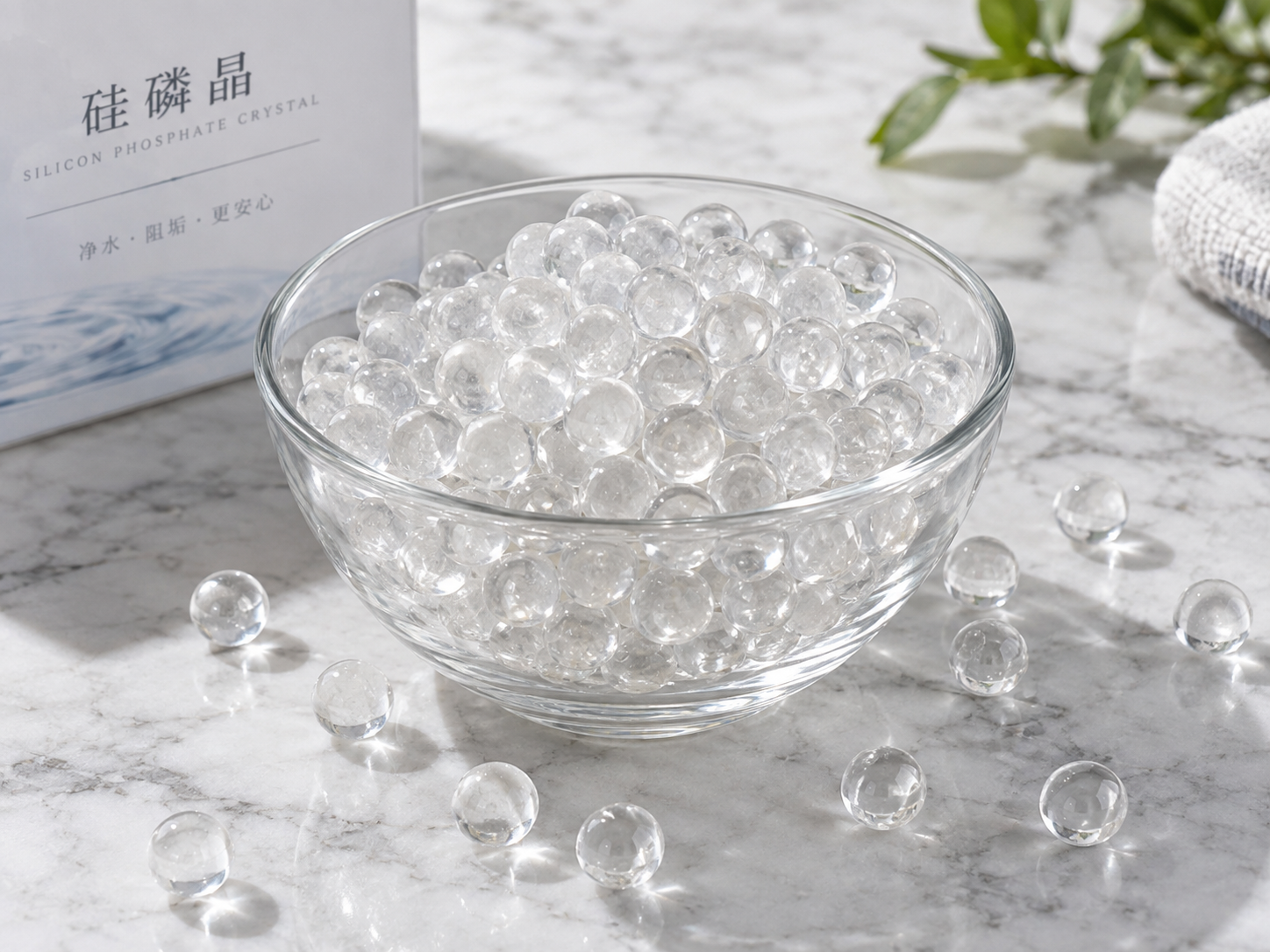
Polyphosphates are a family, not a single substance. Sodium hexametaphosphate, sodium tripolyphosphate, and slow-dissolving silicate-phosphate glasses differ in composition, dissolution rate, and how they interact with calcium and magnesium in water. Siliphos is a trade name commonly associated with one particular type of slow-dissolving silicate-phosphate glass, but in commercial use the name is often applied loosely to almost any clear or amber phosphate crystal.
That looseness matters. Two materials that look similar in a photograph can dissolve at different rates, release different phosphate species, and perform very differently in the same housing. A reseller who says “it’s the same product” without referring to a specific grade, a specific composition range, or a specific reference product is not making a technical claim at all.
Before comparing anything, ask the supplier to identify the material by chemistry and by function, not by brand nickname.
Function check: what is the product actually supposed to do?
Compatibility claims often blur functions. These are not interchangeable:
| Function | What it means | Commonly confused with |
|---|---|---|
| Scale inhibition | Slows or interferes with the formation of mineral scale deposits on surfaces | Scale removal |
| Scale removal | Dissolves or breaks down existing deposits | Scale inhibition |
| Water softening | Removes hardness ions, typically by ion exchange | Scale inhibition |
| Filtration | Physically removes suspended particles | Chemical treatment |
| Corrosion inhibition | Reduces metal loss in pipework or equipment through chemical action | Scale inhibition |
| Disinfection | Inactivates microorganisms | Any of the above |
A polyphosphate medium is generally used as a scale-inhibiting and, in some formulations, corrosion-inhibiting treatment — it does not soften water in the ion-exchange sense, does not remove existing scale, and does not disinfect. If a reseller’s compatibility claim implies otherwise, the claim is wrong regardless of how the material compares chemically.
Verifying the four compatibility dimensions
Chemical and water-chemistry compatibility
Dissolution rate and performance depend on the water itself: pH, hardness, alkalinity, temperature, and the presence of other treatment chemicals such as chlorine or antiscalants. A product that performs acceptably in one water supply may behave differently in another. Ask what test conditions the supplier’s data is based on, and whether those conditions resemble yours.
Physical and mechanical compatibility
Even chemically similar media can differ in particle size distribution, shape, and mechanical durability. This affects how the medium packs in a cartridge, how it flows through a feeder, how much fine material is generated during shipping and handling, and whether it can be used in the same dosing device without modification.
Hydraulic compatibility
Dissolution rate must match the flow rate and contact time of the equipment. If a substitute dissolves faster, it may deplete early and require replacement sooner than expected. If it dissolves more slowly, the treated water may receive less phosphate than the application requires. In an OEM product, either direction can turn into a warranty issue.
Regulatory and market compatibility
This is where substitution claims fail most often. “Food grade” describes a purity category — it does not automatically establish suitability for drinking water. Drinking-water approval is product-, application-, and market-specific, and the applicable scheme differs by country and region. Ask for the exact approval document covering the exact manufacturing site, product grade, and intended use, and check that it applies to your destination market.
A verification checklist for a reseller’s claim
Use this as a written request. A supplier with real documentation can answer it; a supplier working from a datasheet template usually cannot.
| Claim made | Evidence to request |
|---|---|
| “Same as Siliphos / equivalent product” | Material identification by chemistry and function, plus a named reference product the claim is compared against |
| “Same performance” | Dissolution or release data, with the test water conditions and method described |
| “Fits existing equipment” | Particle size distribution, bulk density, and any known handling or fines-generation characteristics |
| “Approved for potable water” | The specific approval certificate, scope, and the market it covers |
| “Suitable for any flow rate” | A stated flow or contact-time range, expressed as a condition rather than a blanket statement |
| “No need to test” | An explanation of why a system-specific trial is unnecessary — treat this as a warning sign |
How to run a practical comparability test
You do not need a full-scale trial to get useful information. A structured small-scale comparison will usually expose a mismatch quickly.
- Define a baseline. Use the product you currently trust as the reference, and test both materials under identical conditions.
- Use real water. Synthetic or softened test water can hide the effects that matter most.
- Control the variables. Same housing type, same contact time, same flow, same temperature, same run duration.
- Monitor meaningful parameters. At minimum, track pressure drop, visible media condition, and measurable phosphate behaviour over time. Add hardness, pH, and alkalinity if scale control is the objective.
- Run long enough to see change. A short test shows initial behaviour; depletion and fouling only appear over a longer interval. Compare the two materials over the same duration.
- Record everything in writing. Trial conditions become the basis for your specification and your supplier agreement.
Red flags worth acting on
- Compatibility is asserted verbally but no document is offered.
- Test data is available only as a summary table with no stated test conditions.
- Certification is described as “meets the standard” rather than “certified by” a named body for a defined scope.
- Specifications are quoted in a way that matches a well-known brand’s published values exactly, word for word.
- Particle size, dissolution behaviour, or regulatory scope is described as “the same” across all grades.
- You are asked to accept the claim because the price is lower.
None of these prove a product is defective. They do mean the claim is unverified, and the risk sits with whoever sells the finished equipment.
Frequently asked questions
Is siliphos crystal identical to every polyphosphate crystal?
No. The term is used both as a specific trade name and as a loose generic label. Two suppliers using the same words may be selling materials with different compositions and dissolution behaviour. Identification by chemistry and function is the only reliable comparison.
Does a polyphosphate medium soften hard water?
Not in the way an ion-exchange softener does. Polyphosphate treatment is generally aimed at scale inhibition, and in some formulations corrosion inhibition. Hardness ions are not removed from the water.
If a product is food grade, can I use it in drinking water?
Not automatically. Food-grade purity and drinking-water suitability are different assessments. Drinking-water use requires approval for the specific product, application conditions, and destination market, and that approval must be confirmed rather than assumed.
Can I switch suppliers without any testing?
Only if the physical, chemical, hydraulic, and regulatory parameters are documented as equivalent for your application. In practice, a short controlled comparison against your current material is usually faster and cheaper than resolving a field failure later.
What if the reseller refuses to provide test conditions?
Treat the performance claim as unsupported. You can still evaluate the material, but you would be doing so at your own risk and on your own test data, not on the basis of the supplier’s claim.
Reviewing a specific offer?
If you are comparing a polyphosphate or Siliphos-type crystal against a material you already use, send us the application, the source-water conditions that matter in your case (hardness, pH, temperature), the equipment or housing type, the required specification, the destination market, and the quantity you are considering. With those details we can tell you what information is needed to support a compatibility comparison — and what still has to be confirmed by testing on your side.
