
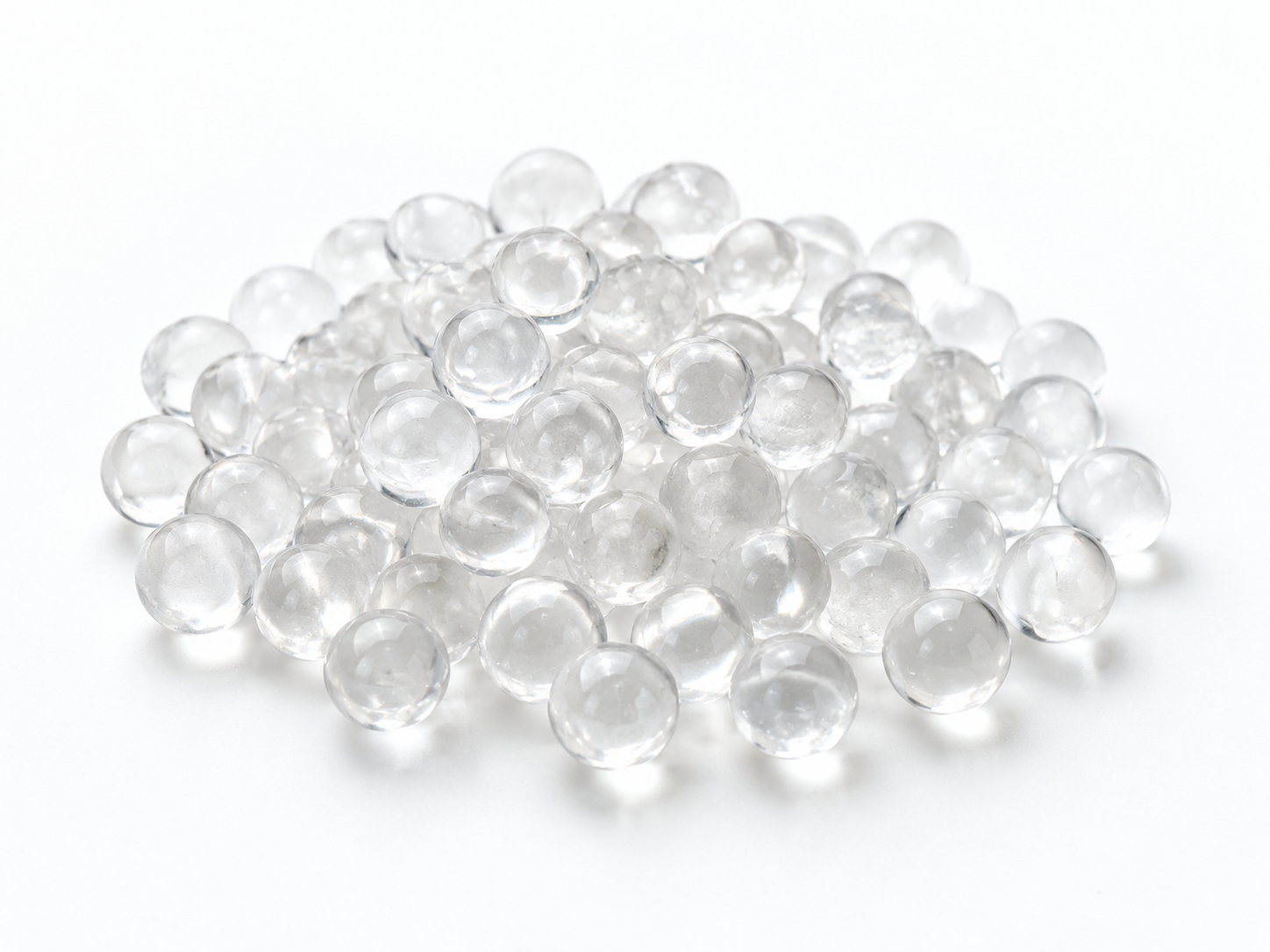
Start With the Answer
When a distributor asks for an exclusive polyphosphate ball size, the request almost always bundles three different things: a technical change (a new nominal diameter or tighter tolerance), a commercial change (tooling, minimum order quantity, price structure), and a contractual change (exclusivity of that size). Handle them one at a time. Many requests can be solved with the existing polyphosphate ball sizes plus a redesigned cartridge or refill, while a smaller number genuinely justify new tooling and a dedicated SKU. Answering “we can make any size” and answering “no” are both unhelpful — the useful answer is a structured evaluation.
Why Distributors Ask for a Size Nobody Else Sells
The underlying motive is usually commercial, not technical. A distributor that resells a commodity media competes mainly on price. A proprietary ball diameter lets them:
- position the refill as a brand-specific part that generic suppliers cannot match;
- control aftermarket sales for housings they already installed;
- avoid direct price comparison with competitors selling the same catalog diameter;
- lock a larger account into their own cartridge platform.
Occasionally the motive is genuinely technical — an existing housing has a fixed internal screen aperture, a filter manufacturer wants to change fill weight without changing the housing, or a refill must pass a defined dissolution or pressure-drop target that the catalog diameter cannot meet.
Separating the commercial motive from the technical one is the first step, because it determines how much engineering effort the request deserves. A request driven purely by differentiation is a commercial negotiation; a request driven by a measurable performance gap is an engineering project.
Clarify the Vocabulary Before You Quote Anything
“Exclusive size” is used loosely in this industry, and mismatched expectations at this stage cause most of the later friction.
Siliphos, polyphosphate crystal, and polyphosphate balls are not interchangeable terms
Siliphos is a trade name commonly associated with polyphosphate crystal media; it is not a generic synonym for every phosphate-based ball product. Polyphosphate balls sold under different names may differ in chemistry, dissolution behavior, density, and intended application. Never assume that a diameter requested for one product can simply be produced in another, or that two products with the same appearance perform identically.
“Exclusive” can mean at least four different things
- Size exclusivity — the supplier will not sell that exact diameter to anyone else.
- Territory exclusivity — the distributor is the only buyer of that size in a defined market.
- Channel exclusivity — the size is reserved for a specific application or equipment brand, regardless of geography.
- Full product exclusivity — the distributor controls the size, the formulation, the packaging, and the branding.
Each level has a different cost and a different contract structure. Ask the distributor which one they actually need before discussing price.
Keep the water-treatment functions separate
Polyphosphate media are generally used for scale inhibition and, in some systems, thin-film corrosion control in water lines. They are not the same as:
- water softening, which removes hardness ions through ion exchange and reduces hardness measurably;
- scale removal, which dissolves existing deposits;
- filtration, which removes suspended particles;
- disinfection, which inactivates microorganisms.
A new ball diameter does not change which of these functions a product performs. If a distributor is requesting a new size because they expect it to solve a hardness or bacteria problem, that expectation should be corrected before any tooling is discussed.
How Ball Diameter Actually Affects Performance
Diameter is not a cosmetic variable. For a uniform spherical bed, several properties shift as the nominal diameter changes:
| Property | Effect of a smaller ball diameter | Why it matters |
|---|---|---|
| Surface-area-to-volume ratio | Increases | More wetted surface per unit of bed volume generally means faster release of the active material per unit time |
| Pressure drop across the bed | Increases | Smaller particles create more flow resistance at the same bed depth and flow rate |
| Balls required to fill a fixed volume | Rises sharply | Ball count scales roughly with the cube of the diameter, which affects counting, QA, and filling accuracy |
| Bulk fill weight per cartridge | Broadly similar for uniform spheres | Packed bed density is largely independent of diameter, so per-cartridge weight may not change as much as expected |
| Retention by screens or plates | Higher risk of passing through | The ball must be reliably retained by the housing aperture, including at end of life |
| Fragmentation and carry-over | Higher risk downstream | Fines and fragments are harder to retain and may deposit in valves or aerators |
Because several of these effects push in opposite directions, a new diameter should be validated against the actual target: a dissolution or release profile over time, a maximum acceptable pressure drop, and reliable retention in the specific housing. If a distributor cannot state those targets numerically, the request is not yet an engineering brief.
Standard Size vs. Exclusive Size: A Decision Framework
Use the questions below to decide whether to quote from the catalog or move to a custom development discussion.
- Does the application work with an existing size? If a standard diameter plus a modified screen, refill volume, or cartridge geometry meets the target, that is nearly always the faster and cheaper path for both sides.
- Is the requested diameter physically distinct? A tolerance tightening on an existing diameter is a quality-control conversation. A genuinely new nominal diameter requires new forming tooling and a new production setup.
- What is the realistic annual volume? Custom tooling, separate production runs, dedicated packaging, and additional inventory all have to be absorbed somewhere. If the volume forecast cannot support the setup, the request is better handled as a one-time trial or declined.
- Who owns the tooling? Decide in advance whether the distributor pays for tooling outright, amortizes it into unit price, or receives it as a development investment tied to a volume commitment.
- What happens if the project ends? Define who keeps the tooling, whether the size can later be sold to others, and how residual inventory is handled.
Contract Clauses That Prevent Later Disputes
An exclusivity request without written boundaries tends to become a problem within a year or two. At minimum, define:
- Scope: the exact nominal diameter, tolerance range, and any color, coating, packaging, or branding element included.
- Territory: named countries or regions, with an explicit statement about online and export sales.
- Duration and renewal: a fixed initial term with renewal conditional on performance.
- Minimum purchase commitment: expressed as volume per period, with consequences for missing it.
- Carve-outs: existing customers, existing equipment platforms, spare-part obligations, and small-quantity sample or testing requests that must remain possible.
- Price validity: how long quoted pricing holds and what triggers renegotiation.
- Exit: notice period, final order rights, and post-termination inventory treatment.
A carve-out list matters more than it appears. Without it, a supplier can be blocked from servicing an existing OEM account that happens to use a similar diameter, which damages the relationship that made the custom size possible in the first place.
What to Confirm Before You Quote a Custom Diameter
Gather this information in one pass rather than trading emails for weeks:
- application and equipment type — inline cartridge, refillable housing, dosing vessel, or other;
- source-water conditions, including hardness, pH, temperature range, and flow rate;
- the performance target, stated as a measurable outcome rather than a description;
- required nominal diameter and acceptable tolerance;
- retention method and aperture size in the housing;
- maximum acceptable pressure drop at design flow;
- expected service interval and how it will be verified;
- packaging format and labeling requirements;
- annual and first-order volume forecast;
- destination market and applicable regulatory requirements.
On the last point, be precise: a material described as food grade is not automatically approved for drinking-water contact. Suitability for potable water depends on the exact product, the application conditions, and the regulations of the destination market, and must be verified separately for each case. If that verification has not been done, say so rather than implying an approval that does not exist.
Frequently Asked Questions
Can any polyphosphate ball be produced in any diameter?
Not automatically. Forming behavior, curing or cooling requirements, and mechanical strength all influence which diameters are practical for a given formulation. A diameter that works for one product may not be reproducible in another without reformulation work.
Is a custom diameter enough to justify exclusivity?
Usually a diameter alone is a weak basis for exclusivity, because a determined competitor can request a nearby size. Stronger positions combine the size with a specific housing interface, packaging format, or documented performance target that is difficult to replicate without the same development work.
How many stock sizes should a distributor carry?
Fewer than most assume. Every additional diameter adds a separate SKU, separate safety stock, and a separate risk of obsolete inventory. Distributors should justify each size with a named equipment platform or customer segment.
Does a smaller ball always mean faster scale inhibition?
It increases available surface area, which can increase release rate per unit volume, but the actual result depends on flow, temperature, contact time, and the specific chemistry. Faster release is not automatically better — it can shorten the effective service interval and increase phosphate carry-over.
Discussing a Specific Size Request
If you are evaluating a custom polyphosphate ball diameter or an exclusive supply arrangement, the fastest route to a useful answer is a complete brief rather than a diameter alone. Send the application and equipment type, source-water conditions, target diameter and tolerance, retention method, flow rate and allowable pressure drop, required performance outcome, packaging format, forecast volume, destination market, and the exact exclusivity scope you are requesting. ENVO CHEMICAL can then respond on the points that are genuinely verifiable for the product in question and identify clearly what still needs to be tested or confirmed.
