
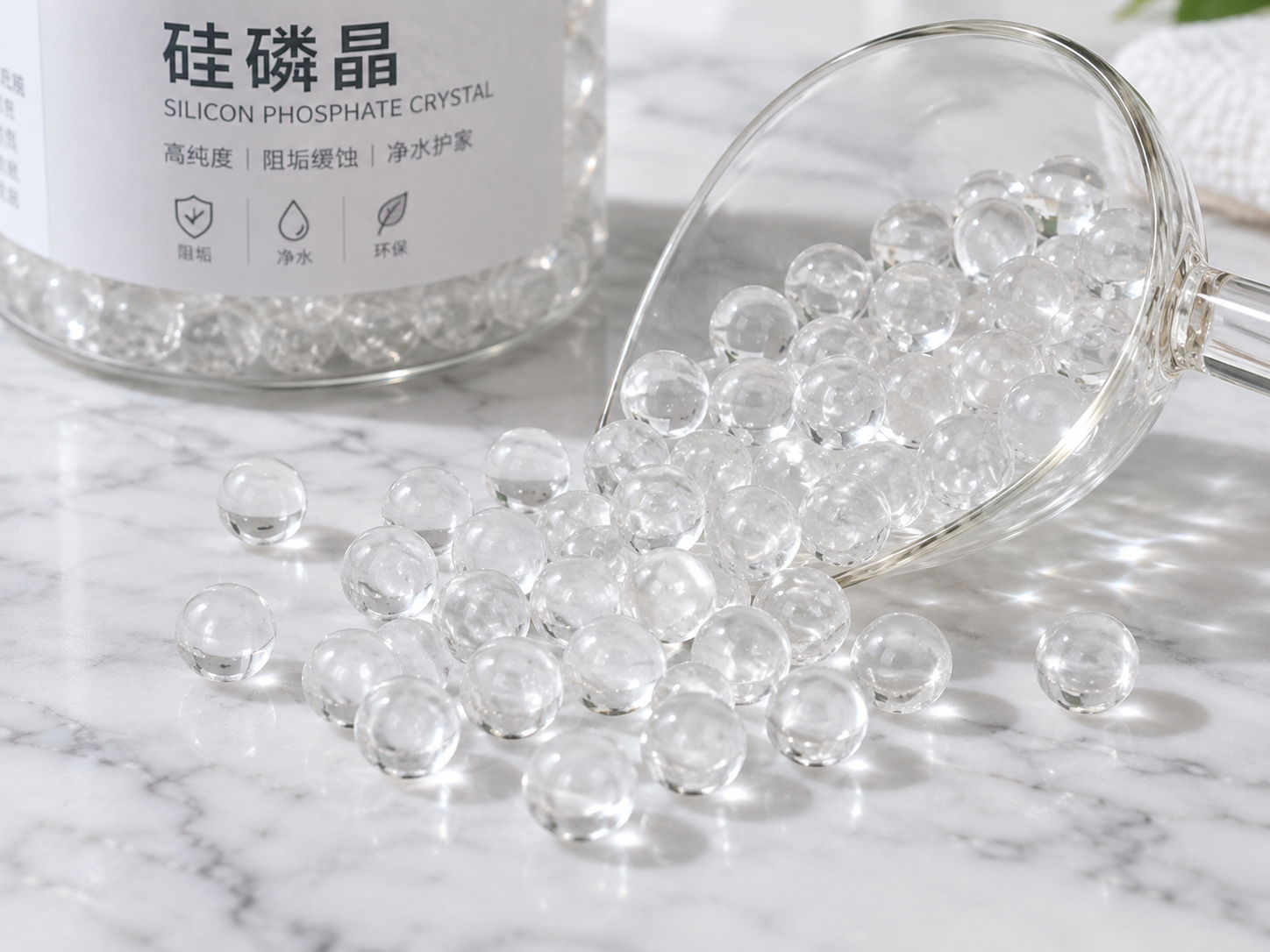
What a Polyphosphate Refill Conversion Guide Actually Does
A polyphosphate refill conversion guide is a controlled document that maps each discontinued media code to a technically justified replacement candidate — and records the evidence that supports the swap. It is not a simple “old code = new code” cross-reference list. Product codes get retired for commercial, regulatory, or raw-material reasons, and the replacement is rarely identical in every respect. The guide exists to make those differences visible before a refill cartridge, filter housing, or bulk order reaches a customer.
If you are a filter manufacturer, water-treatment equipment OEM, importer, distributor, or contractor holding inventory or spare-part references for a discontinued polyphosphate or siliphos-type crystal, the practical goal is the same: keep refills working, keep documentation defensible, and avoid quietly changing system performance.
Who This Guide Is For
Conversion work usually lands on one of four desks:
- Filter and cartridge manufacturers who must update bill-of-materials entries, labels, and datasheets.
- Equipment OEMs whose service manuals list a media code the supplier no longer produces.
- Distributors and importers holding purchase history and customer expectations built around an old reference.
- Procurement and technical buyers asked to approve a substitute without a formal engineering comparison.
Each group needs the same core output: a documented reason why the chosen replacement is acceptable for the specific application, and an honest list of what still has to be verified.
Step 1: Recover the Original Product Record Before Comparing Anything
Conversion fails most often because the original specification was never properly archived. Start by assembling what still exists:
- Last-issued technical datasheet (TDS) and safety data sheet (SDS).
- Certificates of analysis (CoA) from the final production batches, if available.
- Purchase records showing packaging format, fill weight, and order frequency.
- Any regulatory or potable-water approvals the code carried in each destination market.
- Internal notes on field failures, complaints, or reformulations.
- Customer drawings, cartridge dimensions, and refill instructions that reference the code.
Where records are missing, note the gap explicitly rather than filling it with an assumption. A missing particle-size specification, for example, cannot be reconstructed from memory — it has to be re-established through testing or through the supplier’s historical data.
Step 2: Define the Function, Not Just the Code
Before matching products, confirm what the media was actually doing in the system. These functions are frequently confused with one another, and the confusion produces bad conversions:
- Scale inhibition — interfering with the formation or adhesion of mineral deposits. Slow-dissolving polyphosphate-based media such as siliphos-type crystals are typically used in this role, often alongside some corrosion-control effect in once-through or low-flow systems.
- Water softening — removing calcium and magnesium hardness ions, normally by ion exchange. Polyphosphate media do not soften water in this sense.
- Scale removal — dissolving or breaking down existing deposits, usually with acids or dedicated descaling chemicals. Inhibitors prevent; removers remove.
- Filtration — physically retaining suspended solids. A phosphate crystal bed is not a sediment filter.
- Corrosion inhibition — forming a protective film on metal surfaces. Some polyphosphate products contribute here, but the mechanism and evidence differ from scale inhibition.
- Disinfection — inactivating microorganisms. No polyphosphate crystal performs this function.
Write the intended function into the guide in one sentence. If the answer involves two functions, separate them and treat each as a distinct requirement.
Step 3: Compare the Criteria That Change Refill Behaviour
The comparison matrix is the working heart of the conversion guide. Populate it from verified supplier data only — never from a similar-looking product from a different manufacturer.
| Parameter | Why it affects the conversion | What to confirm |
|---|---|---|
| Chemistry type | Polyphosphate, silicate-blended, or other chemistries behave differently in the same housing. | That the replacement belongs to the same functional family. |
| Active content | Determines how much material is available to dissolve over the refill interval. | Reported basis (as-is vs. active) and test method. |
| Particle size distribution | Controls dissolution rate, bed packing, and flow resistance. | Full distribution, not a single mesh or millimetre figure. |
| Bulk density | Changes the mass that fits into a fixed-volume cartridge or housing. | Measured density under the same method as the original. |
| Dissolution / release profile | Sets how long a refill lasts and how stable the dosing is over time. | Any supplier data available, plus your own test under real conditions. |
| Operating tolerance | Temperature, pH, and flow affect release rate and media integrity. | Limits stated for the specific product, not for the category. |
| Binder or carrier | Affects hardness, dusting, and handling characteristics. | Whether the original used a different carrier system. |
| Packaging and fill weight | Changes refill logistics, labels, and dose per container. | Net weight, bag type, and whether bulk is available. |
| Regulatory status | Food-contact or potable-water approval is product- and market-specific. | Approval for the exact product, the intended use, and the destination market. |
Food grade and potable-water suitability are not the same claim. A material described as food grade is not automatically approved for drinking-water contact. That determination depends on the exact product, the application conditions, and the regulations of the destination market, and it must be verified separately.
Step 4: Establish Why the Code Was Discontinued
The reason for discontinuation changes the conversion strategy:
- Commercial rationalisation — the supplier consolidated grades. A near-equivalent replacement may exist within the same product family.
- Raw-material change — the original input is no longer available. Expect differences in dissolution behaviour even if the chemistry name is unchanged.
- Regulatory action — an approval was withdrawn or a restriction was introduced. The replacement must satisfy the new rule, not the old one.
- Performance or quality issues — the code was retired because it underperformed. Replicating it is the wrong objective.
Record the reason in the guide with the source of that information. Without it, the conversion has no defensible direction.
Step 5: Choose the Conversion Level
Not every substitution carries the same risk. Classify each mapping:
- Direct replacement — same chemistry family, matching physical form, same regulatory position. Documentation update only, subject to incoming inspection.
- Qualified substitute — functionally equivalent but with measurable differences in particle size, density, or release rate. Requires a documented evaluation and often a controlled field trial.
- Reformulation — the replacement changes refill mass, refill interval, or housing design. Requires updated instructions and customer notification.
- System redesign — no equivalent exists. The application may need a different treatment approach entirely, such as a softener, a dosing system, or a filtration stage.
Most discontinued polyphosphate codes fall into the second category. Treating them as direct replacements is the most common source of field complaints.
Step 6: Validate Before You Rebrand a Whole SKU
Validation should be proportionate to the risk and to what can actually be measured. A reasonable sequence:
- Bench comparison of old and new media under identical flow and temperature conditions.
- Measurement of the parameters your customers actually care about — for example, residual phosphate where that is the controlled variable, or observations of deposit formation in a test loop.
- Physical checks: bed compaction, fines generation, pressure drop across the housing.
- Refill-interval tracking to confirm the practical service life under real consumption patterns.
- Controlled field trial at one or two representative sites before full release.
Do not publish a service life, dosage, or refill cycle until it has been established for the specific replacement product under the specific application conditions. These values cannot be inherited from the discontinued code.
Common Conversion Mistakes
- Matching on product name rather than on documented specification.
- Assuming that any polyphosphate crystal behaves like any other — particle size and binder changes shift release rates substantially.
- Carrying an old potable-water approval across to a new product without re-verification.
- Describing a scale inhibitor as a water softener in customer-facing literature, which creates expectations the product cannot meet.
- Omitting the discontinuation notice from distributor communications, leaving old codes live in catalogues.
- Filling specification gaps with plausible numbers instead of marking them as unconfirmed.
Frequently Asked Questions
Can a siliphos-type crystal be replaced by another polyphosphate crystal?
Only after the two products are compared on chemistry, active content, particle size distribution, density, and dissolution behaviour. Products that share a general description can still perform differently in the same housing. The comparison has to be made product-to-product, using verified data.
Does polyphosphate media soften water?
No. Softening means removing hardness ions, typically by ion exchange. Polyphosphate media work by inhibiting scale formation and adhesion, which is a different mechanism with different measurable outcomes.
Will a replacement media remove existing limescale?
Generally no. Established deposits are addressed by descaling, not by an inhibitor. If a customer’s complaint is existing scale rather than new scale formation, the conversion guide should flag the application as not matching the product’s function.
How long does a refill last?
That depends on the dissolution characteristics of the specific product, the volume of water treated, the flow pattern, and the water temperature. It must be established for the replacement product; it cannot be copied from the discontinued code or from another manufacturer’s datasheet.
Is food-grade media automatically suitable for drinking water?
No. Drinking-water suitability depends on the exact product, the application, and the regulations of the destination market, and needs separate verification and documentation.
Sending a Conversion Request That Gets a Useful Answer
ENVO CHEMICAL can help evaluate a replacement for a discontinued polyphosphate or siliphos-type media code when the request includes the technical context rather than just the old part number. To move quickly, send:
- The discontinued code and any surviving TDS, SDS, or CoA.
- The application and the function the media was performing.
- Equipment type, housing or cartridge dimensions, and flow characteristics.
- Source-water conditions relevant to the decision — for example hardness, pH, and temperature range.
- Required specification points you cannot compromise on, such as particle size range or regulatory status.
- Estimated quantity and destination market.
With those details, the response can address your actual conversion case instead of quoting a generic grade. Where a specification cannot be confirmed for your conditions, that will be stated plainly — which is more useful to your change-control file than an optimistic assumption.
