
The short answer: if you are buying media to fix a device problem, you are buying the wrong thing
Buyers who search for Siliphos crystal usually fall into two groups. The first group knows exactly what it needs: a defined polyphosphate media, in a defined crystal size range, for a device they already build or service. The second group has a performance problem — scale on heat exchangers, complaints from appliance customers, a filter housing that stops working after a few months — and has concluded that the fix is a bag of crystals. Only the first group is actually shopping for raw media. The second group needs an equipment partner, because the outcome they want depends on how the media is held, sized, dosed, and documented, not only on what the crystals contain.
The fastest way to tell which group you are in is to ask who will own the performance claim. If you will warrant the finished unit, you own the sizing, the contact time, the pressure drop, and the refill schedule. If a supplier will warrant the finished device, you are looking for a partner, not a commodity.
What polyphosphate crystal media actually does
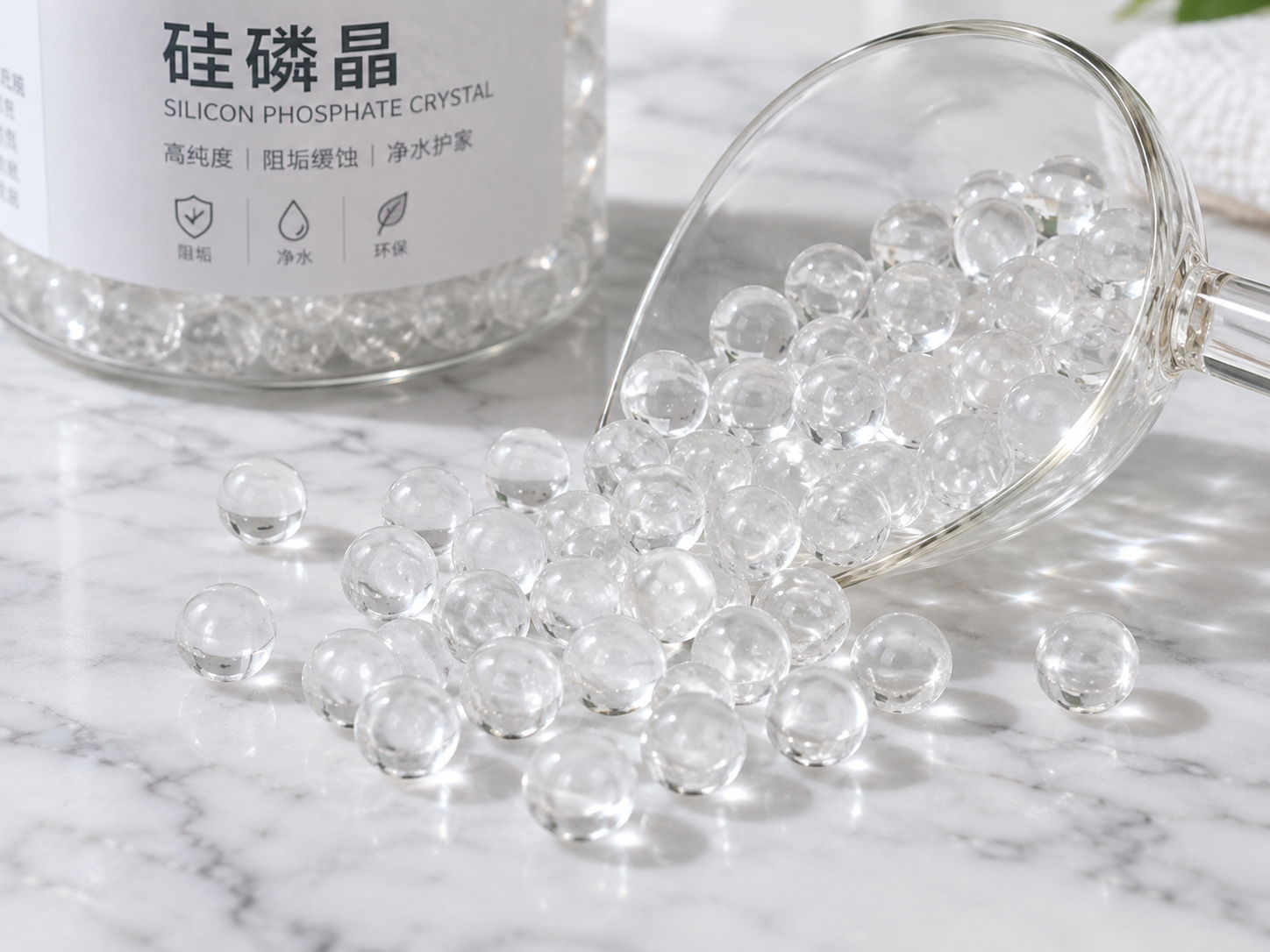
Siliphos is a brand name widely associated with polyphosphate-based crystal media, and like many brand names in water treatment it is often used loosely. Not every polyphosphate crystal on the market is the same product: formulation, crystal size distribution, dissolution behaviour, and approval status can differ between suppliers, and a data sheet from one source should never be applied to another.
Functionally, these media are used mainly for scale inhibition — interfering with the crystallization of hardness salts so that deposits form more slowly on downstream surfaces. That is a different job from several tasks it is often confused with.
| Function | What polyphosphate crystal media typically does | What it does not do |
|---|---|---|
| Scale inhibition | Reduces the rate at which hard carbonate scale forms on downstream surfaces when dosage and contact conditions are adequate | Does not make the water soft; performance depends on water chemistry, flow, and contact time |
| Water softening | Nothing — this is not an ion-exchange process | Does not remove calcium or magnesium from the water |
| Scale removal | May gradually loosen very thin, recent deposits in some installations | Is not a descaler and should not be sold as one; existing hard scale requires a different treatment |
| Filtration | Nothing — the media is a treatment bed, not a filter element | Does not remove sediment, turbidity, iron particles, or microorganisms |
| Corrosion inhibition | Polyphosphates can form thin films on some metal surfaces under suitable conditions | Is not a general substitute for a properly specified corrosion-control programme |
| Disinfection | Nothing | No biocidal action at any normal dose |
Keep this table in mind when a customer asks for “the crystal that softens water.” The honest answer is that no polyphosphate crystal softens water. If softening is the requirement, the discussion has moved to ion exchange, and the media question is a different conversation.
When buying raw media is genuinely the right choice
Buying bulk crystal is efficient and appropriate when the engineering is already solved. That is usually true when:
- You already manufacture a validated housing or cartridge and hold the performance data for it.
- The crystal size range you need is defined, and your filling process can handle it consistently.
- Your warranty covers the assembly, and the media is one input among several.
- You have established dosage and contact-time criteria from your own testing or from the media supplier’s documented guidance.
- You can manage quality control, storage, moisture exposure, and lot traceability internally.
In these cases the purchase is a routine raw-material transaction, and the main variables are consistency, documentation, and delivered cost per unit of treated water.
When you need an equipment partner instead
Several situations look like a media purchase but are not. Consider an equipment partner when any of the following is true:
- You cannot specify contact time. Scale inhibition depends on the water spending enough time in contact with the media bed. That is a function of bed volume, flow rate, and housing geometry. A bag of crystals does not answer the question.
- Your crystal size does not match the housing. Too fine and you create excessive pressure drop or media migration; too coarse and the bed may channel, so part of the flow bypasses the treatment. Crystal size distribution and housing design have to be selected together.
- You are being asked for a certified or documented product. If a customer, specifier, or regulator requires documentation for the finished device, the paper trail has to cover the assembly and the media as installed, not just the raw material.
- You are supplying OEM units at volume. Repeatable performance across thousands of units depends on controlled media grading and a stable supply, which is an operations problem as much as a chemistry problem.
- Refilling is part of your business model. Refillable housings raise questions about hygiene, handling, cross-contamination, and liability that a raw media supplier will not resolve for you.
- Water conditions are outside the ordinary range. Temperature, pH, and other water characteristics affect polyphosphate behaviour and media life. When conditions are unusual, the limits for the specific product must be confirmed rather than assumed.
In each of these cases, the useful question stops being “what is the price per kilogram?” and becomes “who is responsible for the treated-water result?”
The technical questions that decide the route
Before choosing between bulk media and a partner-supplied assembly, work through the following. If you can answer all of them confidently, raw media is probably viable. If several answers are “we will test it later,” you are designing a device, and you should design it with whoever supplies the media.
- Flow rate and pressure budget. What flow must pass through the treatment stage, and how much pressure loss is acceptable at that flow?
- Contact requirement. What residence time does the media supplier specify for the intended effect, and does your housing provide it at the design flow?
- Media format. Which crystal size range, and does it match your housing and filling method?
- Water chemistry. Hardness, alkalinity, pH, temperature, chlorine or oxidant residuals, and any iron or manganese present. Oxidants and unusual pH can shorten media life.
- System architecture. Is the media stage upstream of the appliance, downstream of a sediment filter, or both? What protects the bed from particulate fouling?
- Service model. Sealed cartridge, refillable housing, or bulk recharge? Who performs the replacement, and who disposes of the spent media?
- Claims and approvals. What exactly will you print on the label, and what evidence supports it in each destination market?
Comparing the two routes
| Consideration | Raw media purchase | Equipment partner |
|---|---|---|
| Sizing and contact time | Your responsibility | Shared or partner-led, with documented basis |
| Housing and cartridge design | Your existing design | Selected or developed with the media |
| Performance accountability | Yours | Defined in the supply agreement |
| Documentation burden | You assemble it | Supplier supports it |
| Flexibility | High — any compatible media | Lower — typically tied to a qualified supply |
| Best suited to | Established products, in-house engineering | New devices, new applications, regulated or OEM programmes |
Neither route is inherently better. The mistake is buying like the left column while carrying the risk profile of the right column.
Drinking water and food-grade labelling
One point deserves a separate note because it regularly causes problems. A material described as food grade is not automatically approved for drinking-water contact. Drinking-water suitability depends on the exact product, the application conditions, and the rules of the destination market, and it is normally demonstrated through a recognised contact-approval scheme rather than a general material description. If your product will treat water intended for human consumption, confirm the approval status of the specific media and the specific assembly before making any claim — and do not assume that approval of a raw material extends automatically to a finished cartridge.
What to prepare before contacting a supplier
A supplier can only respond usefully if the request contains the right inputs. A short, structured enquiry usually gets a faster and more accurate answer than a general price request. Include:
- Application: what the treated water is used for, and what problem you are solving.
- Source-water data: hardness, alkalinity, pH, temperature, oxidant residual, iron or manganese if known.
- Equipment details: housing type, cartridge format, design flow rate, allowable pressure drop.
- Media requirement: crystal size range if already specified, or leave it open and state the objective.
- Volume: annual or per-order quantity, and whether you need one shipment or a repeat schedule.
- Destination market: this determines which documentation and approvals are relevant.
- Commercial context: OEM programme, distribution, or single project.
Frequently asked questions
Is Siliphos crystal a water softener?
No. It is used for scale inhibition. It does not remove calcium or magnesium, so it does not soften water in the technical sense. If a customer needs softened water, an ion-exchange softener is the correct device.
Can I refill my own cartridges with bulk crystal?
Sometimes, but it depends on the housing design, the crystal size range it was built for, your filling and hygiene controls, and whether the original equipment warranty or any certification depends on the cartridge being sealed. Check these points before building a refill programme.
Does buying in bulk always reduce cost?
Not necessarily. The relevant figure is cost per unit of treated water at the performance you need. If oversized or poorly graded media causes premature replacement, channeling, or pressure complaints, the apparent saving disappears. Compare total cost of ownership, not price per kilogram.
Can polyphosphate media replace a corrosion inhibitor or a filter?
No. It is a scale-inhibition medium. Corrosion control and particulate removal are separate functions requiring separate design decisions.
Where ENVO CHEMICAL fits
ENVO CHEMICAL supplies water-treatment materials, including polyphosphate crystal media, and works with filter and equipment manufacturers who need the media matched to a housing, a flow rate, and a documentation requirement rather than simply delivered in bags. If your project sits in the second group described above — a device that still needs sizing, grading, or approval support — that is the conversation worth having, and it starts with your application data rather than a price list.
To get a useful response, send the application, the source-water analysis, the equipment type and design flow, the media or cartridge specification you are working to, the quantity, and the destination market, along with a short statement of the technical objective. Those inputs are enough to say whether you need raw media or an equipment partner.
