
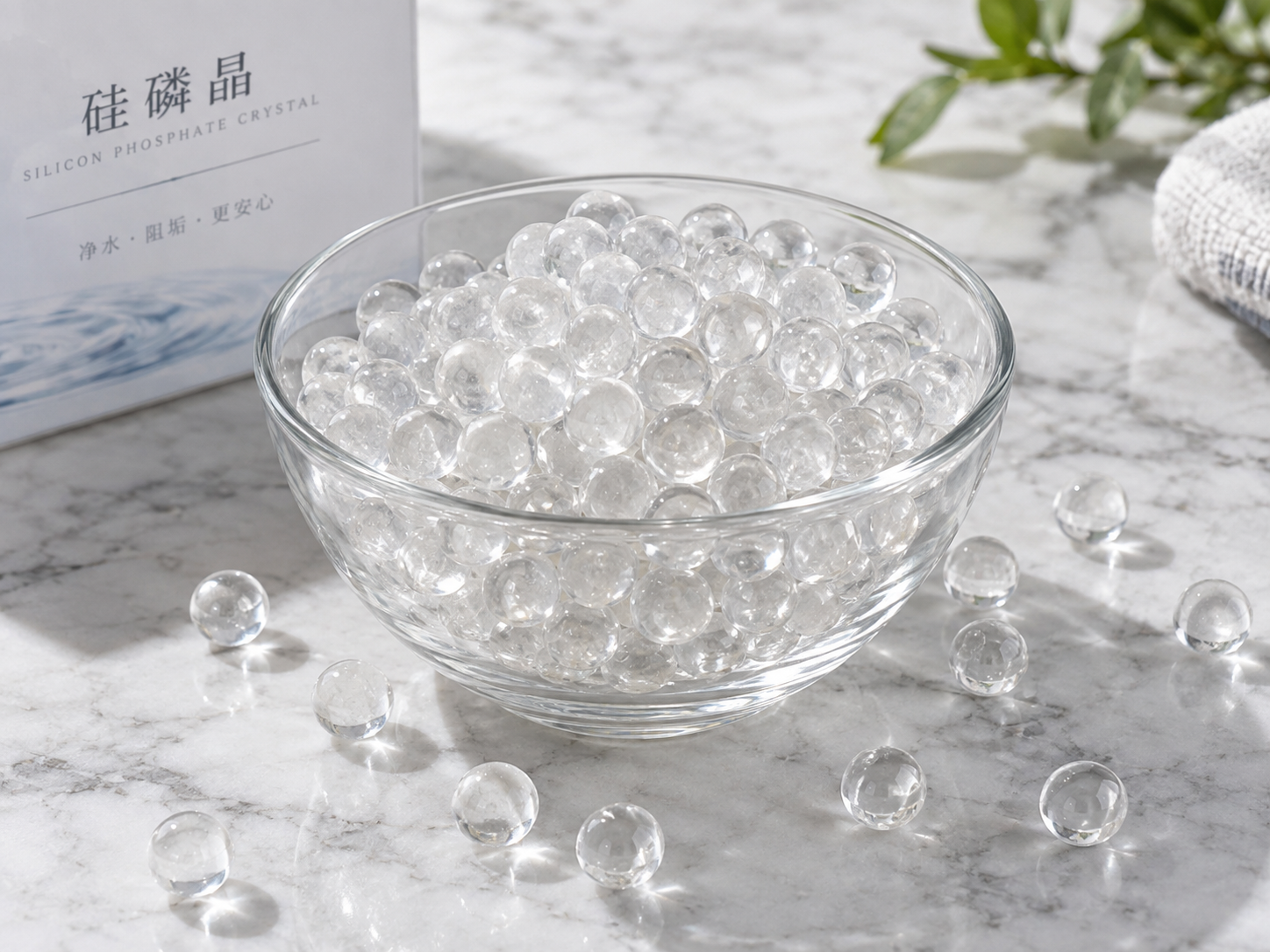
A sample parcel of polyphosphate material sent overseas for technical evaluation is not simply a box of crystals. Its real job is to deliver a representative, traceable, properly sealed quantity of material — plus the documentation a laboratory needs to interpret what it finds — so that the results mean something when they come back. When sampling, packaging, labeling, and paperwork are handled well, a small consignment can answer the questions that actually matter: does this grade dissolve at the expected rate, does it inhibit carbonate scaling under our water chemistry, and will it work in the housing we already own?
This guide is written for importers, distributors, filter and water-treatment equipment manufacturers, and procurement engineers who are about to send or receive a polyphosphate sample for laboratory or pilot evaluation in another country. The material is often described as Siliphos crystal, siliphos media, or phosphate crystal, but those terms are not strictly interchangeable. “Siliphos” is a trade name that has drifted into generic use, and slow-dissolving polyphosphate glasses from different producers can differ in composition, dissolution behavior, and particle size distribution. Treat every sample as its own specification.
First, Define What the Evaluation Is Actually Testing
Most failed sample evaluations fail before the parcel is packed, because the sender and the laboratory are thinking about different objectives. Polyphosphate media are used for scale inhibition, sequestration of hardness ions, and — in some formulations — corrosion inhibition through thin-film formation on metal surfaces. They are not ion-exchange water softeners, they do not remove existing scale deposits, they are not a filtration medium for suspended solids, and they are not disinfectants. A parcel designed for one of these purposes will not answer questions about another.
| Evaluation objective | Most useful sample form | Information needed alongside the sample |
|---|---|---|
| Dissolution rate and estimated service life | A defined particle size fraction, weighed into subsamples | Water temperature, flow rate, mass-to-volume ratio, target contact time |
| Carbonate scale inhibition | Single-lot material, consistent particle size across all samples | Hardness, alkalinity, pH, temperature, test duration |
| Corrosion inhibition screening | Crystal plus a defined metal-coupon protocol | Pipe or coupon material, flow regime, chloride level, dissolved oxygen |
| Compatibility with a dosing device or filter housing | Bulk free-flowing material in original condition | Housing dimensions, bed depth, service flow rate, backwash practice |
| Supplier comparison | Blinded, coded samples from each candidate lot | One identical protocol and one identical water source for every sample |
Write the objective down before sampling. If the laboratory cannot state what a “pass” looks like, the parcel is premature.
Sampling: The Step Most Overseas Sample Parcels Get Wrong
A scoop taken from the open top of a drum is not a sample of the lot. Phosphate glasses can segregate by particle size during handling and transport, and fines tend to migrate. A parcel built from one convenient scoop may show faster or slower dissolution than the material a buyer will eventually receive in bulk.
Where the supplier’s quality system allows it, ask for a composite sample drawn from several positions in the lot, blended, and then reduced by quartering or a sample splitter to the final parcel quantity. Keep the split method consistent across suppliers if you are comparing them.
Record these details at the moment of sampling
- Product name, grade, and manufacturer’s internal code
- Lot or batch number, and production date if available
- Particle size fraction, stated as a range, not as “standard”
- Net weight of the sample actually placed in the container
- Sampling date, sampler’s name, and sampling method
- Seal number or tamper-evident closure reference
- Storage conditions between sampling and dispatch
These records become the chain of custody. Without them, a laboratory result cannot be tied back to a purchasable lot.
How Much Material Should Go Into the Parcel?
Let the test protocol decide the quantity, then add a retained reference portion that stays sealed. Sending a generous but unweighed bag is worse than sending a small, precisely documented one, because the receiving laboratory cannot normalize its results.
| Test scale | What drives the quantity |
|---|---|
| Bench dissolution or jar test | Number of replicate runs, test duration, and the mass-to-volume ratio the protocol specifies |
| Recirculating loop or coupon test | Loop volume, target concentration, duration, and any make-up water replacement |
| Pilot column or filter cartridge trial | Bed volume, bed depth, service flow rate, and planned run length |
| Live installation trial | Site flow, expected replacement interval, and the packaging increments the supplier can provide |
For anything beyond bench scale, confirm the quantity with both the laboratory and the supplier before dispatch. Bulk quantities may be constrained by available packaging formats or by the shipping method, and those are commercial details that vary by supplier and destination.
Packaging That Survives International Transit
Polyphosphate glasses can absorb atmospheric moisture to varying degrees, and moisture pickup changes free-flowing behavior and can promote premature hydrolysis. Confirm the moisture sensitivity and storage guidance for the exact grade in its technical data sheet before choosing packaging. As a general practice:
- Use a heat-sealed barrier foil pouch or a rigid container with a gasketed, screw-top closure and an inner liner.
- Double-contain the material: an inner sealed pouch inside a rigid outer box, so that a failed seal does not contaminate the whole parcel.
- Avoid paper, woven, or stitched bags for long-haul shipments; they offer poor moisture and abrasion protection.
- Do not reuse containers that previously held other chemicals, even if they appear clean.
- Cushion the contents and fill voids so the pouch cannot abrade against the box wall.
- Add a desiccant only if it is compatible with the product and the test protocol; a desiccant sachet inside a pouch is not a substitute for a proper moisture barrier.
Package the retained reference portion identically and store it under the same conditions, so that later disputes can be resolved against a known sample.
Labeling and Documentation Inside the Parcel
On the outer parcel and on the inner container
- Product name, grade, and lot number
- Net weight and gross weight
- Particle size fraction
- Country of origin
- “Sample — not for resale”
- Handling and storage pictograms consistent with the safety data sheet
Inside the parcel
- Safety data sheet (SDS) for the actual product, not a generic template for “polyphosphate”
- Technical data sheet covering particle size, appearance, and recommended application conditions
- Certificate of analysis for the sampled lot, where the supplier issues one
- Packing list matching the label data
- A one-page evaluation worksheet: objective, water chemistry to be used, protocol, and the data the buyer wants returned
An SDS is generally expected for chemical samples crossing borders, and the transport classification must follow the SDS prepared for the actual product. Do not assume that a polyphosphate glass is automatically non-hazardous or automatically regulated — the classification depends on the specific composition and the destination’s rules.
Customs, Courier, and Compliance Details
These are the items that most often delay a technical evaluation by weeks:
- Accurate description. The invoice and waybill should describe the material chemically and consistently with the SDS, not as “water treatment parts.”
- Declared value. Samples sent with no commercial value still require a declared value for customs purposes in most jurisdictions.
- Classification. Harmonized System codes for phosphate chemicals differ between countries. Confirm the correct code with the supplier and the customs broker for the destination.
- Dangerous goods determination. Base this on the SDS and the applicable transport regulations, not on the fact that the parcel is small.
- Destination restrictions. Some markets require import permits, pre-shipment inspection, or registration for water-treatment chemicals. Check before dispatch, not after arrival.
- Incoterms and insurance. Agree in writing who carries risk, who clears customs, and who pays duty on a sample.
Because these requirements change and vary by route, the freight forwarder or customs broker for the destination should confirm them for each shipment.
Conditions in transit and on arrival
Keep the parcel sealed and out of prolonged high heat and humidity. Extreme conditions can affect free-flowing properties and, in some cases, the material itself. On arrival, store the sample according to its SDS and technical data sheet until testing begins, and record how it was stored.
What the Receiving Laboratory Should Do First
- Photograph the parcel and inner packaging before opening, including seal numbers.
- Check for seal integrity, moisture damage, or contamination.
- Weigh the inner container and compare against the declared net weight.
- Record appearance, colour, and a visual estimate of particle size; compare with the stated fraction.
- Split the material into a test portion and a retained portion, resealing the retained portion immediately.
- Confirm the water chemistry, temperature, contact time, and target concentration with the requester before the first run.
- Log everything into a chain-of-custody record tied to the lot number.
Common Mistakes That Invalidate an Overseas Evaluation
| Mistake | Effect on results | Correction |
|---|---|---|
| Sample drawn from one position in the lot | Dissolution data that will not repeat at bulk scale | Composite sampling with documented reduction |
| Comparing suppliers using different particle sizes | Apparent performance differences caused by surface area, not chemistry | Sieve or specify a common fraction before testing |
| No lot number on the inner container | Results cannot be tied to a purchasable lot | Label inner and outer packaging identically |
| Test water chemistry differs from the target site | Scale inhibition results that do not transfer | Test with site water or a documented synthetic analogue |
| Sample stored open in a humid laboratory | Caking and altered dissolution behavior | Reseal after each withdrawal; store per the SDS |
| Expecting softening, scale removal, or disinfection from a polyphosphate medium | Concludes the product “failed” when the objective was wrong | Restate the objective as inhibition or sequestration before testing |
Turning Sample Results Into a Purchasing Specification
Once the evaluation is complete, convert it into a written specification before requesting bulk pricing. At minimum, define:
- Particle size range and acceptable fines content
- Appearance and colour tolerance
- Moisture or free-flowing requirement, referenced to an agreed test method
- Dissolution or leaching behavior under stated conditions, expressed as a method and a limit
- Batch-to-batch consistency requirement and the certificate of analysis content
- Packaging format, net weight, and labeling language
- Documentation set required per shipment
- Storage and shelf-life statement from the manufacturer
Frequently Asked Questions
Is Siliphos crystal the same as every polyphosphate medium?
No. Siliphos is a trade name that has become a loose generic term. Slow-dissolving polyphosphate glasses can differ in composition, dissolution rate, and particle size, so specifications and test results should always be tied to a named product and lot rather than to the generic category.
Does a polyphosphate sample need a safety data sheet?
In most cross-border shipments, yes. The SDS should describe the actual product and should be the basis for the transport classification and labeling. Confirm the current requirements for the specific route with the freight forwarder.
Can a beaker test prove scale inhibition performance?
A bench test can screen candidate materials and rank them under a fixed set of conditions. It cannot reproduce the contact time, temperature, flow regime, and water chemistry of a real installation, so treat bench results as a screening step and confirm with a pilot trial on site water before making a purchasing commitment.
Can sample material be used in drinking water?
Not automatically. A material described as food grade is not thereby proven suitable for drinking-water treatment. Suitability depends on the exact product, the dose and contact conditions, the equipment, and the regulations of the destination market. These points must be verified for the specific product and application before any drinking-water use.
How should a sample be stored before testing?
Sealed, dry, and within the temperature range given in the SDS and technical data sheet. Reseal immediately after each withdrawal and record storage conditions as part of the evaluation record.
Requesting a Polyphosphate Sample for Technical Evaluation
If you are preparing a technical evaluation of slow-dissolving polyphosphate media, ENVO CHEMICAL can discuss the product form and documentation that fit your test protocol. To give you a useful answer rather than a generic reply, include the following when you make contact:
- The application: scale inhibition, sequestration, corrosion inhibition screening, or equipment compatibility
- Source-water conditions: hardness, alkalinity, pH, temperature, and chloride where relevant
- The equipment or test setup, including housing, bed depth, and flow rate if applicable
- The particle size fraction or specification you need to evaluate
- The quantity required for your protocol, and whether a retained reference portion is needed
- The destination country and any import or documentation requirements you must meet
- Your evaluation objective and the data you want returned from the test
With those details, the sample parcel can be built around the test rather than around the shipping schedule.
