
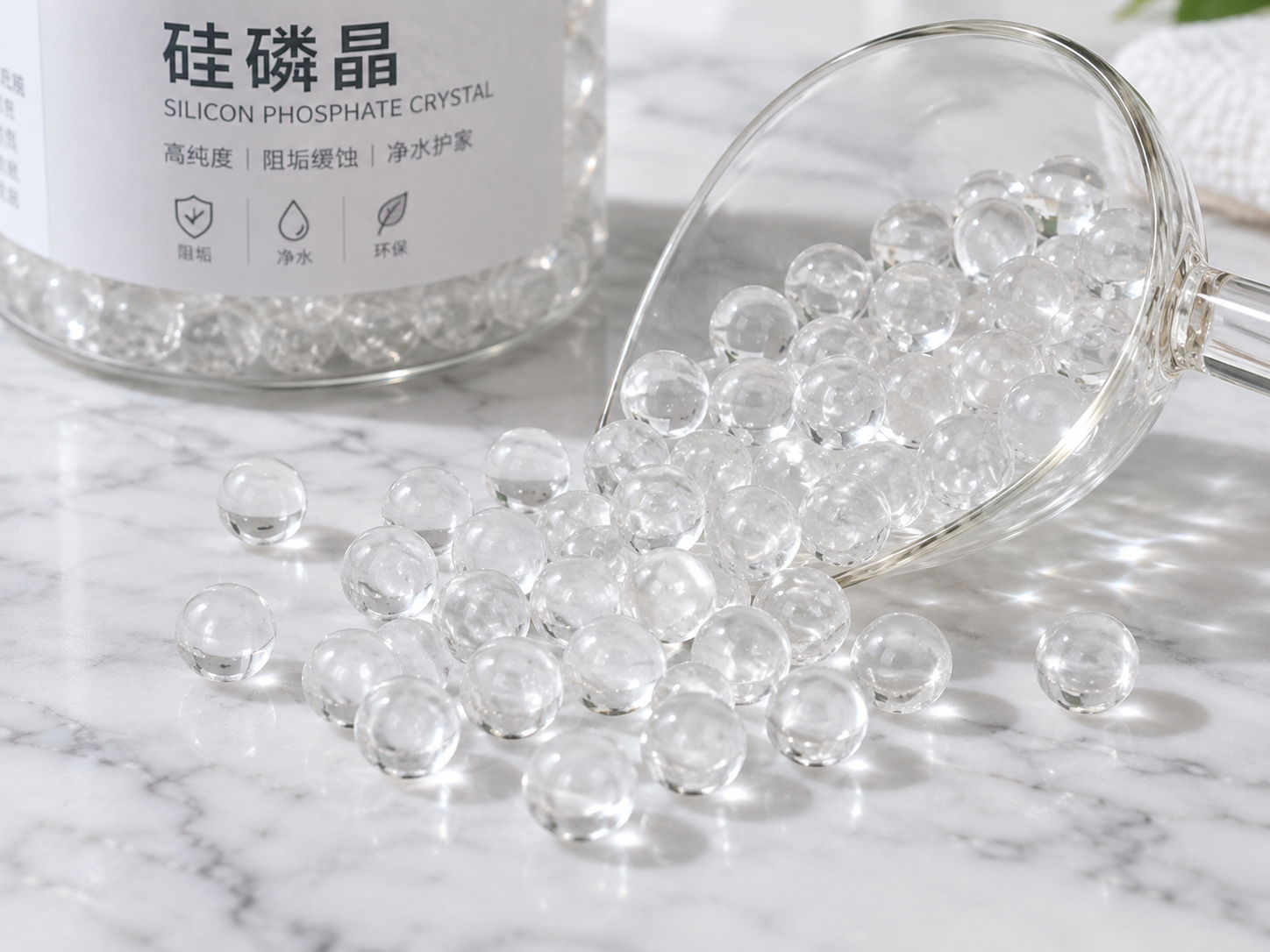
A dry outer carton does not mean dry contents
When a buyer opens a Siliphos carton that looks perfectly dry on the outside but finds sticky, clumped, or discolored crystals inside, the first question is almost always the same: where did the water come from, and how do we prove it? The short answer is that the outer carton is a poor moisture indicator. A corrugated box can stay visually dry for three common reasons: the moisture is trapped inside a polyethylene liner bag, the box absorbed water and then dried before inspection, or the crystals themselves took up atmospheric moisture through a hygroscopic mechanism without any liquid water ever touching the packaging.
That matters because polyphosphate crystals used for scale inhibition are hygroscopic by nature. Many Siliphos-type products are glassy sodium or potassium polyphosphates that can absorb moisture from humid air, soften, cake, and eventually partially dissolve. A carton that shows no external staining can still hold degraded material. This article explains how to document that condition properly, in an order that keeps the evidence usable for a supplier claim, a quality investigation, or an insurance review.
Note on terminology: “Siliphos,” “polyphosphate crystal,” and “phosphate crystal” are not automatically interchangeable descriptions. Different products can differ in composition, dissolution behavior, and intended function. Always document against the specification and purchase order you actually received, not against a generic product name.
Contain the evidence before you contain the problem
Moisture damage investigations fail more often because of mishandled evidence than because of bad material. Once a pallet is opened, moved, or repacked, you can no longer prove what condition it arrived in.
- Stop movement. Quarantine the pallet or the affected cartons in place, or move them as an intact unit and label them clearly with “hold for inspection.”
- Do not dry, wipe, or air the cartons or crystals. Drying destroys the moisture evidence you need.
- Record the environment at the moment of discovery. Ambient temperature, relative humidity, and whether the cartons were near a door, dock opening, cold wall, or roof leak.
- Keep the pallet pattern intact if possible. Which cartons are affected, and whether they are on the bottom, top, or outer rows, is direct evidence about the moisture pathway.
- Preserve transport records. Container number, seal number, stuffing date, vessel and voyage, temperature or humidity loggers if fitted, desiccant bags, and any humidity indicator cards.
What to record before opening the carton
Photographic set
Photograph all six faces of at least one affected carton plus one unaffected carton from the same lot, using consistent lighting and a scale reference. Include close-ups of:
- corner and edge deformation, bulging, or “washboard” waviness in the board;
- tape, glue lines, and any sign of re-sealing;
- printed lot, batch, and production codes;
- pallet top deck and bottom slip sheet, including any staining or mold;
- liner bag closure, folds, and any visible punctures;
- any desiccant or humidity indicator card in its original position, before touching it.
Timestamps and a written note of who took each photo are more valuable than high resolution alone.
Traceability data
Write down the supplier, invoice and packing list numbers, purchase order line, lot or batch code, net weight declared on the label, quantity per pallet, and the date the goods were received. If the cartons were stored for weeks before inspection, record the storage conditions as well: racking position, exposure to sunlight, proximity to wet processes, and whether the warehouse is temperature-controlled.
Opening inspection: what “wet” actually looks like
Open the carton carefully along the original seam rather than cutting a new one, and keep the removed flap for inspection. Then work from the outside inward.
| Observation | What it may indicate | What it does not prove |
|---|---|---|
| Carton board is soft, wavy, or delaminated | Liquid water or sustained high humidity reached the board | Whether the crystals were affected, or when the exposure happened |
| Liner bag has visible free water or droplets | Condensation inside the sealed bag, or ingress through a breach | The source of the water |
| Crystals are sticky, glossy, or fused into lumps | Moisture uptake by a hygroscopic polyphosphate, possibly without liquid water contact | How much the active content or dissolution behavior changed |
| Crystals are white, opaque, or powdery where they were glassy | Partial hydration or surface reaction | Whether the product still meets its specification |
| Fine powder at the bottom of the bag | Attrition during transport, or breakdown of crystals | Moisture exposure on its own |
| Odor, discoloration, or mold on the board | Prolonged wet conditions and possible biological growth on packaging | That the crystal itself is contaminated |
Smell and touch records are legitimate observations, but describe them precisely — “crystals adhere to a stainless spatula and retain a visible impression” is more useful than “product feels damp.”
Weighing and sampling
Weighing the carton
Weigh the full sealed carton on a calibrated scale and record the value next to the declared net weight and the packaging tare. Weight gain is consistent with moisture uptake, but it is not proof on its own: filling tolerances exist, and the tare weight of the bag and carton must be known. Weigh at least three affected cartons and three cartons from an unaffected position in the same lot for comparison.
Sampling procedure
- Use clean, dry, stainless steel or plastic tools. Avoid bare hands.
- Take a top, middle, and bottom sample from the same bag, kept separate.
- Place each sample in a moisture-barrier bag or a screw-cap jar with a tight seal, filled as fully as practical.
- Label with lot code, carton ID, sampling position, date, time, and sampler name.
- Keep one sealed reference sample untouched for a third-party laboratory.
- Photograph the samples before sealing.
Condensation, ingress, or hygroscopic uptake: separating the three causes
These three pathways produce similar-looking damage but have different implications for the claim.
Container condensation (“container rain”)
Warm, humid air trapped at stuffing condenses on the container ceiling as the vessel moves into cooler latitudes, then drips onto the top layer of cartons. Telltale signs: damage concentrated on the top tier, water staining on upper surfaces, and a pattern that does not follow pallet edges. Container desiccant bags, dew point records, and voyage data support this explanation.
Liquid ingress
Rain during loading, a leaking container roof, or a damaged liner allows liquid water to reach the goods. Signs usually show a directional pattern — one side, one corner, or the bottom layer — often with tide marks and staining on the board. Look for liner breaches and check whether the pallet wood itself is wet.
Hygroscopic uptake through the packaging
Even without liquid water, humid air can migrate through board and through some liner materials over time. The crystals gradually absorb moisture, and the visible result is caking rather than staining. This pathway can produce damaged product with an apparently pristine carton, and it is the case that most often surprises buyers.
Laboratory confirmation and what to ask for
Visual inspection cannot quantify the effect of moisture on a polyphosphate product. If the material matters commercially, arrange testing rather than relying on appearance. Typical tests include moisture content by loss on drying or Karl Fischer titration, pH of a prepared solution, solubility and insoluble residue, sieve or particle-size distribution, and phosphorus content expressed as P2O5 or as declared on the specification.
Use acceptance limits from your own specification sheet, contract, or the supplier’s current technical data — not from a generic online source. If no limits are specified for the parameter in question, state that clearly in your report instead of inventing a pass/fail threshold. Where the final use involves drinking water, note that food-grade status alone does not establish suitability: the exact product, dose, contact conditions, and destination-market requirements must be verified separately.
Writing a report that survives a claim review
Separate the report into three clearly labeled parts: facts (what was measured or seen, with time and location), observations (patterns and comparisons), and conclusions (what the evidence supports, and what remains unresolved). Avoid causal language in the facts section — “the carton was wet” is a fact; “the supplier shipped wet goods” is a conclusion that the evidence may not support.
Include a chronology, a photo index, the sampling log with chain of custody, instrument calibration records for any measuring device, and copies of transport and storage records. Send written notification to the supplier within the contractual claim window and keep the affected goods, samples, and packaging in quarantine until the claim is closed. Disposing of damaged material early is the most common reason a legitimate claim is rejected.
Can moisture-affected crystals still be used?
Sometimes, but only after evaluation. Mild surface caking may break up with gentle handling, and the material may still perform within specification. However, moisture uptake in a polyphosphate can alter dissolution rate, dosing behavior, and available active content, and caking can cause bridging or blockages in feeders and dosing equipment. Do not assume that drying and re-screening restores the original product. For any application involving potable water, obtain written confirmation from the manufacturer for the specific lot and use condition before reintroducing the material.
Prevention points worth writing into your next order
- Specify the liner bag material, thickness, and sealing method rather than leaving it to default packaging.
- Ask for desiccant in the liner or carton where the product is genuinely hygroscopic, and define how it is to be recorded.
- Request moisture-barrier pallet wrapping and corner protection for sea freight.
- Confirm whether container desiccant bags and dew point monitoring will be used on humid routes.
- Agree in advance on the sampling and testing method for moisture disputes, including which laboratory is acceptable.
- State the claim notification period and the retention requirement for samples.
Frequently asked questions
If the carton is dry, can moisture damage really exist?
Yes. Hygroscopic crystals can absorb moisture from humid air without any liquid water contacting the carton, and a sealed liner can hold condensation that never reaches the board. Inspect the product itself, not only the packaging.
Does caking always mean moisture damage?
No. Caking can also result from stacking pressure, vibration during transport, static charge, or long storage under normal conditions. Caking is a symptom that requires further evidence, including weight comparison and laboratory testing.
Should I dry the crystals and put them back into service?
Not without a documented evaluation. Drying changes particle structure and does not restore the original composition or dissolution profile. Treat the lot as non-conforming until testing or the manufacturer indicates otherwise.
How long do I have to file a claim?
That depends entirely on your contract, purchase terms, and the applicable trade rules. Check those documents immediately on discovery, because inspection and notification deadlines can be short and are often strictly applied.
When you need packaging or specification clarification
If your inspection shows that the affected lot must be replaced, or if you want to define moisture-barrier packaging and sampling requirements before the next shipment, ENVO CHEMICAL can review the relevant product specification with you. Please include the intended application (for example, scale inhibition in a specific water system), source-water conditions if relevant, equipment type, required specification or grade, quantity, destination market, and the technical objective you are trying to meet. With that information, our team can respond to the specific question rather than to a general product name.
