
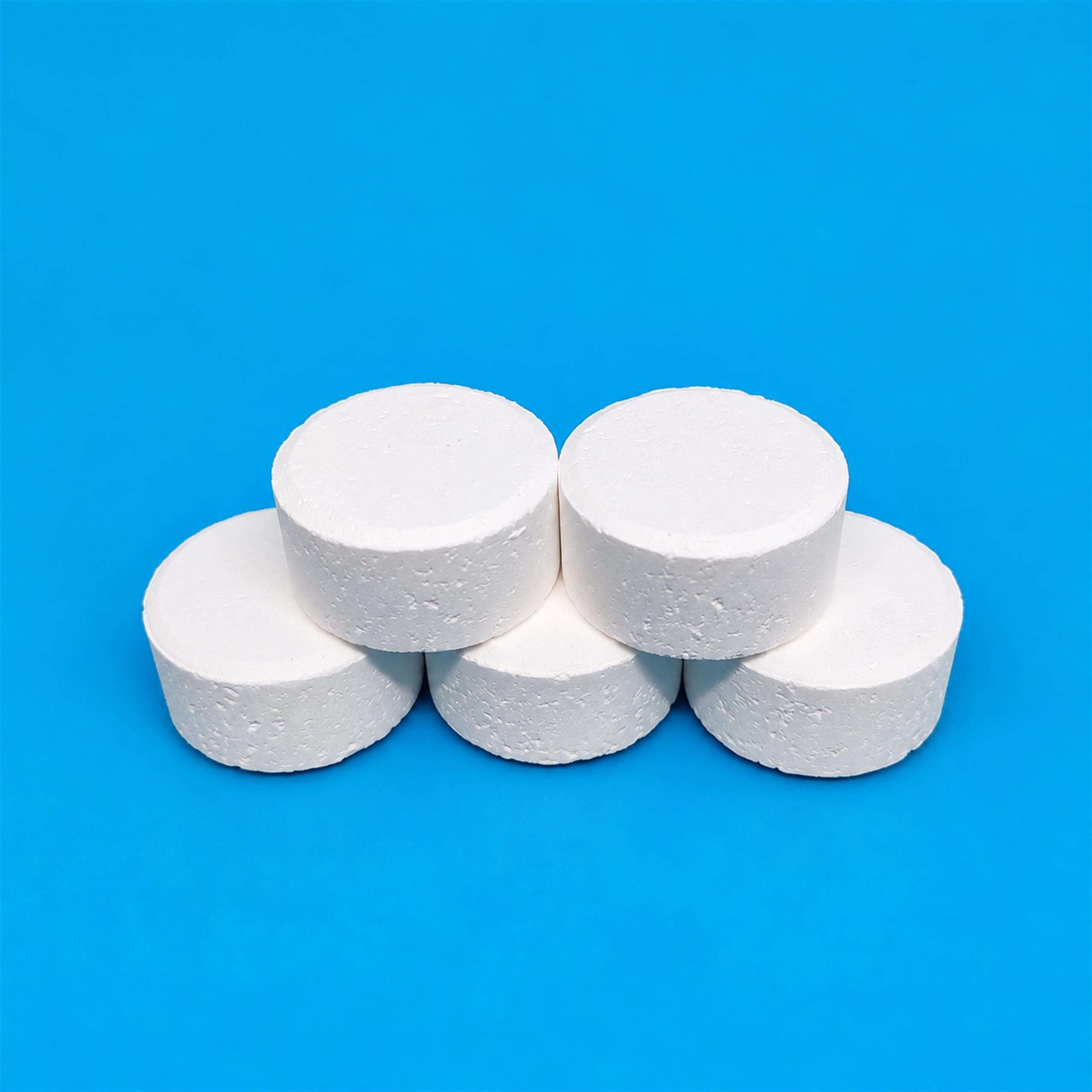
Why Recontamination Occurs Even When NaDCC Is Used in Stored Drinking Water
NaDCC (sodium dichloroisocyanurate) can effectively disinfect drinking water at the point of use, but it does not guarantee permanently safe water once that water is stored. Recontamination risk depends on how the treated water is handled, the storage conditions, the container integrity, and whether a sufficient chlorine residual is maintained over time. If any of these controls fail, pathogens can re-enter the water regardless of the initial NaDCC dose.
The essential takeaway: NaDCC treatment is a snapshot disinfection event. Stored drinking water remains vulnerable to recontamination through multiple pathways unless specific storage and handling practices are in place. Understanding those pathways is the only way to manage risk reliably.
How NaDCC Works in a Stored-Water Context
NaDCC is a solid, chlorine-releasing compound. When dissolved in water, it hydrolyses to produce hypochlorous acid (HOCl), the active disinfecting species. In drinking-water applications, a measured dose of NaDCC is added to a known volume of water to achieve a target free chlorine residual, typically in the range that provides microbiological protection without exceeding taste or safety thresholds.
What matters for recontamination is what happens after that initial dose. The free chlorine residual acts as a continuing but finite barrier. It reacts with any organic matter, biofilm, or new microbial load that enters the water. As the residual is consumed, the protective effect diminishes. Once the residual drops below an effective level, the water is no longer protected against incoming contamination.
Primary Pathways for Recontamination in NaDCC-Treated Stored Water
Introduction of Contaminants Through the Storage Container
The most common recontamination route is physical contact with unclean surfaces. If the storage vessel has not been properly cleaned and disinfected before filling, biofilm or residual organic material on the container walls provides both a nutrient source and a habitat for microorganisms. Even a container that looks clean can harbour biofilm that shelters bacteria from the chlorine residual.
Hands, utensils, cups, and scoops that touch the stored water or the inside of the container are frequent vectors. Each contact event introduces new microbes and organic load, both of which consume free chlorine. Repeated dipping with a shared cup is a well-documented cause of residual depletion and recontamination in household water storage.
Biofilm Development Inside Storage Vessels
Over days or weeks, biofilm can develop on the interior surfaces of any water storage container, especially in warm conditions. Biofilm is a structured community of microorganisms embedded in a protective matrix. The matrix limits the penetration of free chlorine, meaning that organisms within biofilm may survive even when a measurable chlorine residual is present in the bulk water.
This is a critical point: a positive free chlorine test on a water sample does not confirm that biofilm on the container wall is inactive. Recontamination can occur when fragments of biofilm slough off into the water, releasing organisms that were previously shielded.
Inadequate or Depleted Chlorine Residual
The dose of NaDCC must be calculated for the specific volume of water and the expected chlorine demand of that water. Turbid or organic-rich source water consumes more chlorine, leaving less residual. If the initial dose is too low, or if the water has a high demand, the residual may never reach a protective level or may fall below it quickly.
Chlorine also degrades naturally over time. Exposure to sunlight, high temperature, and open-air conditions accelerates loss. In a transparent container left in direct sun, the residual can fall to ineffective levels within hours. NaDCC does not provide a permanent disinfectant barrier; it provides a time-limited one.
External Environmental Exposure
Open or poorly sealed containers allow airborne particles, insects, and dust to enter the water. Each of these introduces microbial load and organic matter. Even a container with a lid can be compromised if the seal is poor or if the lid is frequently removed without attention to hygiene.
Factors That Change the Recontamination Risk Profile
Not every situation carries the same risk. Several variables determine how quickly and how severely recontamination can occur after NaDCC treatment.
| Factor | Higher Risk Condition | Lower Risk Condition |
|---|---|---|
| Storage temperature | Warm or hot environments (above 25 °C) | Cool, shaded storage |
| Container type | Porous, damaged, or previously used containers | Clean, food-grade, narrow-neck, opaque containers | Container seal | Open top or loose lid | Tight-fitting, dedicated spigot or pour spout |
| Access frequency | Many daily contacts with hands or objects | Infrequent, controlled access |
| Source water quality | High turbidity or visible organic matter | Relatively clear source water |
| Time since treatment | More than 24–48 hours without re-dosing | Short storage periods with residual monitoring |
Temperature deserves emphasis. Chemical reaction rates, including chlorine decay and microbial growth, roughly double with every 10 °C increase. In tropical or summer conditions, recontamination timelines compress dramatically compared with cooler settings.
What Should Be Checked to Manage Recontamination Risk
Verify the Initial Dose and Residual
Before relying on stored water, confirm that the NaDCC dose was calculated for the actual volume and that the free chlorine residual was measured after the recommended contact time. A residual of at least 0.2 mg/L free chlorine after 30 minutes is commonly cited as a minimum for ongoing protection in point-of-use drinking water, though specific guidance depends on local regulatory standards and water quality conditions. Where no test kit is available, the risk of over- or under-dosing increases.
Inspect and Prepare the Storage Container
The container should be cleaned with soap and clean water, rinsed thoroughly, and disinfected before each filling. A narrow-neck design reduces the chance of hand or object contact. Opaque containers limit sunlight-driven chlorine decay. Containers should be dedicated to water storage and not repurposed from other uses without proper cleaning.
Monitor Residual Over Time
If storage extends beyond a few hours, periodic residual testing is the only reliable way to know whether protection remains. When the residual falls below the protective threshold, re-treatment with a freshly calculated NaDCC dose is necessary. This assumes the water has not already been heavily recontaminated, in which case discarding and starting over may be the safer option.
Limit Introduction Events
Every time the container is opened, there is an opportunity for recontamination. Using a spigot, tap, or pour spout that does not require inserting hands or objects into the water reduces this risk significantly. Educating users about not dipping cups or utensils directly into stored water is a practical and often overlooked control.
Limitations of NaDCC in Preventing Recontamination
NaDCC is a disinfectant, not a preservative. It inactivates microorganisms present at the time of treatment and provides a residual that slows regrowth, but it does not sterilise a container indefinitely. It does not remove chemical contaminants, heavy metals, or toxins. It does not prevent biofilm formation if conditions favour it.
No single chemical dose can compensate for poor hygiene, damaged containers, or extended storage without monitoring. Recontamination risk is a system-level problem that involves the chemical, the container, the user behaviour, and the environment. Addressing only the NaDCC dose while ignoring the other factors leaves the water unprotected.
Safety note: NaDCC should never be mixed with acids, ammonia, or other incompatible chemicals. Concentrated solutions can cause skin and eye irritation. Always follow the product-specific handling instructions and ensure treated water meets applicable drinking-water guidelines for chlorine levels before consumption.
Summary of Key Points
- NaDCC provides time-limited disinfection; it does not prevent all recontamination in stored water.
- The main recontamination routes are dirty containers, biofilm, repeated hand or object contact, and residual chlorine decay.
- Warm temperatures, open containers, and frequent access accelerate risk.
- Maintaining a measurable free chlorine residual and using clean, sealed, opaque containers are the most important practical controls.
- Residual testing over time is necessary for any storage beyond a short period.
If you need clarification on appropriate NaDCC dosing calculations for a specific stored-water volume or guidance on residual monitoring methods, contact ENVO CHEMICAL with your water volume, source-water characteristics, and intended storage duration so we can address the details that matter for your situation.
