
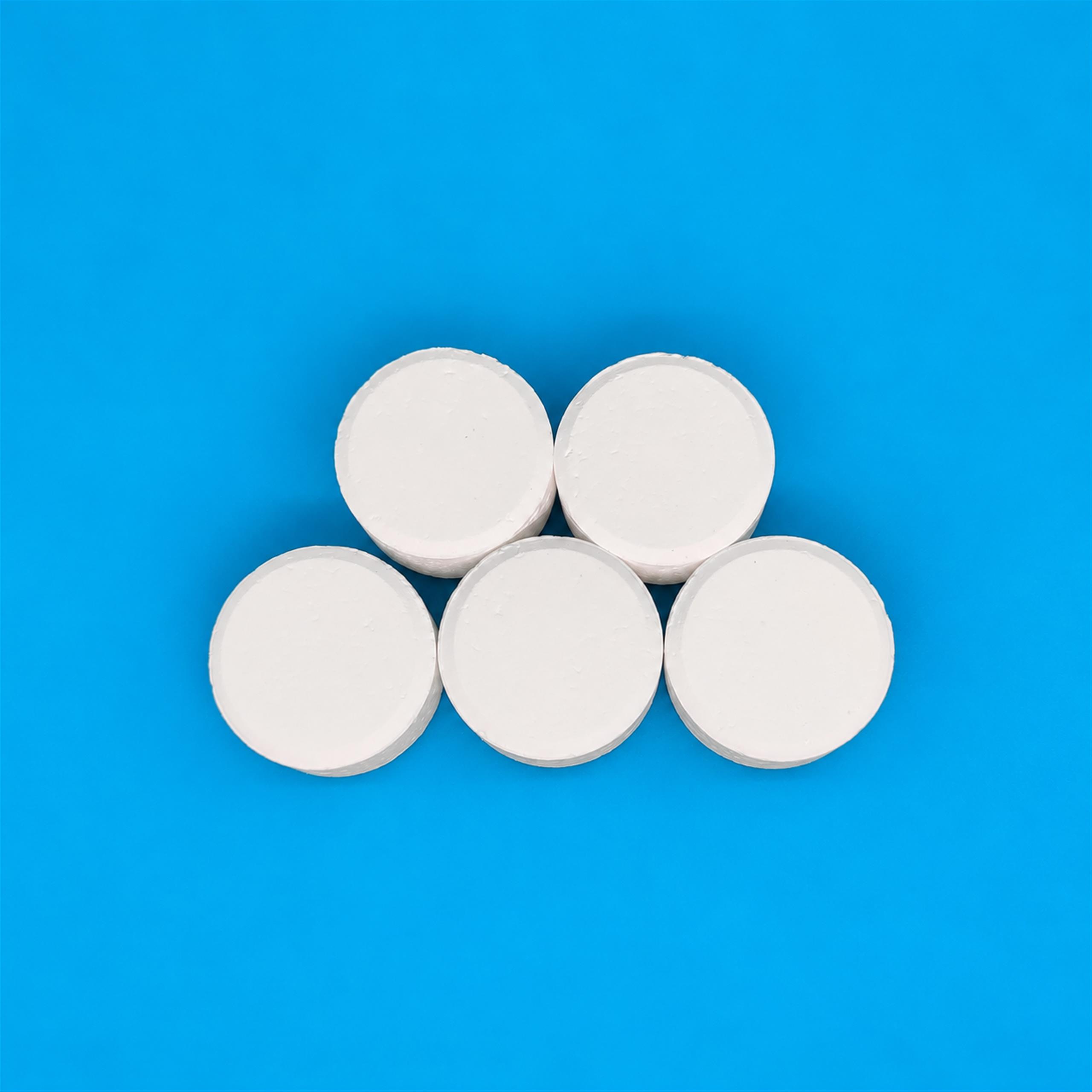
Why NaDCC Can Trigger Taste and Odor Complaints in Treated Water
Sodium dichloroisocyanurate (NaDCC) can produce detectable chlorine taste and odor in finished water when applied doses exceed the level needed for disinfection, when residual chlorine is not properly managed, or when the product’s formulation contains stabilizer byproducts. The most direct response to community feedback is to verify actual residual chlorine levels, review dosing accuracy, and adjust application to keep free available chlorine within the target range without overshooting.
Not every complaint originates from NaDCC itself. Before blaming the chemical, operators should rule out taste and odor from source-water organics, biofilm in distribution lines, or interaction with pipe materials. Only after these checks can the focus narrow to NaDCC-specific contributions.
Understanding the Source of Chlorine Taste and Odor from NaDCC
NaDCC dissolves to release hypochlorous acid (HOCl), the active disinfecting species. When free available chlorine residual remains above the sensory threshold—generally around 0.5 mg/L for taste and as low as 0.2 mg/L for odor in sensitive populations—consumers notice a swimming-pool-like or medicinal character. The compound does not carry a strong inherent odor; the perception comes from the chlorine residual it generates.
Two NaDCC-specific factors can worsen this perception:
- Overdosing due to purity assumptions. NaDCC is available at different available chlorine percentages (commonly 56% or 60% for the dihydrate form, higher for anhydrous grades). Using the wrong percentage in dose calculations delivers more chlorine than intended.
- Cyanuric acid accumulation. NaDCC contains cyanuric acid (CYA) as a stabilizer. While CYA itself is largely tasteless at typical levels, high CYA can reduce the efficacy of free chlorine, prompting operators to increase NaDCC dose to compensate—creating a cycle that elevates residual and taste complaints.
How to Systematically Respond When Community Members Report Taste or Odor
Step 1: Confirm the Complaint with On-Site Measurement
Do not rely on anecdotal reports alone. Take grab samples at multiple points—treatment outlet, storage, and consumer taps—and measure free available chlorine and, if possible, total chlorine. Compare readings to the applicable regulatory or guideline limit for residual chlorine in the specific water-use category. Document the date, time, location, and method so the data is defensible.
Step 2: Check Dosing Equipment and Calibration
Many taste complaints trace back to mechanical or calibration errors rather than the chemistry of NaDCC. Verify that:
- Solution preparation concentration matches the design value (for example, a 1% w/v stock solution versus a misprepared 2% solution doubles the delivered dose).
- Dosing pump flow rate has not drifted due to wear, air locks, or incorrect stroke settings.
- The specific gravity or available chlorine percentage used in the controller’s calculation matches the actual NaDCC grade being dispensed.
Step 3: Evaluate Whether the Dose Itself Is Too High
If measurements show residual consistently above the sensory or regulatory threshold, reduce the applied dose incrementally. NaDCC dosing for disinfection typically targets a free chlorine residual that balances pathogen inactivation with acceptability—often 0.2–0.5 mg/L at the point of delivery for drinking-water systems, though exact targets depend on contact time, water quality, and local regulations. Lower the dose, re-measure, and repeat until residual is within range.
Step 4: Assess CYA Build-Up and Its Effect
Because every kilogram of NaDCC adds cyanuric acid to the water, long-term use in systems with limited bleed-off can elevate CYA to levels that mask chlorine efficacy. When CYA rises, the same free chlorine residual provides less disinfection power, yet the sensory perception of chlorine may remain high. If CYA is elevated, partial water replacement or process adjustment may be needed before dose reduction alone solves the problem.
Communicating Findings Back to the Community
Once data is collected, share a concise explanation with stakeholders. Avoid technical jargon; instead state what was measured, what was found, and what action is being taken. For example: “Water samples taken on [date] showed a free chlorine residual of X mg/L, above the guideline of Y mg/L. We have reduced the NaDCC feed rate by Z% and will re-test within 48 hours.” Transparency reduces repeated complaints even when the issue is resolved quickly.
If the investigation reveals the taste or odor came from another source—such as algal metabolites in the source water or a corrosion event in pipes—say so clearly. Misattributing the cause to NaDCC erodes trust when the real issue resurfaces.
When to Reconsider the Product Form or Switch Approach
In some cases, communities with highly sensitive taste perception or very low acceptable chlorine thresholds may find NaDCC difficult to manage within those limits. Alternatives include switching to a non-stabilized chlorine source (such as sodium hypochlorite or calcium hypochlorite) or adding activated carbon filtration to polish residual chlorine before delivery. Any change must be evaluated for disinfection efficacy, regulatory compliance, and operational feasibility—not made solely to address taste.
Important: do not mix NaDCC with acids, ammonia-based compounds, or other chlorine products, as this can generate hazardous gases. Any product substitution should follow the supplier’s handling and compatibility guidance.
Preventing Recurrence
Install or verify continuous residual chlorine monitoring at key points so that excursions are caught before consumers notice. Schedule periodic review of dosing calculations against the actual NaDCC grade in use, including any change in supplier batch specifications. Keep a log of community feedback, measurements taken, and corrective actions to build a reference for future complaints.
If your system uses NaDCC and you are facing persistent taste or odor feedback that has not resolved after checking dose and residual, contact ENVO CHEMICAL with your current residual readings, NaDCC grade and concentration, and target chlorine level so we can help evaluate whether the product application needs adjustment.
