
Start with a Like-for-Like Specification Before You Open Any Bid
The single most important step in comparing NaDCC disinfectant bids for a hospital network is to define the exact technical and regulatory specification that every bidder must meet, then evaluate offers only against that baseline. Without a unified specification sheet, you cannot reliably compare price per unit of available chlorine, formulation stability, packaging integrity, or compliance documentation—and you risk selecting the cheapest bid that fails healthcare disinfection requirements.
This means the procurement team and the infection-prevention or facilities department must agree on target parameters such as available chlorine content (typically expressed as a percentage of the NaDCC compound or tablet), tablet weight or granule form, dissolution rate, shelf life under hospital storage conditions, and any required regulatory registrations (such as national health authority product licences or hospital-grade disinfection approvals) before soliciting quotations.
Normalise Price Against Available Chlorine, Not Against Product Weight
NaDCC products vary widely in available chlorine concentration. One bidder may quote a lower price per kilogram but supply a 55 % available-chlorine tablet, while another quotes higher per kilogram but delivers 60 % available chlorine. Comparing price per kilogram alone misleads you.
Convert every bid to a common unit—typically cost per gram of available chlorine or cost per litre of prepared disinfectant solution at the concentration the hospital actually uses. Request each supplier to confirm the exact available chlorine percentage on the certificate of analysis for the quoted batch, and verify whether the figure refers to the anhydrous NaDCC basis or the dihydrate form, because the two have different molecular weights and therefore different available-chlorine yields per unit mass.
Check Formulation and Physical Form Against Hospital Use Points
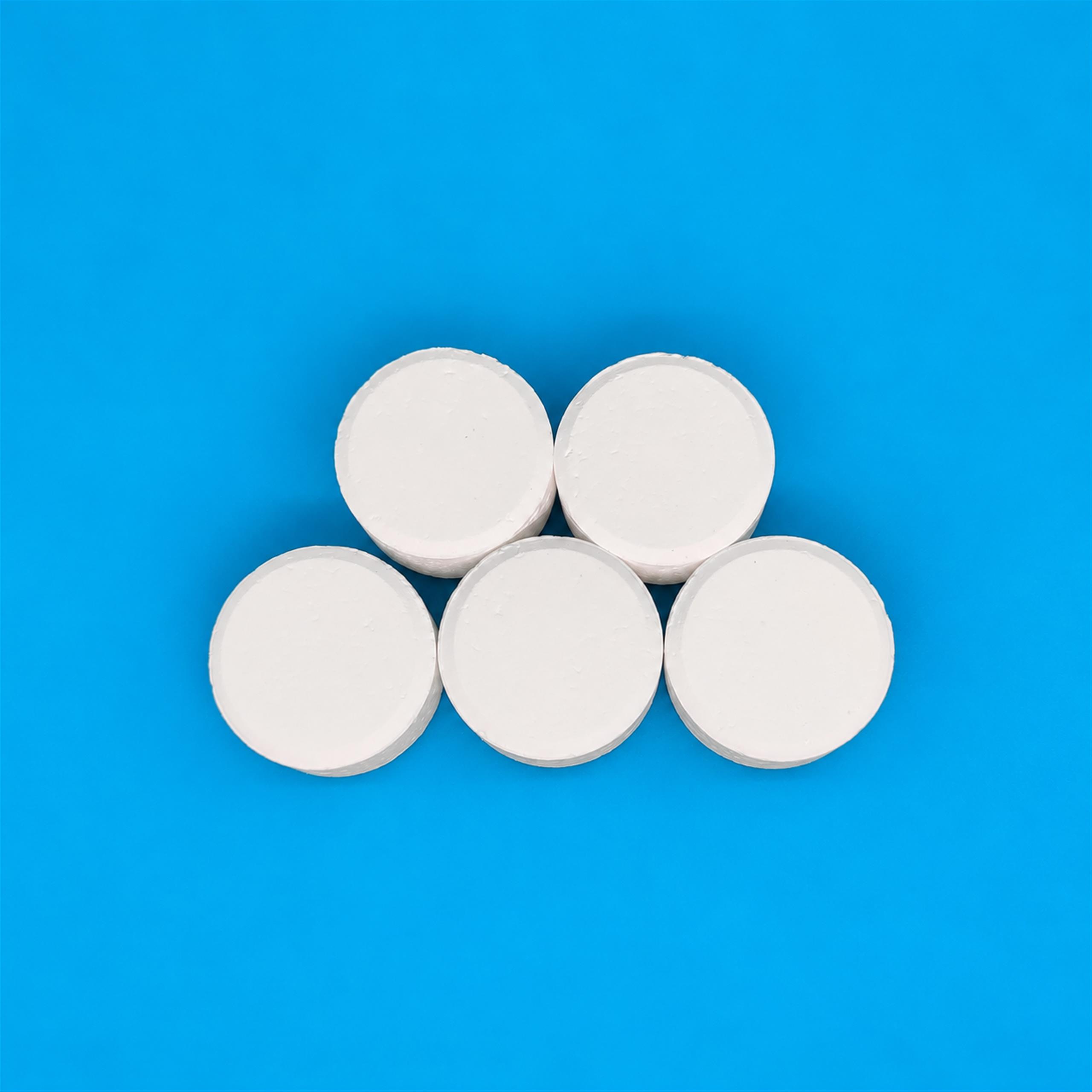
Hospital networks use NaDCC disinfectant in multiple locations: central sterile supply departments, ward cleaning protocols, endoscopy unit decontamination, and sometimes water-system dosing. A single bid may cover tablets, effervescent tablets, or granular NaDCC. These forms differ in dissolution time, dosing accuracy, and compatibility with automated dispensing equipment.
Ask each bidder to specify:
- The physical form supplied (tablet, granule, powder)
- The dissolution time in water at the temperature and volume used on site
- Whether the product is a raw NaDCC compound or a pre-formulated tablet that may include binders, surfactants, or stabilisers
- Packaging configuration (bulk drums, individual sachets, blister packs) and how that affects opening, storage, and waste in a clinical environment
A bid for bulk granules may look cheaper per unit of chlorine but could introduce cross-contamination risk or dosing errors if staff must weigh product manually in a ward setting. A tablet bid may cost more per gram of chlorine but reduce preparation error and improve compliance with standard operating procedures.
Verify Regulatory and Healthcare-Specific Compliance in Every Bid
Hospital disinfection is not the same as general-purpose or pool-water disinfection. Bids must include evidence that the NaDCC product holds a valid registration or licence for healthcare disinfection in the jurisdiction where the hospital operates. “Food grade” or “general disinfectant” labelling does not automatically satisfy hospital infection-control policy.
Request from each bidder:
- The product registration number and the scope of that registration (surface disinfection, instrument decontamination, water treatment, etc.)
- A current certificate of analysis for the offered batch, including available chlorine, moisture content, heavy-metal limits, and microbiological purity where required
- Material safety data sheets aligned with local occupational-health regulations
- Evidence of stability testing under the storage conditions the hospital can provide (temperature, humidity, shelving type)
If a bidder cannot supply a healthcare-specific registration or a batch-specific certificate of analysis, that bid should be excluded from the final comparison regardless of price.
Evaluate Supply Reliability and Logistics as Part of the Bid
A hospital network typically requires uninterrupted supply across multiple sites. A lower unit price from a supplier with limited production capacity, long lead times, or a single shipping origin may cost more in practice through emergency orders, expired stock, or last-minute substitutions that bypass the approved specification.
Include in your bid evaluation:
- Stated lead time from order to delivery at each hospital site
- Minimum order quantities and whether they match the network’s consumption pattern
- Cold-chain or moisture-protection requirements and whether the bidder’s packaging and logistics address them
- Contingency provisions (alternative production sites, stock-holding agreements, substitute product approval process)
Treat logistics capability as a scored criterion, not an afterthought. For a multi-site hospital network, a supplier who can deliver to several locations with consistent quality and documentation often justifies a modest premium over a single-site, low-cost bid.
Watch for Hidden Costs That Distort the Comparison
The headline price on a NaDCC bid may exclude several cost elements that matter to a hospital network. Before ranking bids, ensure each offer is adjusted to include or explicitly exclude:
- Freight and insurance to each hospital location
- Customs duties or import licences if the product is sourced internationally
- Waste-disposal requirements for packaging (blister packs, foil sachets, plastic drums)
- Training or technical support for staff who prepare and use the disinfectant
- Batch-to-batch variability allowances and the cost of re-testing if a delivered lot falls outside specification
Ask every bidder to state their price basis clearly—ex-works, FOB, CIF, or delivered—and confirm which ancillary costs are included. A bid that appears ten per cent cheaper may become more expensive once packaging waste handling and site-specific delivery are factored in.
Use a Simple Scoring Matrix to Rank Bids Objectively
Once you have normalised price, confirmed specifications, verified compliance, and accounted for logistics and hidden costs, rank bids with a weighted scoring table rather than choosing on price alone. A practical matrix for a hospital network might weight:
| Criterion | Suggested Weight | What to Verify |
|---|---|---|
| Compliance with healthcare disinfection registration | Mandatory pass/fail | Valid registration number and scope |
| Cost per gram of available chlorine at use concentration | 30 % | Batch COA, price basis, delivery terms |
| Product form suitability for hospital use points | 20 % | Dissolution, dosing accuracy, packaging |
| Supply reliability and multi-site logistics | 20 % | Lead time, MOQ, contingency plan |
| Stability and shelf life under hospital storage | 15 % | Stability data, storage conditions |
| Documentation and technical support | 15 % | COA, MSDS, training, batch traceability |
Any bid that fails the mandatory compliance check is eliminated before scoring begins. The remaining bids are ranked on total weighted score, giving the procurement team a transparent rationale for the final selection.
Confirm Before Signing: What You Still Need to Verify
Even after ranking, do not finalise a contract until you have a confirmed sample batch tested independently against the specification you used in the bid comparison. NaDCC available chlorine degrades with moisture and heat, and a bidder’s certificate of analysis represents one lot, not every future shipment. A hospital network should require ongoing batch-by-batch verification or a supplier quality agreement that defines re-testing triggers and rejection criteria.
If your specification or evaluation criteria need adjustment for a particular NaDCC form or a specific hospital disinfection application, clarify those details before the next bid cycle.
Contact ENVO CHEMICAL to discuss the technical parameters and documentation you need to build a compliant bid-comparison framework for your hospital network’s NaDCC disinfectant procurement.
