
Why Product Confusion Happens With NaDCC in Commercial Kitchens
The single most reliable way to prevent confusion between NaDCC-based products and other cleaning agents in a commercial kitchen is to treat NaDCC containers as a distinct chemical category, label them with unmistakable disinfection-specific identifiers, and physically segregate them from detergents, degreasers, and acid-based cleaners. Confusion arises not because the products look identical, but because kitchen environments already contain dozens of white powders, tablets, and liquid concentrates stored in similar-looking bottles with overlapping terminology such as “sanitiser,” “cleaner,” and “hygiene product.”
When a kitchen team member reaches for a container without checking the active ingredient, the consequences range from ineffective sanitation (using a detergent where a disinfectant is required) to hazardous chemical reactions (mixing NaDCC with an acid cleaner and releasing chlorine gas). This article explains the specific sources of confusion, how to recognise NaDCC products at a glance, and what practical controls keep them separate from every other product on the shelf.
How NaDCC Products Resemble Other Kitchen Chemicals
Visual and naming overlap
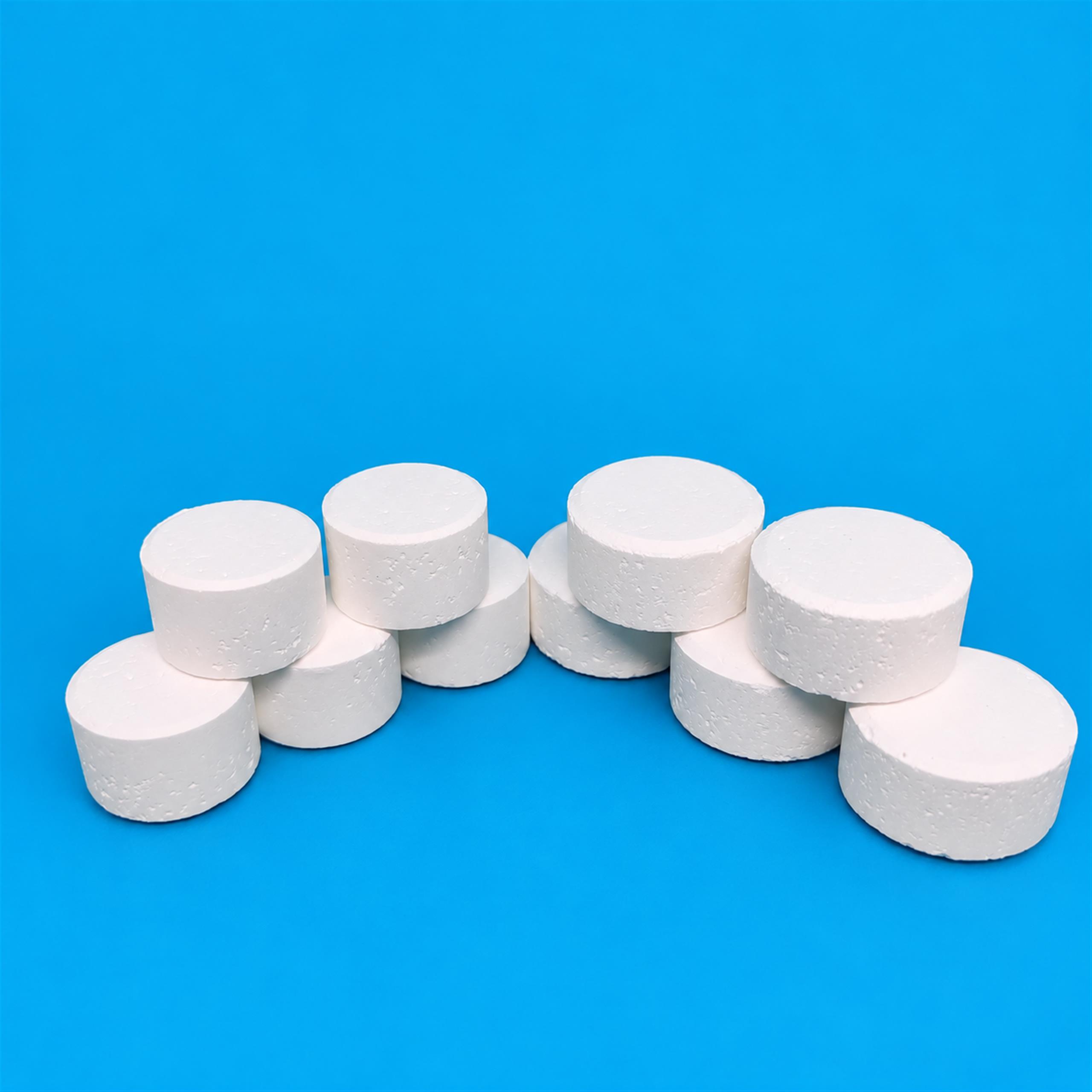
Sodium dichloroisocyanurate (NaDCC) is commonly supplied as a white granular powder, effervescent tablets, or a concentrated solution. In a commercial kitchen, those physical forms overlap with:
- Dishwasher rinse-aid tablets or descaling tablets (also white, solid, round or square)
- Baking soda or other alkaline powders used for deodorising or scrubbing
- Chlorine-releasing pool or laundry sanitisers that may use the same active chemistry but carry different brand labelling
- Quaternary ammonium compound (QAC) sanitisers supplied as clear or slightly coloured liquids
The word “sanitiser” appears on both NaDCC labels and on QAC or peroxide-based product labels, reinforcing the assumption that any product marked this way is interchangeable. Kitchen staff who are not trained to read active-ingredient declarations will default to brand recognition or container shape, both of which are unreliable.
Similar container designs across suppliers
Many chemical suppliers use white HDPE bottles with blue or green caps for cleaning concentrates regardless of chemistry. When NaDCC is repackaged into kitchen-specific dispensing bottles, the original manufacturer label may be replaced by an in-house label that lists only the word “sanitiser” and a dilution instruction. At that point, the container carries no visual cue that it contains a chlorine-releasing oxidising agent rather than a non-oxidising surfactant-based cleaner.
What Makes NaDCC Chemically Distinct and Why That Matters for Separation
NaDCC is an oxidising biocide. It releases available chlorine when dissolved in water and works through oxidation of microbial cell components. This is fundamentally different from three other common kitchen chemical categories:
- Detergents and degreasers work by emulsification and surfactant action; they contain no biocidal active ingredient.
- Acid cleaners (descalers, lime removers) work by dissolving mineral deposits; they are typically based on phosphoric, citric, or hydrochloric acid.
- Non-oxidising sanitisers such as QACs or peracetic acid work by different biocidal mechanisms and must never be mixed with chlorine releasers.
The critical safety point is that mixing NaDCC with an acid-based cleaner produces chlorine gas, a respiratory hazard. Mixing NaDCC with a QAC sanitiser can neutralise both products, leaving the surface neither clean nor disinfected. These are not theoretical risks; they are predictable outcomes of confusing one product for another. Knowing that NaDCC is an oxidiser, not a detergent and not an acid, is the first step in keeping it separate.
Practical Steps to Prevent Confusion in Daily Kitchen Operations
Label every container with the active ingredient, not just the product name
A label that reads “Kitchen Sanitiser” tells a user nothing about chemistry. A label that reads “Sodium Dichloroisocyanurate (NaDCC) – 56% available chlorine – for surface disinfection” removes ambiguity immediately. Where repackaging occurs, the in-house label must reproduce the active ingredient name and hazard class. This is not optional; it is the minimum information needed to prevent a staff member from treating a NaDCC solution as a general-purpose cleaner.
Use colour-coded storage zones
Assign a dedicated, clearly marked storage area for oxidising biocides. In practice this means:
- A locked or clearly bounded shelf separate from the detergent and acid-cleaner shelves
- A consistent colour code (for example, yellow tags or yellow shelving edge-strips) applied to every NaDCC container
- No NaDCC product stored above or adjacent to acid descalers, even in the same chemical cabinet
Physical separation prevents the most dangerous error: a team member grabbing a bottle from the wrong shelf during a busy service period.
Train staff to check before they pour
Confusion is most likely under time pressure. A three-second check—”Is this an oxidiser? What is the active ingredient? Am I about to mix it with anything?”—breaks the habit of reaching for the nearest bottle. Training should include a simple visual reference: NaDCC granules or tablets are white and chlorine-smelling; acid cleaners are typically clear or coloured liquids with a sharp odour; QAC sanitisers are usually colourless liquids with little or no chlorine smell. These sensory cues are not a substitute for label reading, but they provide a quick first filter.
Do not allow NaDCC and acid cleaners to share a dispensing area
In some kitchens, a single wall-mounted dispensing station holds both a sanitiser concentrate and a descaler concentrate for convenience. This arrangement makes cross-contamination almost inevitable through splashback, drip, or accidental swapping of bottles. Keep NaDCC dispensing points at least one metre away from any acid product, and use different wall-mount brackets or drip trays to make the separation obvious.
Common Mistakes That Lead to Product Mix-Ups
| Mistake | Why it happens | What to do instead |
|---|---|---|
| Using NaDCC tablets in a dishwasher detergent dispenser | Tablets look like dishwasher tablets; dispenser is labelled “detergent” | Store NaDCC tablets in a sealed, labelled container never near the dishwasher chemical drawer |
| Pouring NaDCC solution into a spray bottle previously used for degreaser | Reuse of spray bottles without thorough rinse and relabelling | Dedicate specific spray bottles to NaDCC use only, or rinse and relabel every time |
| Adding NaDCC powder to a mop bucket already containing acid cleaner residue | Bucket not emptied or rinsed between tasks | Use separate mop buckets for oxidising sanitisers and acid cleaners; mark each bucket clearly |
| Confusing “available chlorine” percentage with total product weight | Labels list both values; staff read the wrong number for dosing | Training must emphasise that dosing is based on available chlorine, not total weight or volume of product |
What Information You Need on Every NaDCC Product in Your Kitchen
Before a NaDCC product enters a commercial kitchen, verify that the packaging or accompanying documentation includes at minimum:
- The full chemical name (sodium dichloroisocyanurate or NaDCC)
- The available chlorine content expressed as a percentage of the product
- A clear statement of intended use (for example, food-contact surface disinfection) and any dilution instructions
- Hazard pictograms and signal words required under the applicable classification system
- A warning against mixing with acids or other sanitisers
If any of these items is missing or unclear on a product you are considering, the product is not ready for safe use in a kitchen environment. Confirm the details with your supplier before accepting delivery.
Keeping Confusion Out of Your Kitchen Long Term
Product confusion is not a one-time training event. It is an ongoing risk that re-emerges every time a new staff member starts, every time a supplier changes packaging, and every time a kitchen reorganises its storage layout. The controls that work are the ones that are physical and visible: segregated storage, active-ingredient labelling, colour coding, and dedicated dispensing equipment. Written procedures help, but they only work if the physical environment supports them.
NaDCC is an effective oxidising disinfectant for commercial kitchen surfaces when it is used correctly and kept distinct from every other cleaning product on site. The difference between effective sanitation and a dangerous mix-up is often nothing more than whether the container was labelled clearly and stored in the right place.
If you need to confirm the specific labelling requirements or storage guidance for the NaDCC product you are supplying to your kitchen operation, contact ENVO CHEMICAL with your product form and intended application so we can discuss the details that matter for your site.
