
How Cold Temperatures Affect NaDCC Performance and What to Assess Before Use
NaDCC (sodium dichloroisocyanurate) can be used in cold room disinfection, but low temperatures significantly slow dissolution, reduce the rate of available chlorine release, and may require longer contact times or adjusted concentrations to achieve the same microbiological result. Any assessment of temperature-related use conditions must start by defining the actual cold room temperature range, the target pathogen or soiling level, and the form of NaDCC being applied—whether granular, tablet, or pre-dissolved solution.
Below approximately 10 °C, the practical behaviour of NaDCC diverges noticeably from the conditions under which most standard dosage guidance is generated. Operators who ignore this shift risk under-dosing, incomplete disinfection, or unnecessary chemical waste.
Dissolution Rate in Low-Temperature Water
NaDCC must dissolve before it can release hypochlorous acid, the active disinfecting species. In cold rooms where water or rinsing solutions may be near 0–5 °C, dissolution of granular or tablet NaDCC slows measurably compared with use at 20 °C or above.
Factors that determine how much slower include:
- Water temperature: Colder water holds less energy for breaking apart NaDCC granules or tablets.
- Agitation: Mechanical stirring or recirculation can partly compensate, but cold room floors and surfaces are often rinsed with minimal flow.
- Form of product: Fine granules generally dissolve faster than compressed tablets at any temperature, but the gap widens as temperature drops.
- Hardness and mineral content: Cold water in food-processing environments can carry higher mineral loads, which may further retard dissolution or cause turbidity.
The practical implication is that operators should pre-dissolve NaDCC in a separate vessel at the warmest water reasonably available, then transfer the solution into the cold room. Applying dry NaDCC directly onto cold, wet surfaces without adequate contact time for full dissolution is a common source of failure.
Available Chlorine Release Kinetics at Cold Temperatures
Once dissolved, NaDCC hydrolyses to release available chlorine. This hydrolysis is temperature-dependent. At lower temperatures, the equilibrium shifts toward slower release of hypochlorous acid (HOCl). The total available chlorine content of the NaDCC material does not change with temperature, but the speed at which it becomes biologically active does.
What this means for cold room use:
- Contact time must be extended. If a protocol specifies 5 minutes at 20 °C, the same microbial kill may require substantially longer at 4 °C. The exact multiplier depends on the organism, the organic load, and the target reduction level—no single universal factor can be applied without validation.
- Measured free chlorine residual may read lower initially. A test taken shortly after mixing in cold conditions may show a low residual not because the dose was wrong, but because release is still ongoing.
- Peak efficacy is delayed. The solution continues to generate active chlorine over time, so a “wait and re-test” approach is more important in cold rooms than in ambient-temperature settings.
Anyone assessing NaDCC use in a cold room should verify that the extended contact time is compatible with the operational workflow—particularly in food-processing or pharmaceutical cold storage where downtime is costly.
Solution Stability and Shelf Life of Prepared Solutions
Pre-dissolved NaDCC solutions behave differently at low temperatures. Chlorine loss through volatilisation and decomposition is generally slower in the cold, which can be an advantage for storage. However, two opposing effects must be weighed:
| Factor | Effect at Low Temperature | Practical Note |
|---|---|---|
| Chlorine volatilisation | Reduced | Solutions may retain strength longer if kept covered. |
| Dissolution completeness at preparation | Slower, risk of undissolved residue | Prepare well in advance and verify clarity before use. |
| Crystallisation on standing | Increased risk if concentration is high | Avoid over-concentrating stock solutions intended for cold storage. |
| Microbial growth in diluted solution | Suppressed but not eliminated | Solutions should still be prepared fresh or used within a validated holding period. |
A key point: storing a concentrated NaDCC stock solution at low temperature does not indefinitely preserve it. Cyanuric acid, the stabiliser inherent in NaDCC, accumulates and can interfere with disinfection efficacy if the solution is repeatedly topped up rather than remade. This is a temperature-related consideration because cold storage may encourage the practice of keeping a single batch for extended periods.
Temperature-Specific Assessment Checklist
Before deploying NaDCC in a cold room, confirm the following for your specific conditions:
- Actual surface and air temperature. Measure at the point of application, not just the room thermostat setting. Floor surfaces, especially near drainage, can be colder than ambient air.
- Water temperature for dissolution. If using cold tap water directly, expect longer dissolution. Pre-warming to at least 15–20 °C where possible is advisable.
- Target organism and required log reduction. Different pathogens have different temperature-sensitivity profiles. Do not assume that what works at room temperature automatically translates.
- Organic load. Cold rooms in food processing accumulate fats, proteins, and biofilm. These consume available chlorine faster, and the effect is compounded when release kinetics are already slowed by cold.
- Contact time validation. The most critical variable. Extend contact time and re-test free chlorine residual before declaring the surface clean.
- Material compatibility. NaDCC solutions are corrosive to some metals. Low temperature does not remove this risk; in fact, some stainless steels become more susceptible to chloride-induced stress corrosion at low temperatures.
Common Mistakes When Using NaDCC in Cold Environments
Three errors recur in cold room settings:
- Applying the same dose per litre as used at ambient temperature and expecting the same kill. Dose may need to be higher, or contact time longer, or both—but this must be validated, not assumed.
- Testing residual chlorine too early. A low reading taken within the first minute or two in cold water may simply reflect incomplete hydrolysis. Wait and test again.
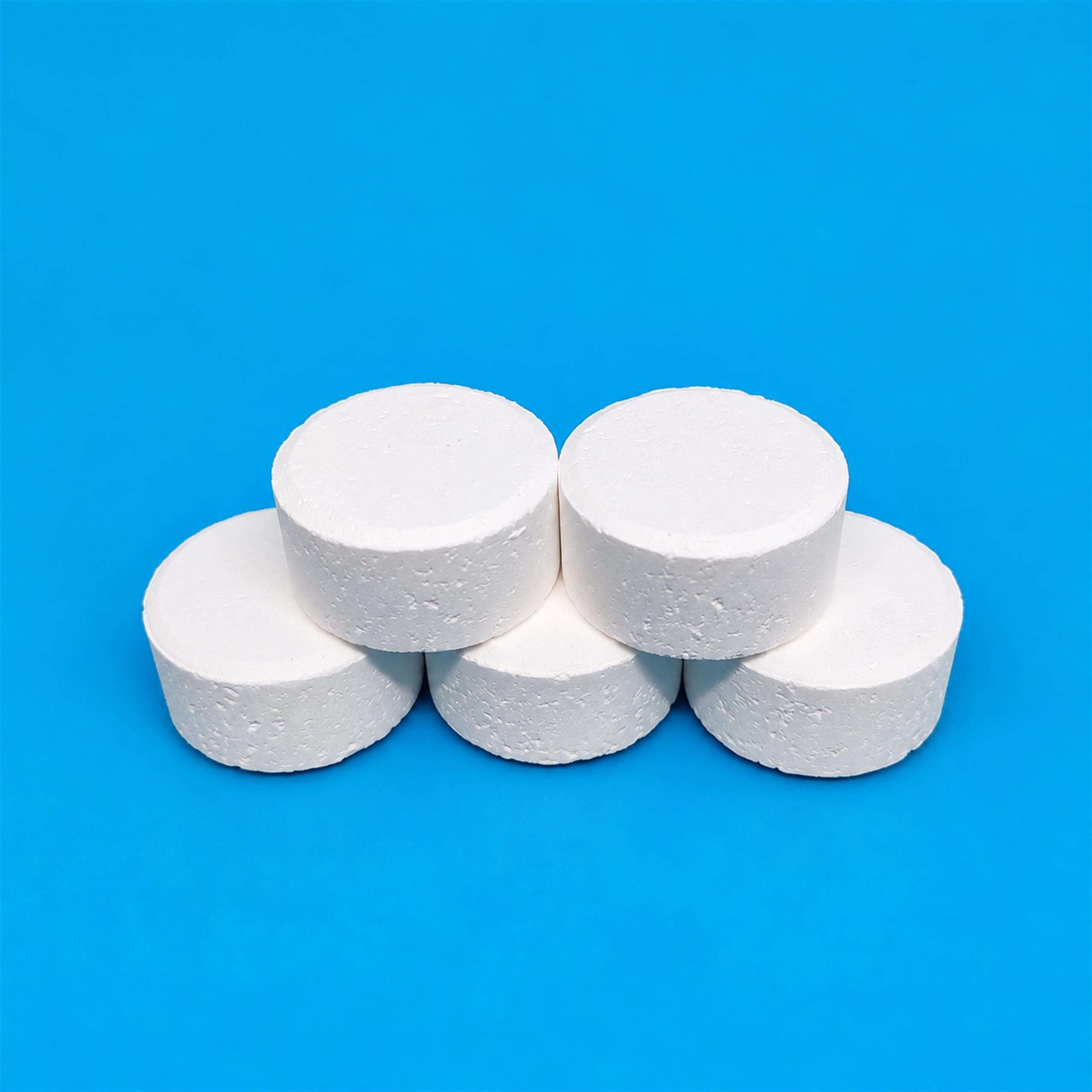
- Ignoring the form of NaDCC. Tablets designed for slow-release in swimming pools are not appropriate where rapid disinfection of a cold surface is needed. Granular or soluble powder forms give faster and more controllable results in cold conditions.
What Cannot Be Generalised
It is important to note that no single correction factor applies to all NaDCC use in cold rooms. The interaction of temperature with concentration, contact time, organic load, surface type, and target microorganism means that each facility must assess its own conditions. Published efficacy data generated at 20 °C or 25 °C cannot be directly transposed to 4 °C without specific validation. ENVO CHEMICAL can support users in reviewing product-specific technical data for cold-temperature applications, but the on-site validation remains the operator’s responsibility.
If you are evaluating NaDCC for disinfection in a cold room and need to confirm the appropriate use conditions for your temperature range and target application, contact ENVO CHEMICAL with your specific cold room temperature, surface type, and disinfection target so we can discuss the relevant technical parameters.
