
Regulatory Compliance with SDIC in Municipal Drinking Water Disinfection: A Strategic Guide for Utility Directors
By: Dr. Elias Thorne, Senior Municipal Water Infrastructure & Public Health Strategist
Let’s be brutally honest for a second. There is a specific kind of silence that falls over a city council meeting when a concerned parent stands up, holds a glass of tap water that looks crystal clear, and asks, “Why does it taste like a swimming pool, and are the carcinogens in this water going to make my children sick?” As water professionals, we know that clarity doesn’t equal safety. The real enemy isn’t just the bacteria we kill; it’s the toxic cocktail we accidentally create while killing them, or the inconsistent residuals that leave the farthest corners of our distribution network vulnerable to regrowth.
I remember consulting for a mid-sized municipality in the Great Lakes region a few years back. The utility director, a weary woman named Sarah, met me at the treatment plant looking defeated. “We’re trapped,” she sighed, gesturing to the intake river swollen with autumn leaves. “Our liquid bleach degrades so fast in storage that by the time we dose it, the potency is a guess. Some days we over-chlorinate and get complaints about taste; other days we under-dose and risk bacterial regrowth in the dead-end mains. Worse, our Disinfection Byproduct (DBP) levels are flirting with the EPA limits. We need stability, but we’re chasing our own tails.”
Sarah’s dilemma highlights the critical, often overlooked role of Sodium Dichloroisocyanurate (SDIC) in modern municipal drinking water disinfection. Unlike liquid sodium hypochlorite, which can lose up to 50% of its strength in months, high-purity SDIC is a stable, solid oxidant that offers precision, longevity, and superior pathogen control. But here is the catch: using SDIC isn’t just about swapping chemicals; it’s about navigating a complex web of regulatory compliance, ensuring every drop meets strict international standards while maintaining operational safety.
This isn’t just chemistry; it’s a blueprint for public health security. Let’s dig into why SDIC is becoming the go-to solution for forward-thinking municipalities and how to wield it compliantly.
The Regulatory Maze: Rules That Don’t Sleep
First, let’s dispel a dangerous myth: “If the water tests fine for bacteria, the regulators won’t care about the chemical source.” Wrong. In municipal water treatment, scrutiny is higher than anywhere else. When deploying SDIC, you are bound by a rigid framework of international and local laws:
- EPA Safe Drinking Water Act (SDWA) / EU Drinking Water Directive: These strictly mandate disinfection efficacy (Log removal of viruses/bacteria) while simultaneously limiting Disinfection Byproducts (DBPs) like Trihalomethanes (THMs) and Haloacetic Acids (HAAs). SDIC helps here because its controlled release minimizes the “spike and decay” cycles that often drive DBP formation. However, you must monitor Cyanuric Acid (CYA) levels, a byproduct of SDIC, to ensure they don’t interfere with disinfection efficacy or exceed local guidelines (though in flow-through systems, accumulation is rarely an issue).
- NSF/ANSI 60 & NSF/ANSI 61 Standards: This is non-negotiable. Any chemical added to drinking water must be certified to these standards to ensure it doesn’t introduce harmful contaminants like heavy metals, arsenic, or excessive insolubles. Using non-certified, industrial-grade SDIC is a direct violation that can lead to immediate shutdowns and massive liability.
- OSHA Process Safety Management (PSM): While SDIC is safer than chlorine gas, it is still a strong oxidizer (Class 5.1). Storage of threshold quantities triggers strict requirements for segregation, ventilation, and fire suppression. Ignoring this because “it’s just powder” is a fast track to catastrophe.
- Local Discharge Regulations: Backwash water containing high levels of chloramines or unreacted compounds must be managed. Violating these discharge limits can result in massive fines.
Compliance isn’t bureaucracy; it’s your shield against disaster and liability.
Operational Excellence: The SDIC Advantage
So, how do we wield SDIC safely while maintaining balance? It starts with understanding its unique profile.
- Stability is King: SDIC boasts approximately 60% available chlorine and is incredibly stable. What you buy today is what you use six months from now. This eliminates the “potency guesswork” that plagues liquid systems, ensuring consistent dosing and reliable residuals.
- Controlled Release: SDIC dissolves gradually, maintaining a steady residual of hypochlorous acid (HOCl). This steady presence allows the oxidant to penetrate deep into biofilms and reach the farthest ends of the distribution network without the rapid decay seen with liquid bleach.
- pH Neutrality: Unlike liquid bleach (pH 12-13), SDIC has a near-neutral pH impact. This reduces the need for aggressive acid correction, stabilizing the water chemistry and minimizing the risk of scaling or corrosion in pipes.
The Critical Factor: Purity Determines Compliance
Here is the nuance that separates success from disaster: Not all SDIC is created equal.
Cheap, industrial-grade SDIC often contains fillers, binders, and insoluble residues. These impurities don’t just vanish; they turn into a chalky sludge that clogs feeders, clouds the water, and—most critically—can introduce heavy metals that violate NSF/ANSI 60 standards. I’ve seen facilities spend thousands on maintenance to remove sludge caused by low-quality tablets, only to face regulatory fines for exceeding metal limits.
You need a product that is pharmaceutical-grade pure. You need consistency.
The ENVO CHEMICAL Advantage: Engineering Excellence
This is where ENVO CHEMICAL stands apart. As a global leader in the R&D, production, and sales of water treatment chemicals, ENVO has engineered SDIC specifically for the rigorous demands of municipal drinking water disinfection.
- Unmatched Purity & Certification: ENVO’s SDIC boasts >60% available chlorine with <0.1% insolubles. Crucially, every batch is fully certified to meet NSF/ANSI 60, EPA, REACH, and WHO standards. This guarantees that your water remains free from heavy metals and other contaminants, eliminating the risk of regulatory shutdowns.
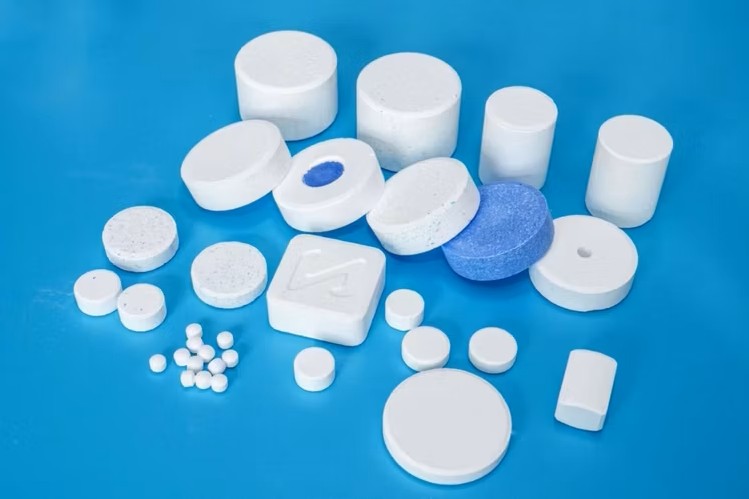
- Uniform Density: ENVO’s manufacturing process ensures every granule and tablet has consistent hardness and dissolution rates. Whether you are in a humid tropical climate or a dry desert region, the performance is identical. No more rock-hard bricks that won’t dissolve or dusty crumbs that choke your feeder.
- Global Reliability: With a distribution network spanning over 200 countries, ENVO ensures that your supply chain never breaks. You aren’t forced to buy inferior, risky substitutes because your local supplier ran out. The quality remains identical whether you are in North America, Europe, Asia, or Africa.
- Technical Partnership: ENVO doesn’t just sell drums; they provide feeder calibration support, dosing strategy consulting, and staff training. They help you navigate the complex transition from liquid to solid chlorination, ensuring full compliance from day one.
For Sarah’s municipality, switching to ENVO’s high-purity SDIC was transformative. Within two weeks, chlorine residuals held steady day and night across the entire distribution map. Her chemical budget dropped by 20% due to reduced waste and lower transport costs, and her maintenance team stopped fighting clogged feeders. Most importantly, their DBP levels dropped comfortably below regulatory limits. “It’s like we finally have control again,” Sarah told me. “We aren’t guessing anymore; we know exactly what we’re delivering to our citizens.”
Frequently Asked Questions (FAQ)
Q: Is SDIC safe for drinking water?
Yes, absolutely. When used at recommended doses and sourced from certified suppliers like ENVO CHEMICAL (NSF/ANSI 60 certified), SDIC is fully approved for drinking water disinfection globally.
Q: Does SDIC cause Cyanuric Acid (CYA) buildup?
SDIC does release CYA as it dissolves. However, in flow-through municipal systems with regular water turnover, CYA accumulation is negligible and poses no health risk. It actually helps stabilize the chlorine residual against UV degradation in open reservoirs.
Q: How does SDIC compare to liquid bleach in terms of cost?
While the upfront unit cost of SDIC may appear higher, the Total Cost of Ownership (TCO) is significantly lower. Due to its high potency (60% vs 12%) and stability, you use far less product. Additionally, you save on transportation, storage, acid for pH correction, and the disposal of degraded liquid bleach.
Q: Will SDIC clog my dosing equipment?
Only if you use low-quality products with high insoluble content. ENVO’s SDIC has <0.1% insolubles, ensuring complete dissolution and smooth operation in even the most sensitive automated feeders.
Q: Why choose ENVO CHEMICAL for municipal SDIC?
ENVO combines ultra-high purity (>60% active chlorine) with global logistical reliability and full regulatory certification. Their products reduce decomposition risks, ensure consistent water quality, and come with comprehensive technical support, making them the safest and most cost-effective choice for municipalities.
The Bottom Line
Stop letting volatile, inefficient chemicals compromise your water quality and operational budget. The shift to SDIC offers a clearer, safer, and more efficient path forward for municipal drinking water disinfection—but only if you start with the highest quality ingredients.
Don’t gamble with inferior products that clog and cloud. Partner with ENVO CHEMICAL, a trusted global innovator with decades of experience. Their commitment to purity, consistency, and reliability ensures that your move to advanced disinfection delivers the safe, compliant, and great-tasting water your community deserves.
Ready to transform your municipal water treatment strategy? Contact ENVO CHEMICAL today to request a sample, speak with our municipal specialists, or get a customized design for your SDIC dosing system. Let’s make every drop count.
Author: Dr. Elias Thorne
Senior Municipal Water Infrastructure Consultant | 25+ Years in Public Health & Disinfection Strategy
