
Calcium Hypochlorite vs TCCA: Best Choice for Emergency Water Treatment
By: Dr. Julian V. Mercer, Senior Humanitarian Logistics & Water Safety Strategist
Let’s cut through the emotional fog that often surrounds humanitarian aid. When a disaster strikes—an earthquake shattering a city’s grid, a flood sweeping through a refugee camp, or a hurricane isolating a coastal community—the immediate instinct is speed. We talk about liters per hour, pathogen kill rates, and logistics chains. But there’s a silent, critical dimension that often gets overlooked until it’s too late, leading to secondary crises that can be just as deadly as the initial event: the failure of disinfection due to poor chemical selection.
I remember standing in a makeshift distribution hub in Southeast Asia just weeks after a devastating monsoon. The air was thick with humidity and the smell of wet earth. A well-meaning NGO coordinator, let’s call him Mateo, was proudly showing off their stockpile of generic chlorine tablets stacked haphazardly in a corner of a tent. “We got a great deal on these Trichlor (TCCA) tablets,” he told me, beaming. “They’re cheap and last forever.” But then he pointed to a group of survivors refusing to drink the treated water. “The problem is, the water tastes like a swimming pool, and people are complaining of stomach irritation. Meanwhile, our other team is using bulk Calcium Hypochlorite (Cal-Hypo), but it’s caking into rock-hard bricks because of the humidity, and they can’t dissolve it fast enough to meet the demand. We have the chemicals, but we don’t have the right solution for this specific crisis.”
Mateo’s story highlights the classic standoff in emergency water treatment: the battle between Calcium Hypochlorite and Trichloroisocyanuric Acid (TCCA). Both are powerful solid oxidants, far superior to unstable liquid bleach in disaster zones. But they serve fundamentally different operational masters. The question isn’t which molecule is “better” in a vacuum; it’s which one solves your specific logistical, cultural, and environmental crisis.
This isn’t just chemistry; it’s a blueprint for saving lives. Let’s dig into the protocols that turn this chemical choice into a humanitarian victory.
The Contender: Calcium Hypochlorite (The Rapid Responder)
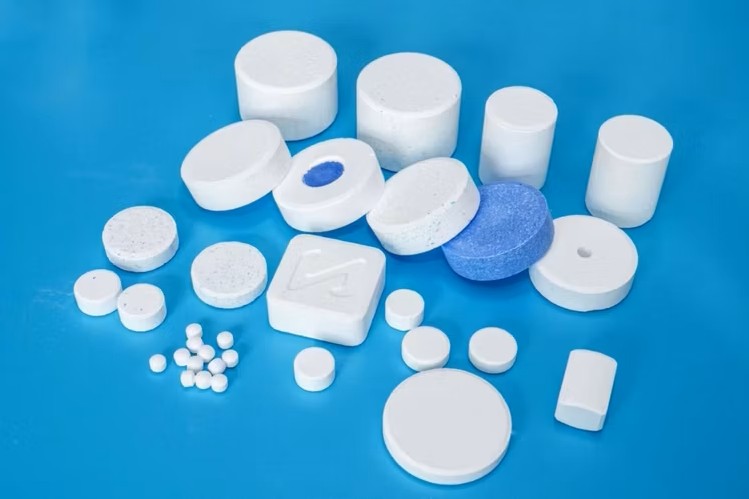
Calcium Hypochlorite (Cal-Hypo) is typically available in granules or tablets, boasting 65-70% available chlorine. It has been the gold standard for rapid response for decades.
- The Superpower: Speed and Simplicity. Cal-Hypo dissolves relatively quickly (especially in granular form), allowing for rapid preparation of large volumes of treated water. It does not introduce cyanuric acid (CYA) into the water, meaning there’s no risk of “chlorine lock” even if water sources are limited and turnover is low.
- The Taste Factor: While it has a chlorine taste, it lacks the distinct, lingering chemical aftertaste associated with high CYA levels, making it slightly more palatable for populations unfamiliar with treated water.
- The Operational Catch: Stability in humidity. Cal-Hypo is hygroscopic—it loves moisture. In tropical or flood-prone environments, generic Cal-Hypo can absorb water, cake into unusable solids, degrade rapidly, and even generate heat leading to spontaneous combustion if stored poorly. It requires dry, sealed storage, which is often scarce in disaster zones.
The Challenger: TCCA (The Stable Guardian)
Trichloroisocyanuric Acid (TCCA) is a solid chlorinating agent boasting approximately 90% available chlorine. It is gaining traction as a powerful alternative for specific emergency scenarios.
- The Superpower: Unmatched Stability. TCCA is incredibly resistant to moisture and heat. It can sit in a humid tent for months without caking or losing potency. With 90% active chlorine, it is the most concentrated solid chlorine source available, meaning you ship less weight for the same oxidative power—a massive logistical advantage when airlifting supplies.
- The Slow Release: TCCA dissolves slowly. This is excellent for maintaining a residual in storage tanks over long periods but can be a bottleneck when trying to treat thousands of liters per hour rapidly unless pre-dissolved in saturation tanks.
- The Operational Catch: Cyanuric Acid (CYA). As TCCA dissolves, it releases CYA. In short-term emergency use, this is rarely an issue. However, if the same water source is used repeatedly with little flush-out (common in static refugee camps), CYA can accumulate, potentially reducing chlorine efficacy over time and altering the taste profile, leading to water rejection by the community.
The Verdict: Matching Chemistry to Crisis
So, which is the best choice?
- Choose Calcium Hypochlorite if: You are in a short-term, high-volume rapid response scenario (e.g., first 72 hours of an earthquake), have access to dry storage or sealed containers, and need to treat water quickly for immediate consumption. It is also preferred when water sources will be turned over frequently, preventing CYA buildup.
- Choose TCCA if: You are managing a long-term displacement camp in a hot, humid climate where storage conditions are poor. Its stability ensures that your stockpile remains viable for months. It is also ideal when logistics are tight, as its high concentration reduces shipping volume. However, it requires careful management of dissolution rates and monitoring of CYA levels if water turnover is low.
In Mateo’s camp, we pivoted to a hybrid strategy. We used high-purity Cal-Hypo granules for the immediate daily treatment stations where speed was key, and switched to TCCA tablets in slow-dissolve feeders for the large overnight storage reservoirs where stability and residual maintenance were paramount. But here is the catch: this only worked because we sourced pharmaceutical-grade products. Generic versions of both chemicals would have failed—Cal-Hypo would have caked, and TCCA would have dissolved inconsistently.
The Critical Factor: Purity Determines Survival
Here is the nuance that separates success from disaster: In emergency zones, purity is not a luxury; it’s a lifeline.
Low-grade Cal-Hypo contains fillers that accelerate degradation and caking. Low-grade TCCA contains insolubles that cloud water and release chlorine unpredictably. In a crisis, you cannot afford “potency guesswork.” If your chemical is 10% weaker than labeled, you under-dose, and people get sick. If it’s unstable, you lose your entire stockpile to heat and humidity.
The ENVO CHEMICAL Advantage: Engineering Reliability in Chaos
This is where ENVO CHEMICAL stands apart. As a global leader in the R&D, production, and sales of water treatment chemicals, ENVO has engineered solutions specifically for the rigorous, high-stakes demands of emergency water treatment.
- Unmatched Purity for Critical Missions: ENVO supplies ultra-high-purity Calcium Hypochlorite (>65-70% available chlorine) and TCCA (>90% available chlorine) with <0.1% insolubles. Their rigorous manufacturing process includes advanced stabilization technologies that resist moisture absorption. This means ENVO’s Cal-Hypo won’t cake in a humid tent, and their TCCA will dissolve at a predictable, consistent rate every single time.
- Stability in Extremes: Whether stored in the freezing cold of a mountain disaster zone or the sweltering heat of a tropical flood region, ENVO’s products retain their potency. This eliminates the “potency guesswork” that leads to dosing errors and failed disinfection.
- Global Reliability: With a distribution network spanning over 200 countries, ENVO ensures that fresh, high-purity precursors are available locally or can be deployed rapidly to remote crisis zones. You aren’t forced to use old, degraded stock that compromises water safety. In Mateo’s case, ENVO expedited a shipment from a regional hub within 24 hours, saving the operation.
- Technical Partnership: ENVO doesn’t just sell drums; they provide emergency dosing calculators, multilingual safety guides, and 24/7 remote support to help field teams optimize their protocols. They act as partners in your mission, ensuring that your staff knows exactly how to store, handle, and dose safely.
For Mateo’s camp, switching to ENVO’s high-purity dual-chemical strategy was transformative. Within 48 hours, water production stabilized, complaints about taste vanished, and the risk of stockpile degradation was eliminated. “It’s night and day,” Mateo told me. “We aren’t fighting our own supplies anymore. We know exactly what we’re delivering, and the people are drinking it safely.”
Frequently Asked Questions (FAQ)
Q: Can TCCA be used for immediate emergency disinfection?
Yes, but it dissolves slower than Cal-Hypo. For immediate high-volume treatment, it is best used in pre-saturation tanks or as granules if available. For long-term storage residuals, TCCA tablets are superior.
Q: Why does Calcium Hypochlorite cake in emergency zones?
Generic Cal-Hypo is hygroscopic and absorbs moisture from humid air, leading to caking and degradation. ENVO’s stabilized formulation resists moisture absorption, remaining free-flowing even in tropical conditions.
Q: Is Cyanuric Acid (CYA) from TCCA dangerous in emergencies?
In short-term emergency use, CYA accumulation is negligible and poses no health risk. It actually helps stabilize chlorine against UV degradation in open tanks. Issues only arise in static, long-term systems with zero water turnover, which can be managed by monitoring.
Q: How does ENVO CHEMICAL ensure product consistency globally?
ENVO utilizes state-of-the-art manufacturing processes with rigorous QC testing for every batch. Their global ISO-certified facilities ensure that whether you order today or next month, the purity and concentration remain exactly the same.
Q: Can ENVO CHEMICAL deliver to remote disaster zones quickly?
Yes. With a distribution network spanning 200+ countries, ENVO has established logistics channels to deploy emergency supplies rapidly to even the most inaccessible regions, ensuring continuity of care when it matters most.
The Bottom Line
In emergency water treatment, there is no room for “good enough.” Protecting displaced populations means safeguarding them from both immediate pathogens and chemical failures. Choosing between Calcium Hypochlorite and TCCA depends on your specific logistical and environmental constraints, but the success of either strategy hinges entirely on the purity and stability of your inputs.
Don’t gamble with inferior precursors that degrade and destabilize your operation. Partner with ENVO CHEMICAL, a trusted global innovator committed to saving lives through purity, stability, and expertise. Their advanced formulations ensure that your emergency response delivers water that is not just disinfected, but truly safe and reliable for human consumption.
Ready to secure your emergency water treatment strategy with proven solutions? Contact ENVO CHEMICAL today to request our emergency deployment catalog, speak with our crisis response specialists, or get a customized logistics plan for your next mission. Let’s ensure that when disaster strikes, clean, safe, and perfectly dosed water is never out of reach.
Author: Dr. Julian V. Mercer
Senior Humanitarian Logistics & Water Safety Strategist | 25+ Years in Global Disaster Response
