
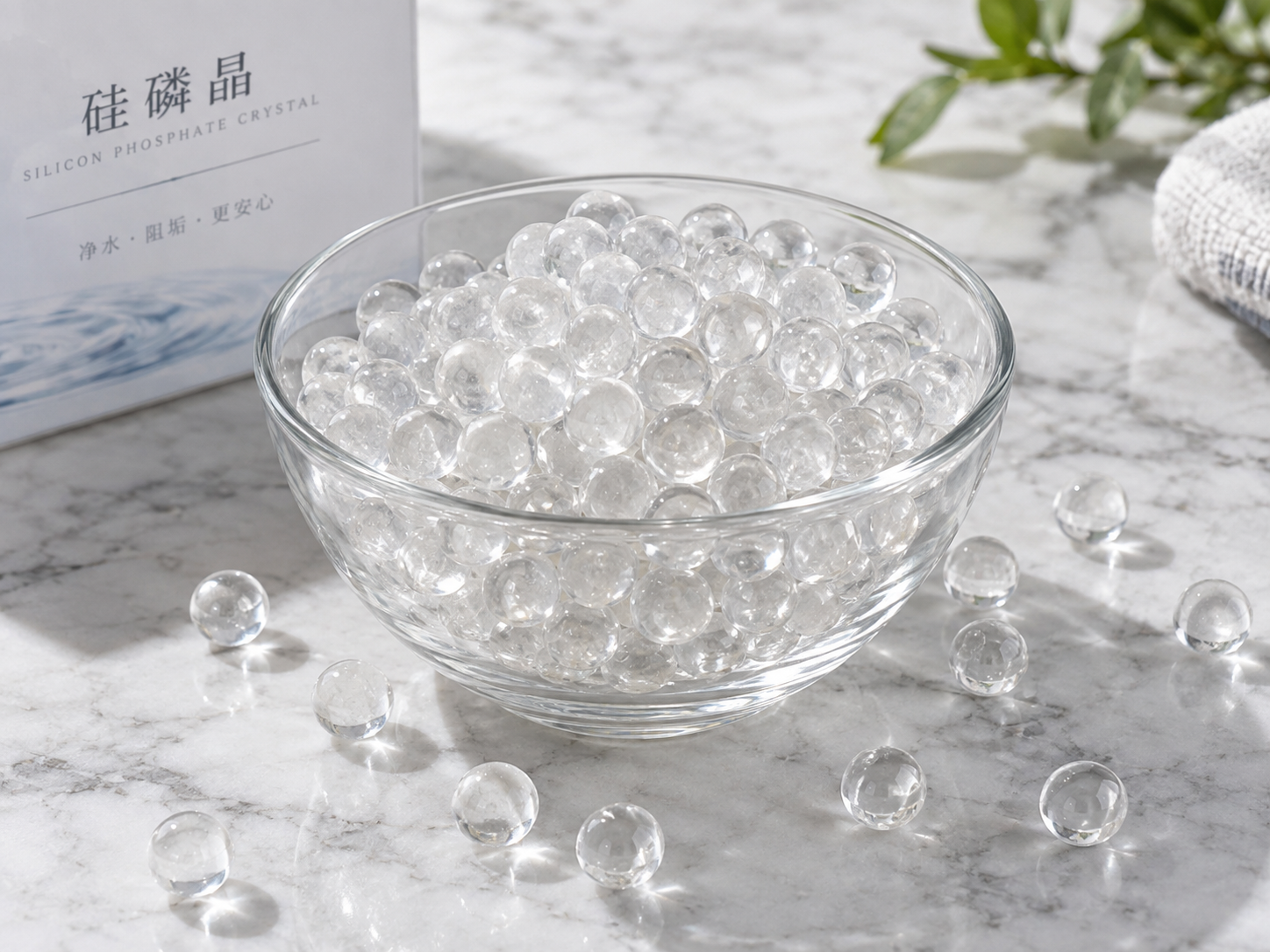
Yes — a boiling-water demonstration can misrepresent polyphosphate performance, and it often does. Boiling changes nearly every variable that controls phosphate chemistry in water: temperature, dissolved carbon dioxide, pH, and the rate at which polyphosphate chains break down. A beaker of boiled water can turn cloudy or drop a white precipitate even when the same media would keep a normal cold or warm water line clear for months. The demonstration has not proved that the product works, and it has not proved that it fails. It has proved that boiling water is a different chemical environment from the one the product will actually face.
For filter manufacturers, water-treatment equipment suppliers, and procurement teams evaluating scale-inhibition media, the practical question is not whether a demo looks convincing. It is whether the test conditions resemble the application. This article explains what a boiling-water demo really measures, where it can legitimately help, and what to ask for instead.
Why boiling water is not a neutral test medium
Heat accelerates polyphosphate hydrolysis
Polyphosphates are chains of phosphate units. In water they gradually hydrolyse — the chains shorten and eventually convert toward orthophosphate. That reaction is driven by time, temperature, and pH, and it speeds up markedly as water gets hotter. A short boiling test therefore pushes the material far along a reaction pathway that, at ambient or mildly warm temperatures, would take much longer to reach.
This matters because short-chain and ortho forms do not behave like long-chain polyphosphates. Orthophosphate reacts readily with calcium and can form precipitates. So the cloudiness seen in a boiling beaker may simply be the product of accelerated hydrolysis, not a defect in the media and not a prediction of what a cold-water line will do.
Boiling strips carbon dioxide and shifts the carbonate balance
Carbon dioxide is less soluble in hot water than in cold water. When water boils, dissolved CO₂ leaves, the carbonate–bicarbonate equilibrium shifts toward carbonate, and pH rises. The water becomes more supersaturated with respect to calcium carbonate. That is the same mechanism that puts scale inside a kettle — the kettle is not being softened, it is being heated.
Any white deposit formed in a boiling demo may therefore be calcium carbonate that the heating itself forced out of solution. Attributing it to the phosphate media is an assumption, not an observation.
Calcium carbonate becomes less soluble as temperature rises
Many salts dissolve better in hot water. Calcium carbonate does the opposite: its solubility decreases with rising temperature. A demonstration that heats water is therefore creating scaling conditions independently of whatever media is sitting in the container. Even a blank control — boiled water with no media at all — will often produce a deposit or haze.
Media-to-water ratio and contact time become arbitrary
In a real installation, the media sits in a housing and water passes through it at a design flow rate, giving a defined contact time and a defined concentration of dissolved phosphate. In a pot or beaker, neither is controlled. A few crystals in a litre of water is an extremely high dose; a handful in a large pot is a very low one. Neither corresponds to a filter housing operating at its rated flow.
What a boiling-water demonstration can and cannot show
| Observation in boiling water | What it may indicate | Why it does not predict in-line performance |
|---|---|---|
| Cloudiness or white precipitate | Calcium carbonate forced out of solution by heat and CO₂ loss; possibly calcium phosphate from accelerated hydrolysis | The system may never reach boiling, and its CO₂ and pH behaviour will differ |
| Crystals soften, whiten, or break down | Dissolution of the media at high temperature | Dissolution rate at 100 °C is not the dissolution rate at 20–40 °C |
| Water remains clear | Little precipitation under those particular conditions | Does not confirm threshold scale inhibition at the design dose |
| pH rises during the test | Carbon dioxide stripping by heat | The pH change happens in the container, not in the pipe |
| Water tastes or smells different | Possible leaching; sensory change | Not a measure of scale inhibition, and not a safety assessment |
Where boiling-water tests do have legitimate uses
A hot-water test is not automatically meaningless. It becomes useful when the application genuinely involves hot water, and when the method is controlled.
- Hot-water and closed-loop screening: if the media will sit in a hot-water line, a controlled elevated-temperature test with defined exposure time, water chemistry, and a parallel ambient control can reveal whether the material dissolves or hydrolyses faster than expected.
- Thermal stability comparison: comparing several candidate media under identical hot conditions can rank their relative stability, even if the absolute numbers do not transfer to the field.
- Failure investigation: if a field installation shows unusual phosphate release or deposit formation, a hot test can help confirm whether temperature exposure is a plausible contributor.
In every one of these cases, the test is only interpretable alongside a control sample at the application temperature and a clear statement of water chemistry.
How to judge a demonstration you have been shown
- Was there a control? Boiled water with no media should be run in parallel. If the control also clouds or deposits, the media is not the cause.
- What was the water? Hardness, alkalinity, pH, and chloride level all change the outcome. Tap water in one city behaves differently from tap water in another.
- What was the temperature and duration? “Boiled” is not a specification. Temperature profile and contact time determine how far hydrolysis has progressed.
- What was the media dose? Mass of media per litre of water, and whether the media was static or in flow.
- What was measured? Visual appearance is not a measurement. Total phosphate, orthophosphate, calcium, alkalinity, pH, and turbidity are.
- Was the conclusion stated before the test? A demonstration designed to produce a particular image is marketing, not evaluation.
What to evaluate instead
A meaningful assessment of polyphosphate media starts with the application, not with a beaker.
- Define the objective. Is the goal threshold scale inhibition, corrosion control, or simply phosphate addition for a downstream process? These are different targets and require different evidence.
- Characterise the water. Hardness, alkalinity, pH, temperature, flow rate, and the presence of other treatment chemicals.
- Set realistic contact time. Threshold inhibition depends on a small, continuous dose of phosphate being present where scaling would otherwise start. That is a dosing question as much as a media question.
- Use a recognised method. Static jar tests, dynamic loop tests, or instrumented field trials give reproducible, comparable results. A domestic kettle does not.
- Measure phosphate speciation over time. Total phosphate tells you how much is present; orthophosphate tells you how much has already hydrolysed and is no longer performing the threshold function.
Functions that are frequently confused
Much of the confusion around boiling-water demos comes from mixing up what polyphosphate media actually do.
- Scale inhibition — interfering with crystal growth so that hardness minerals stay dispersed rather than depositing. This is the main function of threshold-treatment polyphosphates.
- Water softening — removing calcium and magnesium ions from the water. Polyphosphate media do not do this. Hardness remains in the water.
- Scale removal — dissolving existing deposits. That is a cleaning action, not a treatment function.
- Filtration — physically removing suspended particles. Phosphate media are not filters unless combined with a filter element.
- Corrosion inhibition — forming a protective film on metal surfaces. Some phosphate-based treatments are used for this, but the mechanism, dosage, and evidence differ from scale inhibition and should be verified for the specific product and system.
- Disinfection — inactivating microorganisms. Phosphate media do not disinfect.
It is also worth noting that “Siliphos” is a brand name that has become widely used as a generic label. Products sold under similar names are not necessarily the same material, and performance data from one should not be assumed to apply to another. Composition, form, and dissolution behaviour need to be confirmed for the exact product under consideration.
Frequently asked questions
Does cloudiness in boiling water mean the polyphosphate crystal is low quality?
Not by itself. Cloudiness in boiled water is commonly caused by calcium carbonate precipitating because of heat and CO₂ loss, which happens with or without media present. Only a controlled test with a blank sample and measured phosphate and calcium levels can separate the causes.
Can a boiling test prove that a product prevents scaling?
No. Scale prevention depends on maintaining a small phosphate dose at the point where scaling would begin, under the actual temperature, flow, and water chemistry of the system. Boiling a sample removes the flow and dosing variables entirely.
Is a hot-water test ever more relevant than a cold-water test?
Yes, if the application is a hot-water system. In that case the test should use the actual operating temperature rather than boiling point, and should be run alongside an ambient control so the effect of temperature can be isolated.
Does boiling water destroy the media permanently?
Boiling accelerates hydrolysis and dissolution, so it will consume the media faster than normal service conditions would. How much faster depends on the specific product, the water chemistry, and the duration of exposure, and should be confirmed with the supplier rather than inferred from a single demonstration.
What should be confirmed before buying polyphosphate media?
The intended function, the source-water analysis, the operating temperature range, the required contact time and housing type, any local limits on phosphate discharge or drinking-water additives, and the documentation the supplier can provide for the exact product grade.
Practical takeaway
A boiling-water demonstration is a striking visual, but it is a poor proxy for field performance. Treat it as an illustration of what happens at 100 °C in an open container — nothing more. Make selection decisions on the basis of water analysis, application temperature, contact time, and measured phosphate behaviour, and ask any supplier to state the conditions behind their claims.
If you are evaluating polyphosphate or siliphos-type crystal media for a specific project, ENVO CHEMICAL can review the application with you. To give a useful answer rather than a generic one, please share the intended function (scale inhibition, corrosion control, or other), a source-water analysis covering hardness, alkalinity, pH, and temperature, the equipment type and flow rate, the specification or grade you are considering, the quantity required, and the destination market so that applicable local requirements can be taken into account.
