
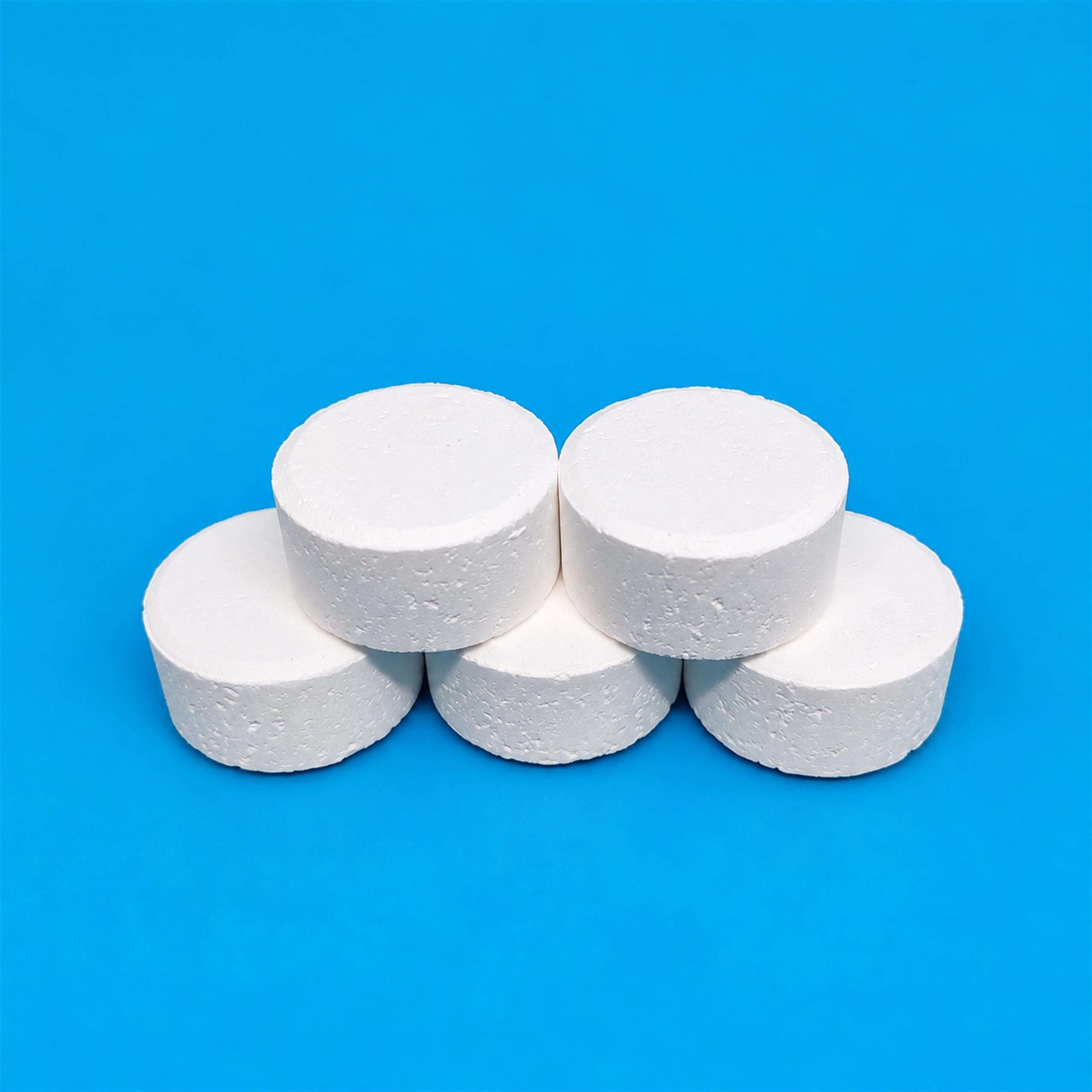
NaDCC Cannot Reliably Remove Pesticides or Heavy Metals from Drinking Water
Sodium dichloroisocyanurate (NaDCC) is a chlorinated disinfectant that releases available chlorine in water. It is not designed to remove pesticides or heavy metals from drinking water, and it does not perform this function at typical disinfection doses. The essential answer is that NaDCC acts primarily as a biocide and mild oxidant, not as a contaminant-removal agent for these classes of pollutants.
Under specific, highly controlled conditions, the oxidative chemistry of NaDCC may break down certain organic pesticide molecules. However, this is partial degradation rather than complete removal, and it does not apply broadly across the thousands of registered pesticide compounds. For heavy metals such as lead, arsenic, cadmium, or mercury, NaDCC provides no meaningful removal mechanism whatsoever.
What NaDCC Actually Does in Water
When NaDCC dissolves, it hydrolyzes to form hypochlorous acid (HOCl), the active disinfecting species. The primary function is pathogen inactivation — killing bacteria, viruses, and some protozoa. The available chlorine concentration from NaDCC typically ranges from 55% to 60% on an anhydrous basis, but in drinking-water applications the applied dose is kept low (often 1–5 mg/L free chlorine residual) to meet safety standards.
This low-dose oxidative environment is sufficient for disinfection but is generally insufficient to:
- Oxidize and mineralize complex organic pesticide molecules into harmless end products
- Precipitate, chelate, or filter dissolved heavy-metal ions from solution
- Reduce total dissolved solids or specific contaminant concentrations to below regulatory limits
In short, NaDCC treats biological risk in water. It does not treat chemical contamination of the type posed by pesticides or heavy metals.
Why NaDCC Does Not Remove Heavy Metals
Heavy metals exist in water as dissolved ions (e.g., Pb²⁺, As³⁺/As⁵⁺, Cd²⁺, Hg²⁺). Removal requires physical or chemical processes that sequester or separate these ions:
- Adsorption — activated carbon, iron-based adsorbents, or specialty media
- Ion exchange — resin systems that swap metal ions for benign ones
- Membrane filtration — reverse osmosis or nanofiltration
- Coagulation and precipitation — using alum, ferric chloride, or lime to form insoluble metal hydroxides or sulfides
Chlorine-based disinfectants like NaDCC do not precipitate dissolved metals. In fact, in some cases, the presence of chloride ions from NaDCC can slightly increase the solubility of certain metal complexes, though this effect is minor at drinking-water doses. There is no credible mechanism by which NaDCC at disinfection levels removes heavy metals to any significant degree.
What NaDCC Can and Cannot Do with Pesticides
The situation with pesticides is more nuanced but still does not support the use of NaDCC as a removal method. Some pesticide compounds — particularly certain organophosphates and carbamates — are susceptible to oxidation by hypochlorous acid. Laboratory studies have shown that free chlorine can degrade specific pesticide molecules under controlled pH and concentration conditions.
However, several important limitations apply:
- Incomplete degradation. Chlorine oxidation often produces transformation products (chlorinated byproducts) that may be as toxic as or more toxic than the parent compound. Complete mineralization to CO₂, water, and inorganic salts rarely occurs at disinfection doses.
- Compound specificity. Efficacy varies enormously across pesticide classes. Many modern pesticides — including neonicotinoids, pyrethroids, and certain herbicides — are relatively resistant to chlorine oxidation at low concentrations.
- Dose incompatibility. Achieving meaningful pesticide degradation would require chlorine doses far exceeding safe drinking-water limits, creating disinfection-byproduct concerns (trihalomethanes, haloacetic acids) that introduce new health risks.
- No physical removal. Even if partial oxidation occurs, the dissolved residues and byproducts remain in the water. NaDCC does not filter, adsorb, or separate anything.
For these reasons, regulatory bodies and water-treatment engineers do not classify chlorination with NaDCC or similar agents as a pesticide-removal technology. Activated carbon filtration, advanced oxidation processes (such as UV/H₂O₂ or ozone), and membrane treatment are the proven approaches when pesticide contamination must be addressed.
When People Confuse Disinfection with Contaminant Removal
A common source of confusion is the assumption that because NaDCC “treats” water, it treats all problems in water. Disinfection and contaminant removal are distinct treatment objectives. A water system may be microbiologically safe (adequately disinfected with NaDCC) yet still contain unsafe levels of lead, arsenic, or pesticide residues. Relying on NaDCC alone in such a scenario would leave chemical hazards unaddressed.
If your goal is safe drinking water free from both pathogens and chemical contaminants, you need a treatment train that combines appropriate steps — for example, coagulation and filtration for particulates, activated carbon for organics including some pesticides, and a dedicated heavy-metal removal stage (ion exchange or RO) for metals — with disinfection (potentially including NaDCC) as the final barrier against recontamination.
What You Should Check Before Assuming NaDCC Solves the Problem
If you are evaluating whether NaDCC can address pesticide or heavy-metal contamination in a drinking-water supply, consider the following:
- Test the water. Identify which specific contaminants are present and at what concentrations. General assumptions about “pesticides” or “metals” are not actionable without analytical data.
- Check regulatory limits. Drinking-water standards (such as those from WHO or national authorities) define maximum contaminant levels. Removal must achieve these targets, not merely reduce concentrations slightly.
- Confirm the treatment mechanism. Ask whether the proposed method physically removes, chemically transforms, or merely masks the contaminant. NaDCC only offers limited chemical transformation for a narrow range of organic compounds and does so at unsafe doses for drinking water.
- Beware of byproduct formation. Introducing high chlorine doses to attack pesticides creates regulated disinfection byproducts. This trades one problem for another.
Summary Answer to the Title Question
NaDCC cannot remove heavy metals from drinking water under any practical condition. It may partially degrade certain pesticide molecules through oxidation, but it does not remove them, does not work reliably across pesticide types, and would require unsafe chlorine doses to attempt meaningful degradation — while generating harmful byproducts. For drinking-water applications where pesticide or heavy-metal contamination is a concern, dedicated treatment technologies are required, and NaDCC’s role, if any, is limited to post-treatment disinfection.
If you are assessing a specific water-quality challenge involving pesticides or heavy metals and need to understand which treatment steps are appropriate, contact ENVO CHEMICAL to discuss your contaminant profile and application requirements.
