
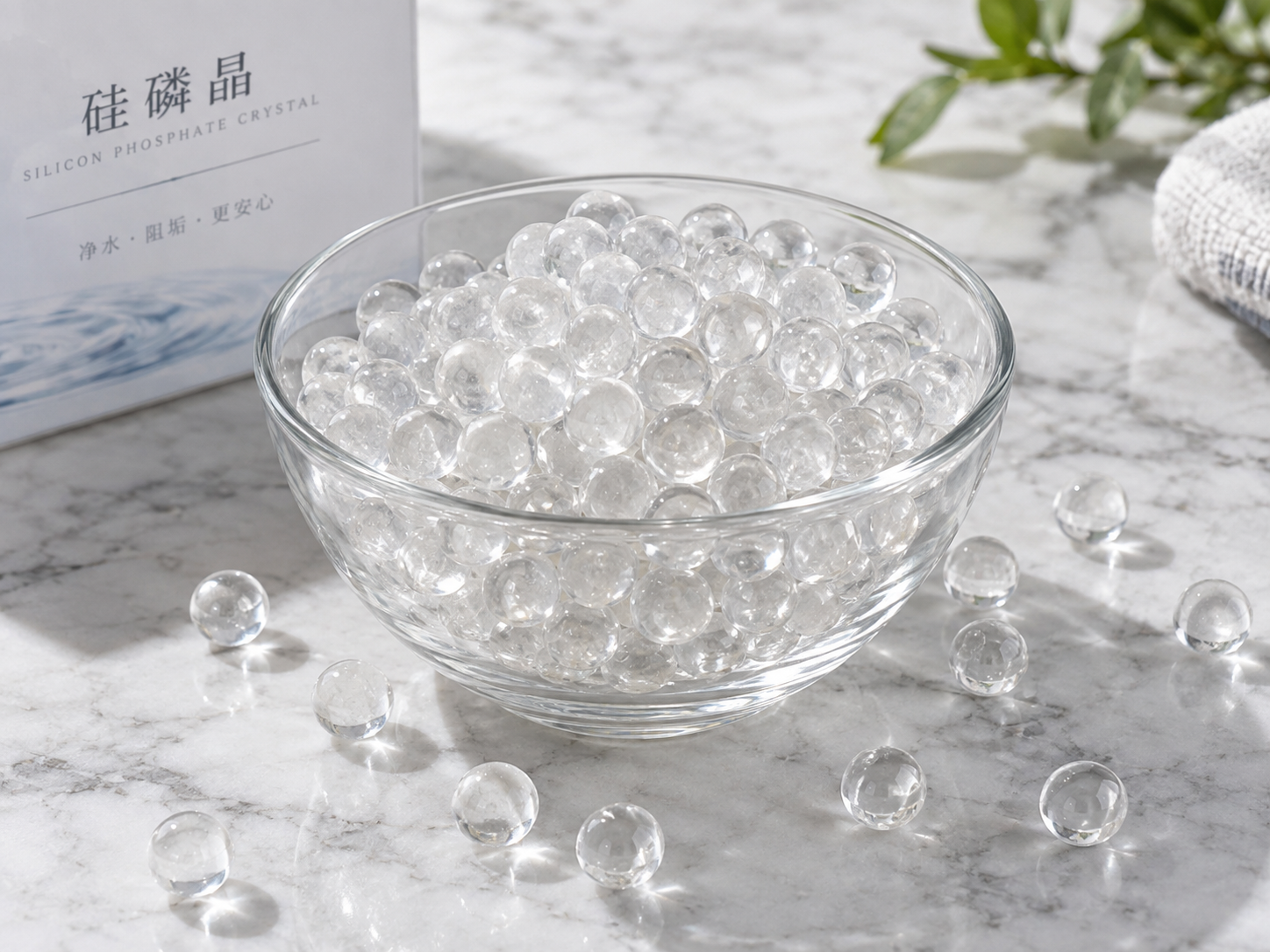
Can You Put Loose Polyphosphate Balls Directly into an Empty Filter Bowl?
In most cases, yes—you can place loose polyphosphate balls directly into an empty filter bowl, provided the bowl or housing includes a retaining mesh or perforated plate that prevents the balls from escaping with the water flow. However, the real question is not whether it is physically possible, but whether doing so alone gives you reliable dosing, adequate contact time, and a long service life. Simply dropping loose balls into an empty housing without understanding how the filter is designed to handle the media can lead to channeling, premature breakthrough, and inconsistent results.
What Polyphosphate Balls Actually Do in a Filter
Polyphosphate media—often supplied as small, translucent to white spherical beads—functions through sequestration, not physical filtration. The active ingredient, typically sodium hexametaphosphate or a related long-chain polyphosphate compound, dissolves slowly at a controlled rate when it contacts water. Dissolved polyphosphate ions bind with hardness minerals such as calcium and magnesium, keeping them in solution so they cannot deposit as scale on pipes, heating elements, or appliances.
This is a critical distinction: polyphosphate balls are a scale inhibitor, not a filter media in the mechanical sense. They do not trap particles the way sand, activated carbon, or pleated cartridges do. Therefore, the filter bowl is serving primarily as a reactor vessel—a contained space where water passes over or through the media long enough to pick up a therapeutic dose of polyphosphate. How you load that vessel matters.
What Happens If You Load Balls into a Completely Empty Housing
Short answer: It will work if the housing retains the balls, but performance may be uneven.
An empty filter bowl with nothing but loose polyphosphate balls and an inlet/outlet connection will let water flow straight through the pile of spheres. Several practical issues can arise:
- Channeling. Water follows the path of least resistance. Without a support bed, screen, or distributor plate, flow may carve channels through the ball pile, meaning some balls see almost no contact while others are over-exposed. This produces inconsistent dosing downstream.
- Ball movement and attrition. In a canister or housing with high flow velocity, loose balls can tumble against each other and against the housing walls. Over time this creates fine particles that can clog downstream fittings or reduce the effective size of the remaining beads.
- No pre-filter protection. If source water contains sediment, iron, or suspended solids, those particles will settle among the balls and eventually coat them, slowing dissolution and reducing efficacy. A proper filter train places a sediment or cartridge stage ahead of the polyphosphate stage.
- Difficult servicing. When the balls eventually exhaust—typically after several months depending on water volume and hardness—you need a way to remove spent media without losing it through the outlet. Most housings accomplish this with a mesh basket or a cap with a fine screen; an entirely open bowl makes removal messy.
None of these are reasons to avoid the practice outright. They are reasons to understand what the housing is designed for and to load the media in a way that matches that design.
Proper Loading Sequence for Polyphosphate Balls in a Filter Housing
Whether you are installing media in a single-stage in-line filter, a canister-style whole-house unit, or a commercial point-of-entry system, the following sequence helps ensure consistent performance:
- Inspect the housing. Confirm that the inlet and outlet fittings match your plumbing, that the housing is rated for your operating pressure and temperature, and that a mesh screen or basket is present at the outlet side (or both ends, depending on design).
- Install any required distributor or support plate. Many housings include a perforated plate or diffuser at the bottom. If yours does not, a flat stainless-steel mesh screen (typically 40–80 mesh) laid across the outlet prevents balls from washing out.
- Add a pre-filter stage if needed. For water with visible sediment or high turbidity, install a sediment cartridge or spun polypropylene filter ahead of the polyphosphate stage. This protects the balls and extends their useful life.
- Load the balls. Pour the polyphosphate balls into the housing on top of the screen or support plate. Do not overfill—leave at least 15–20 % headspace to allow for water expansion and to prevent the housing from being over-packed, which restricts flow.
- Seal and purge air. Close the housing, open a downstream faucet, and slowly introduce water to purge trapped air. Air pockets reduce contact between water and media and can cause erratic dosing during the first few cycles.
- Flush before use. Run water through the system for several minutes before putting the filtered water into service. The initial flush removes any dust from the balls and stabilizes the dissolution rate.
When a Simple “Balls-in-Bowl” Approach Is Acceptable
There are legitimate scenarios where a minimal setup works well:
- Point-of-use applications with low flow. A small under-sink or countertop filter housing that contains a fine mesh basket can hold loose polyphosphate balls with no additional support. Flow rates are low enough that channeling is minimal and the mesh retains the media securely.
- Temporary or test installations. If you are evaluating whether polyphosphate treatment is suitable for a particular water source, a simple housing lets you run a trial without investing in a multi-stage system.
- Housings specifically designed for ball media. Some manufacturers design canister filters with an internal basket shaped to hold spherical media. In those units, loading balls directly into the basket is exactly the intended procedure.
When You Should Not Skip the Supporting Components
Avoid the bare-bowl approach if any of the following apply:
- Flow rate exceeds the housing’s recommended velocity for granular media (typically above 5–8 gpm for residential canisters, though you must verify the specific unit’s rating).
- Source water hardness is very high, because you will need maximum contact time and a uniform flow path to dose effectively.
- The system serves multiple fixtures or a commercial application where dosing consistency is critical.
- The housing has no internal screen or basket—meaning balls would flow straight into your plumbing.
Polyphosphate Balls versus Other Scale-Control Options in a Filter Bowl
It helps to place polyphosphate balls in context with other media that might go into the same housing, because the loading method differs for each:
| Media Type | Mechanism | Typical Loading Method | Requires Pre-Filter? |
|---|---|---|---|
| Polyphosphate balls | Sequestration (dissolves slowly) | Loose in basket or on mesh screen | Recommended for turbid water |
| Catalytic carbon (e.g., KDF-style) | Redox reaction / media filtration | Loose fill, often with gravel support | Often yes, especially with iron |
| Ion-exchange resin (softening) | Ion exchange (removes hardness) | Loose fill with distributor and under-bedding | Yes, to protect resin beads |
| Activated carbon blocks | Adsorption (removes chlorine, organics) | Pre-formed cartridge, not loose | Depends on application |
Notice that polyphosphate balls are among the simplest to load because they are self-contained spheres that do not require gravel under-bedding or special distributor plates—as long as the housing retains them. But their simplicity in loading should not be confused with simplicity in system design. The upstream and downstream plumbing, flow rate, and water chemistry all affect whether a basic bowl-and-balls setup will deliver what you need.
How to Know When the Balls Are Spent
Because polyphosphate works by gradual dissolution, the beads shrink over time. When they have dissolved to roughly half their original diameter or less, their ability to maintain a protective dose diminishes. Some users monitor this visually by opening the housing; others track water hardness or scale buildup on fixtures as an indirect indicator. There is no universal replacement interval—it depends on water volume, hardness concentration, temperature, and the specific formulation of the polyphosphate product. For any given installation, you must establish a monitoring plan based on your actual operating conditions.
A Note on Drinking-Water Claims
Polyphosphate products are sometimes described as food-grade or NSF-listed, but that does not automatically mean a particular product is approved for drinking-water use in every jurisdiction. Drinking-water suitability depends on the exact composition, the relevant local regulations, and how the product is installed and maintained. If your application involves potable water, verify the specific product’s certifications and approvals for your target market before installation.
Getting the Right Media for Your Filter Configuration
The decision to load loose polyphosphate balls directly into a filter bowl is less about whether you can and more about whether your housing, flow conditions, and water quality support reliable performance. When the bowl is designed for it—with proper retention and reasonable flow—it is a straightforward, low-maintenance way to introduce scale inhibition into a water-treatment train. When conditions are more demanding, adding a pre-filter stage, a distributor plate, or choosing a housing purpose-built for spherical media will pay off in longer service life and more consistent dosing.
If you are specifying polyphosphate media for a particular filter system, we can help you match the product form and quantity to your housing size, flow rate, and source-water hardness. To move forward, share your filter housing type, expected flow rate, water hardness range, whether the application is potable or non-potable, and the approximate volume of water you need to treat per day.
