
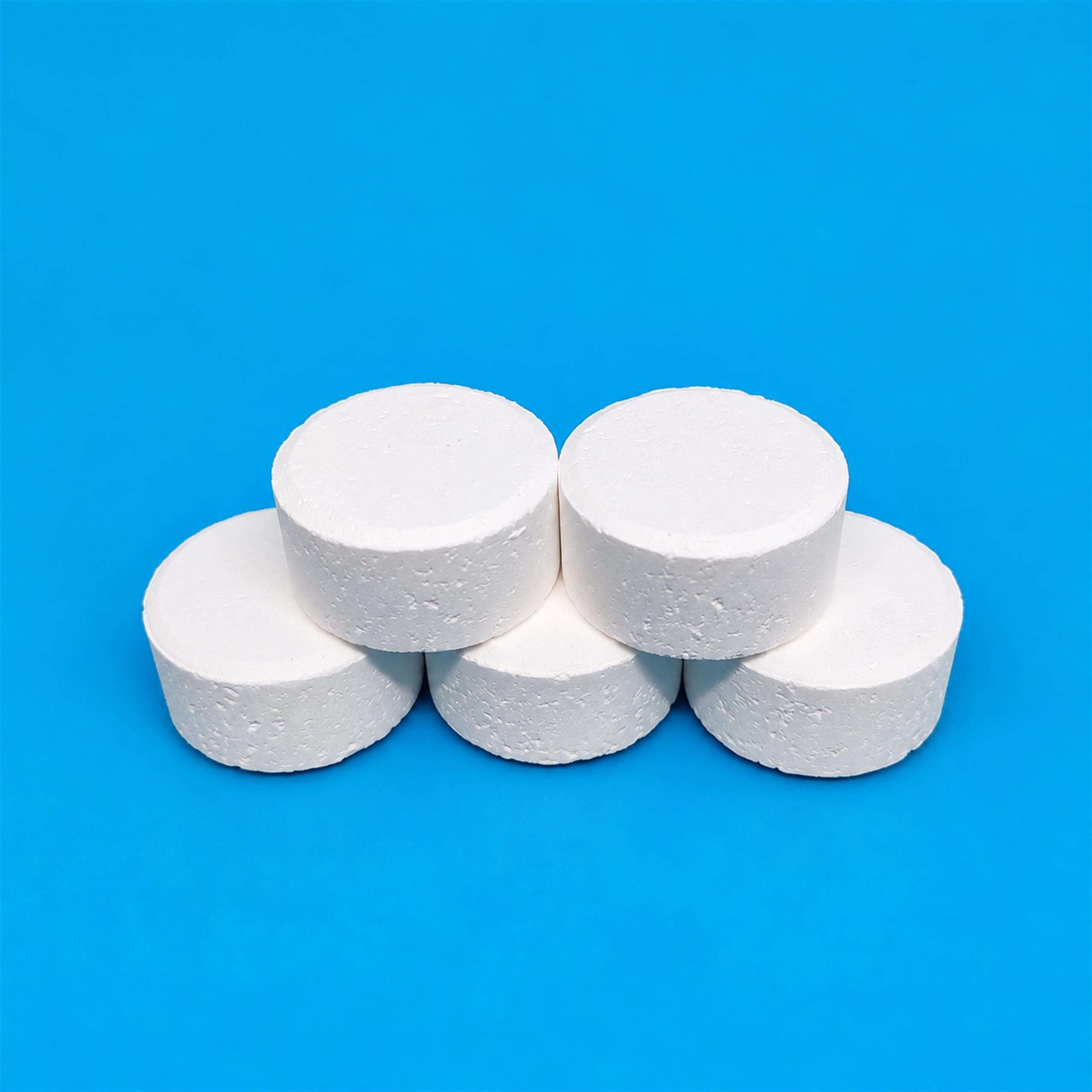
Can You Split a NaDCC Water Purification Tablet?
No — you should not split a NaDCC water purification tablet for dosing purposes. Tablets are manufactured to deliver a precise amount of available chlorine in a single unit, and cutting them compromises dose accuracy, stability, and safety. If you need a lower chlorine dose, use a lower-strength tablet or dissolve a full tablet in a larger volume of water instead of breaking it apart.
Why NaDCC Tablets Are Not Designed to Be Split
Formulation and Dose Integrity
Sodium dichloroisocyanurate (NaDCC, also known as troclosene sodium) water purification tablets are compressed or molded units that contain a fixed mass of active ingredient, typically alongside excipients such as binders, disintegrants, and sometimes effervescent components. Each tablet is engineered to release a defined quantity of available chlorine when dissolved in a specified volume of water.
When you split a tablet, you cannot guarantee that each half contains exactly 50 % of the active ingredient. Compression during manufacturing creates density gradients — the core and the surface may differ in composition. A simple cut with a knife or tablet splitter produces uneven halves, meaning one portion could deliver a significantly higher or lower chlorine concentration than intended. In water treatment, that margin of error can mean the difference between effective disinfection and inadequate treatment, or between safe residual levels and excessive chlorine exposure.
Rapid Degradation Once Broken
NaDCC is hygroscopic and begins to react with moisture as soon as its protective coating or compressed matrix is broken. A whole tablet retains its stability until it contacts water. A broken half-tablet exposes fresh surfaces to ambient humidity, accelerating degradation of the available chlorine. This means that even if you weighed both halves precisely, the actual chlorine available for disinfection may already be lower than the label claim by the time you use it.
Storing split portions is not a practical solution either. Without the original packaging seal, moisture ingress continues, and the remaining half loses potency quickly. There is no reliable way to know how much active chlorine remains in a split tablet that has been stored outside its original container.
Safety Risks of Splitting NaDCC Tablets
Dust and Irritation
Cutting or breaking a NaDCC tablet generates fine powder. Inhaling NaDCC dust can irritate the respiratory tract, eyes, and skin. The powder is also a strong oxidiser and can react with organic materials, including skin oils, causing irritation or minor burns. Working with a whole tablet that is simply dropped into water avoids this hazard entirely.
Uncontrolled Chlorine Release
When a tablet is broken into smaller pieces, the total surface area exposed to water increases dramatically if pieces are added separately. This can cause a rapid, localised release of chlorine gas — especially in warm or acidic water. The resulting spike in chlorine concentration can exceed safe limits for the intended application and may cause splashing or fumes that pose a risk to the person handling the water.
Handling Precautions That Apply Regardless
Even when using a whole tablet, standard precautions apply: handle NaDCC tablets with dry hands, avoid contact with eyes and skin, and never mix with acids or other chemicals that could generate chlorine gas. These precautions become more important, not less, when the tablet integrity is compromised by cutting.
What to Do If You Need a Lower Dose
Use a Lower-Strength Tablet
The most reliable approach is to select a tablet formulated for the dose you need. NaDCC water purification tablets are available in several standard strengths — commonly 1.5 g, 3.3 g, 3.5 g, and other sizes depending on the manufacturer and intended application. Choosing the correct tablet size eliminates the need to split and ensures the label dose matches your requirement.
Dilute a Full Tablet in a Larger Volume
If you only have one tablet strength available, dissolve the entire tablet in a larger volume of water than the minimum recommended. For example, if a 3.5 g tablet is designed for 10 litres, dissolving it in 20 litres roughly halves the chlorine concentration. This method maintains dose accuracy because the full tablet dissolves evenly, and you control the final concentration by the water volume — not by guessing how much active ingredient is in a broken piece.
Always verify the resulting concentration against your target chlorine residual for the specific application. Different uses — emergency drinking water, routine disinfection of storage containers, or point-of-use treatment — require different target residuals and contact times.
Pre-Dissolve and Dose by Volume
Another practical option is to pre-dissolve one or more whole tablets in a known volume of clean water to create a stock solution, then dose from that solution using a measured container. This is especially useful in field situations where multiple small volumes of water need treatment. The stock solution should be prepared fresh each day or stored in a cool, dark, sealed container for the shortest time possible, as available chlorine declines over time.
When Splitting Might Be Considered — and Why It Still Is Not Recommended
In some emergency or resource-limited scenarios, people have considered splitting tablets to stretch a limited supply. While the intention is understandable, the practical drawbacks outweigh any perceived benefit. Uneven dosing means some water may receive insufficient disinfection while other portions receive excess chlorine. The loss of potency in split halves means you may need to use more of the broken tablet anyway, negating the conservation goal. And the safety hazards of handling broken pieces in improvised conditions add unnecessary risk.
If supply is genuinely constrained, the better strategy is to contact a supplier or distributor for the correct tablet size for your volume of water, or to use a measured stock-solution approach with whole tablets.
Key Points to Remember
- NaDCC tablets are dose-specific units — splitting them destroys dose accuracy.
- Broken tablets degrade faster, so the chlorine you measure may already be lower than expected.
- Cutting generates irritating dust and risks rapid, uncontrolled chlorine release.
- Use a tablet of the correct strength, or dissolve a whole tablet in a larger water volume to achieve a lower concentration.
- Never split tablets to save supply — the safety and efficacy trade-offs are too high.
If you need to confirm the appropriate NaDCC tablet strength or concentration for a specific water volume and use case, contact ENVO CHEMICAL with your target water volume and intended application, and we can help identify the right product specification.
