
Short Answer
Polyphosphate treatment can reduce soap scum formation, but it does not prevent it the way a true water softener does. Polyphosphates work by sequestering a limited amount of calcium and magnesium and by interfering with scale crystal growth. They do not remove hardness from the water, so if your supply is genuinely hard, soap will still find calcium and magnesium to react with. The result is usually less curd, slower buildup, and easier cleaning — not a scum-free shower.
Whether you see a meaningful improvement depends on how hard the water is, how much polyphosphate is actually dissolving into the stream, how long the water is in contact with it, and the water temperature. This article explains the chemistry behind that answer, shows where polyphosphate and siliphos-type crystal media genuinely help, and lists what to confirm before you buy.
What Soap Scum Actually Is
Soap is a mix of sodium or potassium salts of fatty acids. When soap meets dissolved calcium or magnesium — the two ions that define water hardness — the calcium or magnesium displaces the sodium and forms an insoluble fatty-acid salt. That white, greasy, difficult-to-remove deposit is soap scum. It is an organic-inorganic hybrid, not the same material as limescale.
This distinction matters because the two problems have different causes and different fixes, and buyers frequently confuse them.
| Deposit | What forms it | Typical appearance | What addresses it |
|---|---|---|---|
| Soap scum (lime soap) | Soap reacting with dissolved Ca and Mg | White to grey curd, greasy film, sticky residue | Removing hardness, or sequestering it before soap contacts it |
| Limescale | Calcium carbonate and related minerals precipitating out of solution, often accelerated by heat and pH | Hard, chalky, crusty, often on heating surfaces | Scale inhibitors, softening, acid cleaning |
| Soap residue in soft water | Undissolved soap and body oils with no hardness to react with | Thin slippery film, rinses off readily | Less soap, better rinsing |
| Corrosion products | Iron or copper release from pipework | Red-brown or blue-green staining | Corrosion inhibitors, pH control |
If your cleaning test removes the film with an acidic descaler, it is probably mineral scale. If it smears and needs a surfactant or mechanical scrubbing, it is more likely soap scum. Many real-world cases are a mixture of both.
How Polyphosphate Treatment Works
Polyphosphates are chains of phosphate units. When dissolved in water they act through two main mechanisms, plus a third that is often bundled into the same product:
- Threshold inhibition. At very low concentrations, polyphosphate adsorbs onto the surfaces of growing mineral crystals and blocks them from developing into hard deposits. This is a scale inhibition effect, not hardness removal.
- Sequestration. Polyphosphate molecules can bind calcium, magnesium, and iron into soluble complexes, keeping them dissolved rather than letting them precipitate or react. Sequestration capacity is limited and roughly proportional to the amount of polyphosphate present.
- Corrosion control. In distribution systems, polyphosphates can form a thin protective film on metal surfaces, reducing iron and copper release and the staining and taste complaints that follow.
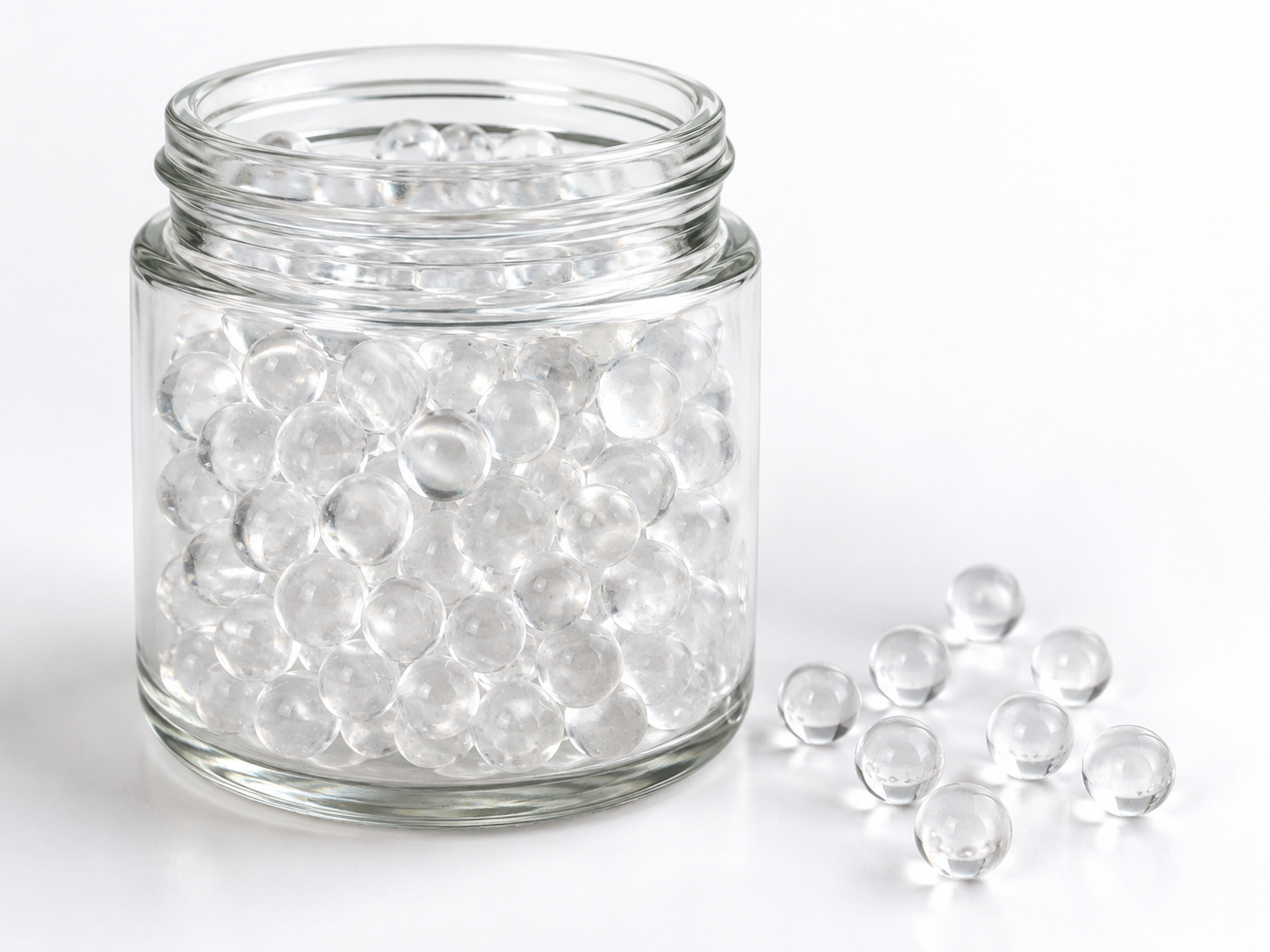
Siliphos-type crystal media are a practical delivery format for this chemistry: a slowly dissolving glassy polyphosphate crystal, often combined with silicate, placed in a cartridge or vessel so that water picks up a small dose as it passes through. Important caveat: not all products marketed as “siliphos,” “polyphosphate crystal,” or “phosphate media” are technically identical. Some are straight polyphosphate, some are polyphosphate-silicate blends, and dissolution behaviour differs significantly between them. Treat each product on its own data sheet.
None of these mechanisms is water softening. Softening by ion exchange physically removes calcium and magnesium from the water and replaces them with sodium or potassium. Polyphosphate leaves the hardness in the water and changes how it behaves. That difference is the whole answer to the title question.
Why the Answer Is “Reduce, Not Prevent”
For soap scum to be prevented outright, essentially all the free calcium and magnesium would need to be tied up before the soap arrives. Polyphosphate dosing for scale control is deliberately small — threshold treatment operates at concentrations far below the hardness concentration in hard water. A few milligrams per litre of phosphate cannot complex the calcium present in water carrying tens to hundreds of milligrams per litre of hardness as CaCO₃.
So the realistic outcome is:
- Some hardness ions are bound and no longer available to react with soap.
- Scale crystal growth is disrupted, so deposits that do form are softer, thinner, and easier to remove.
- Pipe surfaces and fixtures may stay cleaner for longer because a protective film reduces adhesion and corrosion staining.
- Visible soap scum still forms in hard water, especially in high-use areas such as showers.
Conditions that change the result
- Water hardness. At low hardness the same dose achieves proportionally more. At high hardness, the effect becomes marginal for soap scum.
- Temperature. Polyphosphates hydrolyse over time, and heat accelerates that breakdown into orthophosphate, which has much weaker sequestration behaviour. Hot-water circuits are therefore a poor fit for this chemistry, and some conditions can favour calcium phosphate deposition instead.
- Contact time and dose. A cartridge only doses what dissolves during the time water is inside it. High flow rates, intermittent use, and long stagnation all change the delivered concentration.
- Oxidants and pH. Chlorine and other oxidants can degrade polyphosphate, and pH affects both hydrolysis and the solubility of the complexes formed.
- Consumption rate. The crystal bed dissolves and depletes. Effectiveness falls off as the medium is used up, so service life must be defined for the actual conditions rather than assumed.
Because these factors interact, a supplier cannot responsibly promise a fixed percentage reduction in soap scum. Anyone who does is guessing.
Where Polyphosphate and Siliphos-Type Media Fit Best
These materials earn their place in specific jobs:
- Inhibiting scale in cold and moderately warm water lines, valves, and low-temperature equipment.
- Reducing iron and manganese staining and “red water” complaints in distribution systems.
- Extending the interval between descaling maintenance in appliances and fixtures.
- Corrosion control in ageing metal pipework where replacement is not practical.
- As a low-maintenance, low-cost partial measure where a full softener is not feasible.
They are the wrong tool when the objective is:
- Eliminating soap scum in hard water — that requires hardness removal.
- Softening water for laundry, dishwashing, or boiler feed.
- Removing existing scale — that is descaling, a different operation.
- Filtration of particulates, sediment, or microorganisms.
- Disinfection. Polyphosphate has no biocidal function.
A Practical Way to Decide
- Confirm the problem. Clean a test surface with an acidic descaler and separately with a surfactant cleaner. Note which one works. If the deposit is soap scum, hardness control is the lever.
- Get a water analysis. Total hardness as CaCO₃, calcium and magnesium separately, pH, alkalinity, iron, manganese, chlorine residual, and temperature. This is the minimum dataset.
- Define the objective. “No soap scum at all” and “less scum and easier cleaning” lead to different specifications.
- Match the technology to the objective. Ion exchange for hardness removal; polyphosphate for scale inhibition, sequestration, and corrosion control; a combination where both mineral scale and soap scum are present.
- Verify the product, not the category. Request composition, dissolution behaviour, and any third-party test data for the exact grade you intend to buy.
- Test before scaling up. Run a monitored trial on a single line or unit and compare before-and-after observations over a defined period.
What to Confirm Before Buying Polyphosphate Media
- Chemical form and phosphate content, expressed in a defined unit, plus any silicate or other co-components.
- Dissolution rate under stated flow, contact time, and temperature — and how that rate changes as the bed depletes.
- Particle size and physical form, and compatibility with your cartridge or vessel design.
- Recommended replacement or recharge criteria, given as observable or measurable indicators rather than a fixed calendar interval.
- Regulatory status for your destination market and application. Food grade does not automatically mean the product is approved for drinking water. Potable-water suitability must be verified for the exact product, the specific application conditions, and the market where it will be used.
- Material safety documentation and handling guidance.
Where a supplier cannot provide these, the honest position is that the performance in your system is unknown — not that it will work.
Frequently Asked Questions
Does polyphosphate treatment soften water?
No. It does not remove calcium or magnesium, so total hardness and total dissolved solids are essentially unchanged. It changes how those ions behave in solution.
Will it remove soap scum that has already formed?
No. Polyphosphate has no cleaning action. It may slow further deposition and make deposits easier to remove, but existing scum needs mechanical or chemical cleaning.
Can I use it instead of a water softener?
If soap scum elimination is the goal, no. A softener removes the hardness that causes scum. Polyphosphate is a partial measure that reduces scale and staining in specific applications.
Does it work in hot water?
Its effectiveness generally declines as temperature rises, because polyphosphates hydrolyse faster into orthophosphate. Confirm the temperature limits of the exact product with the supplier.
Is siliphos the same as every polyphosphate crystal?
No. Products sold under similar names vary in composition, blend ratios, and dissolution behaviour. Performance data from one product should not be applied to another.
Specifying the Right Material for Your Application
If soap scum is your main complaint, the first step is a hardness analysis, not a media purchase. If you also have scaling, iron staining, or corrosion in the same system, polyphosphate or siliphos-type crystal media may be worth evaluating as part of a combined treatment approach — provided the specification matches your water conditions.
To discuss a suitable grade or to check whether a polyphosphate-based approach fits your case, tell us: your application and equipment type, source-water hardness and other relevant parameters, flow rate and contact time available, water temperature, target objective (scale inhibition, corrosion control, or soap scum reduction), required specification or form, quantity, and destination market. With that information, ENVO CHEMICAL can advise on the most appropriate material and the data you should review before committing to a trial.
