
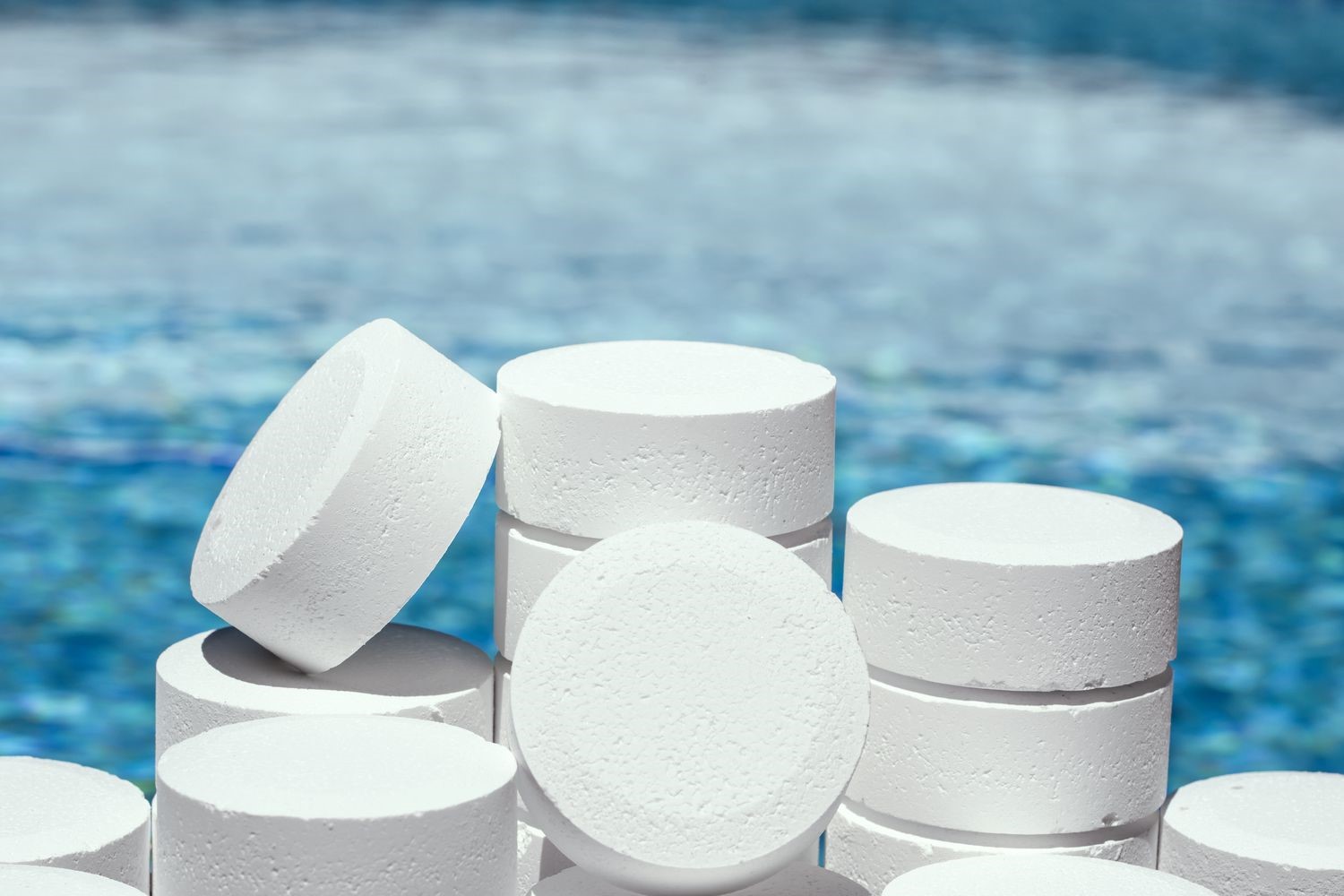
“Fine” and “coarse” describe how SDIC granules handle, not how well they disinfect. Choose coarse granules when dust control, flowability, and stable feeding matter most — for example manual scooping, volumetric feeders, floating dispensers, and sachet filling. Choose fine granules when fast dissolution or uniform distribution in a dry blend matters most — for example rapid stock solutions, low-dose blends, and direct compression. When a process demands both, the practical answer is usually a narrow mid-range cut with a capped fines content, not either extreme.
What “fine” and “coarse” actually mean in an SDIC specification
Sodium dichloroisocyanurate (SDIC, also written NaDCC) is sold as powder, fine granules, and coarse granules. These words are trade shorthand, not standardized definitions. Two suppliers can both ship “coarse granular” and deliver noticeably different material.
The only description that travels between suppliers is a particle size distribution (PSD) from a sieve analysis: the percentage retained on each sieve, the percentage passing the finest sieve, and the sieve series used. A single average or d50 value is not enough, because two lots with the same average can differ sharply in how much dust they generate or how evenly they feed.
Suppliers commonly quote coarse granular in the region of roughly 8–30 mesh and fine granular around 30–60 mesh, with powder below that, but the exact cuts vary by producer, plant, and crystal form. Treat any nominal mesh name as indicative and confirm it against actual sieve data for the grade you are buying.
Anhydrous and dihydrate are separate variables
SDIC is supplied as anhydrous material (typically around 60% available chlorine) and as the dihydrate (typically around 56%). The two differ in available chlorine content and in moisture behavior, so a PSD quoted for one form does not automatically describe the other. When you compare a fine and a coarse offer, confirm which form each sieve analysis was measured on before drawing conclusions.
Where fine and coarse granules behave differently
Dust and operator exposure
Fines produce more airborne dust during pouring, scooping, blending, and equipment cleaning. SDIC dust is an oxidizing, irritating solid, so more dust means more reliance on local exhaust ventilation, respiratory protection, enclosed transfer, and housekeeping. Residual dust on surfaces also raises the chance of accidental contact with incompatible materials. Coarse granules reduce — but do not eliminate — this problem, and they still generate fines through attrition in transit.
Dissolution rate
For the same chemistry and the same agitation, a finer granule dissolves faster because it presents more surface area per unit mass. Coarse granules dissolve more slowly and can leave a residue if the water is cold, hard, or poorly agitated. Dissolution also depends on the rest of the formulation, so a “fast-dissolving” claim must be tied to a defined test, not to granule size alone. If a dosing system or a contact-time claim depends on rapid dissolution, verify the specific product under your own water conditions.
Flow, feeding, and caking
Coarse, narrowly graded granules flow more freely through hoppers, augers, and volumetric feeders, and they resist bridging and rat-holing better. Fine material tends to compact, cake under humidity or stacking pressure, and feed unevenly. If your process uses a dry feeder or an erosion-type dispenser, inconsistent flow changes the applied dose even when the assay is correct.
Segregation in dry blends
In a blend containing other powders, particles of different sizes separate during filling, pouring, and vibration. Matching the SDIC PSD to the rest of the blend matters more than simply choosing fine or coarse. Where SDIC is a small fraction of the blend, fines usually distribute more uniformly, but they also increase dust and can settle differently from coarser excipients.
Tableting and downstream processing
Fine granules are generally closer to directly compressible, while coarse granules often need milling first — which reintroduces dust and fines. For sachets and water-soluble film packaging, coarse granules are usually preferred because fines contaminate seal areas and increase the risk of film damage.
Side-by-side comparison
| Practical factor | Coarse granules | Fine granules |
|---|---|---|
| Dust generation | Lower | Higher |
| Dissolution rate, same conditions | Slower | Faster |
| Flow and feeder consistency | Generally better | Prone to bridging and caking |
| Blend uniformity at low dose | Less uniform | More uniform |
| Tableting | Usually milled first | Often usable directly |
| Losses during handling | Lower | Higher |
| Typical priority | Dust control, flow, controlled release | Speed of dissolution, blending |
How to choose: start from the dosing method
Work backwards from how the product leaves your container or equipment. That single question usually settles the specification.
- Manual scooping or pouring: coarse granules, for dust control and reduced spillage.
- Volumetric or gravimetric dry feeder: coarse, free-flowing granules with a controlled fines limit, so the delivered mass per stroke stays repeatable.
- Erosion or floating dispenser: coarse granules, because a high fines fraction can flush out too quickly and create a short-lived, uneven concentration.
- Rapid stock solution preparation: fine granules, with the dissolution test conditions agreed in advance.
- Dry blending with other powders: match the PSD to the co-formulated ingredients, then cap the fines fraction at a level your dust controls can handle.
- Tablet production: fine granules, or accept that coarse material must be milled and re-screened.
- Sachets and water-soluble film: coarse granules, to keep seal areas clean.
Note that granule size does not fix the dosage. Applied dose, contact time, and required chlorine residual are separate decisions that must be supported by verified data for the exact product and the exact use — a pool product, a drinking-water product, and a surface-sanitizing product are not interchangeable, and “food grade” alone does not establish drinking-water suitability.
Writing a practical granule specification
A specification that can actually be checked on arrival should contain more than a mesh name:
- Form: anhydrous or dihydrate.
- Available chlorine: as a mass percentage, with the test method referenced.
- PSD: percentage retained on at least two sieves, the percentage passing the finest sieve, and the sieve series used.
- Fines limit: a maximum percentage below the finest sieve, since this drives both dust and dissolution behavior.
- Bulk density: poured and tapped, because it determines feeder calibration and package fill.
- Moisture content: relevant to caking, stability, and flow.
- Attrition or friability: how much fines the granules generate after handling and transport, not just at the plant gate.
- Solubility test conditions: water temperature, hardness, agitation, and time, if fast dissolution is part of the requirement.
Sample the delivered lot rather than relying only on the certificate — check the top and bottom of the container, since segregation during shipping can put fines and coarse material in different layers.
Safety limits that apply to either size
Fine and coarse SDIC are the same oxidizing chemistry. Both must be kept dry, away from acids, ammonia and ammonium compounds, reducing agents, and other chlorinating or oxidizing products. Never mix SDIC with another chemical to “boost” performance, and never improvise a handling procedure outside the supplier’s safety data sheet. Fine granules simply raise the exposure and contamination stakes, so dust control, dedicated equipment, and appropriate personal protective equipment become more important, not optional. Confirm current regulatory and transport requirements for your market before finalizing a specification.
Quick answers to common questions
Does finer SDIC dissolve faster?
Generally yes, under the same conditions, because of greater surface area. Temperature, hardness, agitation, and the rest of the formulation can outweigh the size effect, so test the actual product.
Is coarse SDIC stronger?
No. Available chlorine is a mass-based assay and does not change with granule size. Size changes dissolution rate, dust, and flow.
Can fine and coarse be substituted without other changes?
Not safely by default. A swap can shift feeder output, dust levels, dissolution time, and blend uniformity, any of which may invalidate a dose or a process claim.
If you are specifying SDIC granules for a particular dosing method, share your form (anhydrous or dihydrate), target sieve limits, and how the product is fed or dissolved, and ENVO CHEMICAL can confirm which granulation matches that requirement.
