
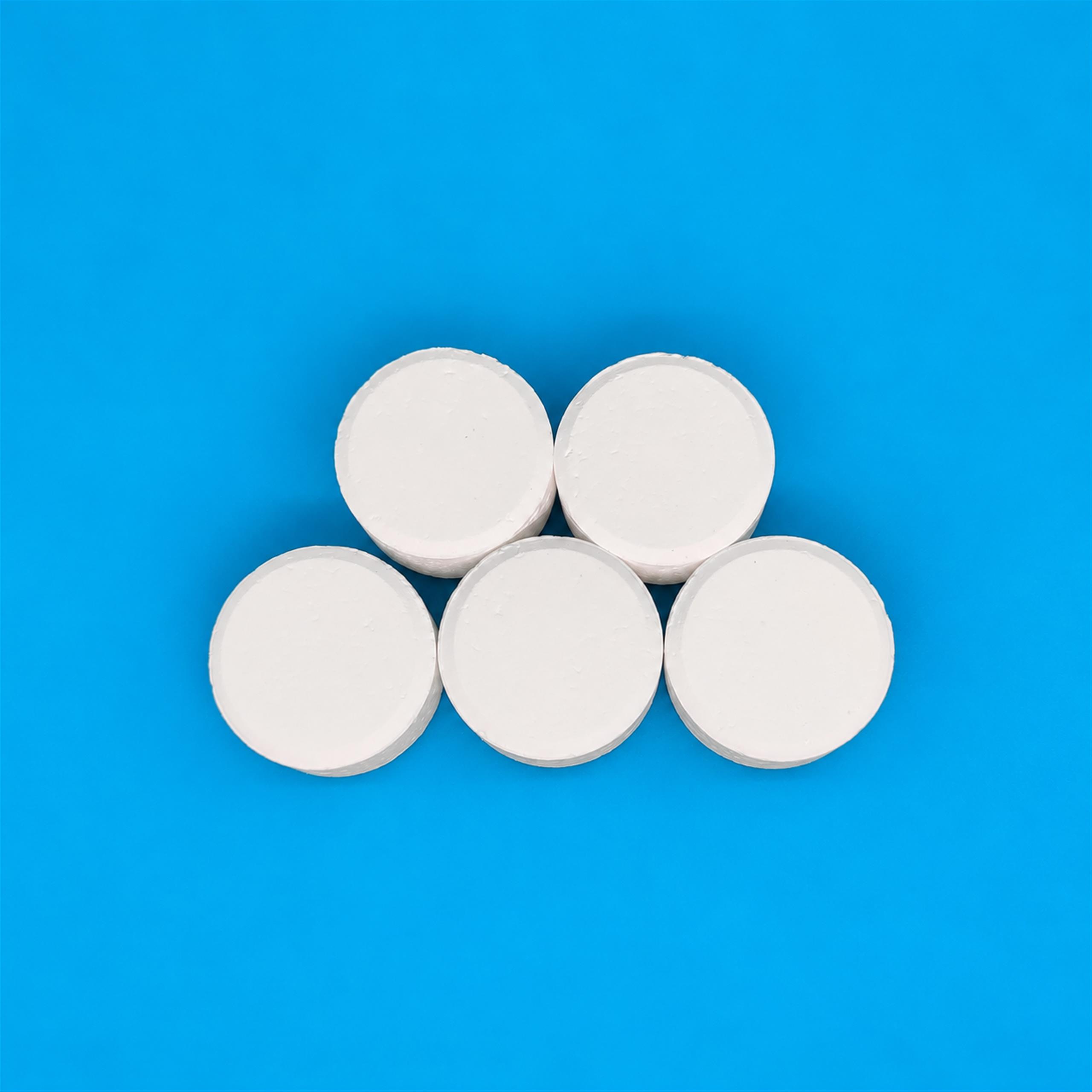
Compare NaDCC Bids by Normalizing to Cost per Gram of Available Chlorine
The only reliable way to compare NaDCC bids that list different tablet counts and different available-chlorine strengths is to convert every offer to a single common unit—typically the price per gram (or per kilogram) of available chlorine. A bid quoting 500 tablets of 1.5 g each at 55 % available chlorine is not directly comparable to one quoting 1,000 tablets of 3 g each at 50 % available chlorine unless both are reduced to the same basis.
If you skip this step, you risk selecting a bid that looks cheaper on a per-tablet or per-package basis but actually delivers less active ingredient for your money—or the opposite, overpaying for a higher declared strength that does not translate into proportionally more usable chlorine in your application.
Why Tablet Count and Strength Alone Mislead
A NaDCC bid typically presents three numbers: total tablet count, individual tablet weight, and declared available-chlorine percentage. None of these alone tells you what you are paying for. Two common sources of confusion are:
- Tablet count without strength context. One thousand 1-g tablets at 55 % available chlorine contain 550 g of available chlorine. Five hundred 3-g tablets at 50 % contain 750 g. The second bid supplies 36 % more active ingredient despite fewer tablets.
- Strength without mass context. A 60 % strength claim on a 0.5-g tablet delivers 0.3 g of available chlorine per tablet. A 50 % claim on a 5-g tablet delivers 2.5 g. Per-tablet pricing obscures this ten-fold difference in active content.
The declared percentage also needs scrutiny. NaDCC is commonly supplied as the anhydrous form (theoretical available chlorine ≈ 60 %) or as the dihydrate (theoretical ≈ 50 %). Bids must specify which form is being offered; mixing these without adjustment produces an invalid comparison.
Step-by-Step Method to Normalize Any Bid
Step 1: Confirm the Chemical Form and Declared Available Chlorine
Before any arithmetic, verify whether the bid refers to anhydrous NaDCC or NaDCC dihydrate and confirm the declared available-chlorine percentage. This figure is usually expressed as a percentage of the tablet mass, not of the theoretical maximum. If the bid does not state the form, request clarification—anhydrous and dihydrate tablets of the same weight carry different amounts of available chlorine.
Step 2: Calculate Total Available Chlorine per Bid
Use this formula for each bid:
Total available chlorine (g) = Tablet count × Tablet weight (g) × Available-chlorine % (decimal)
Example A: 1,000 tablets × 1.5 g × 0.55 = 825 g available chlorine.
Example B: 500 tablets × 3 g × 0.50 = 750 g available chlorine.
At this point you can see which bid supplies more active ingredient in total.
Step 3: Derive Cost per Gram (or per Kilogram) of Available Chlorine
Divide the total bid price by the total available chlorine you just calculated:
Cost per g available chlorine = Bid price ($) ÷ Total available chlorine (g)
If Example A costs $412.50 and Example B costs $375.00:
- Example A: $412.50 ÷ 825 g = $0.50 per g
- Example B: $375.00 ÷ 750 g = $0.50 per g
In this case both bids are equivalent on an active-ingredient basis, even though their tablet counts and strengths differ. Without this calculation, a buyer focusing only on the lower headline price ($375 vs $412.50) would incorrectly conclude that Example B is the better deal.
Quick-Reference Comparison Table
| Bid | Tablet count | Tablet weight | Available Cl (%) | Total available Cl (g) | Bid price ($) | $ per g available Cl |
|---|---|---|---|---|---|---|
| A | 1,000 | 1.5 g | 55 | 825 | 412.50 | 0.50 |
| B | 500 | 3.0 g | 50 | 750 | 375.00 | 0.50 |
| C | 2,000 | 1.0 g | 60 | 1,200 | 540.00 | 0.45 |
Bid C, despite the highest headline price, delivers the lowest cost per gram of available chlorine and would be the most economical on an active-ingredient basis.
Additional Factors That Affect the Comparison
Packaging and Net-Weight Tolerances
Some bids quote gross package weight rather than net tablet weight. Confirm whether the stated tablet weight is the individual tablet mass or an average that includes coating or binder. A 5 % variance in tablet weight across a large batch meaningfully changes the total available chlorine.
Minimum Order Quantity and Shipping
A lower cost per gram of available chlorine is only useful if the order quantity meets your operational need and if logistics costs do not erase the margin. Factor freight, customs duties, and storage requirements into the total landed cost before deciding.
Stability and Shelf Life
NaDCC tablets lose available chlorine over time, especially if exposed to moisture or heat. A bid that offers a lower cost per gram but requires you to hold inventory for many months may deliver less usable chlorine at the point of application. Verify shelf-life claims and storage conditions in the bid documentation.
Safety and Handling Compliance
Higher-strength tablets release chlorine more rapidly on dissolution. Confirm that the application method and dosing equipment are rated for the tablet strength in question. Do not alter tablet strength by crushing or subdividing unless the supplier explicitly states the product is suitable for that practice.
When a Higher Declared Strength Does Not Mean Better Value
A bid advertising 60 % available chlorine on a very small tablet may look impressive but could cost more per gram of active ingredient than a 50 % product in a larger tablet. Always run the normalization calculation. The percentage is a concentration; the total active mass delivered per dollar is what determines value.
Likewise, do not assume that a higher tablet count automatically means a better bid. More tablets of a weaker product can still underperform fewer tablets of a stronger one—or they can outperform, but only the math will tell you.
Contact ENVO CHEMICAL for a Bid Comparison Review
If you have received multiple NaDCC bids with different tablet counts and strengths and want help normalizing them to available-chlorine cost, share the tablet count, individual weight, declared available-chlorine percentage, and quoted price from each offer, and we will run the comparison with you.
