
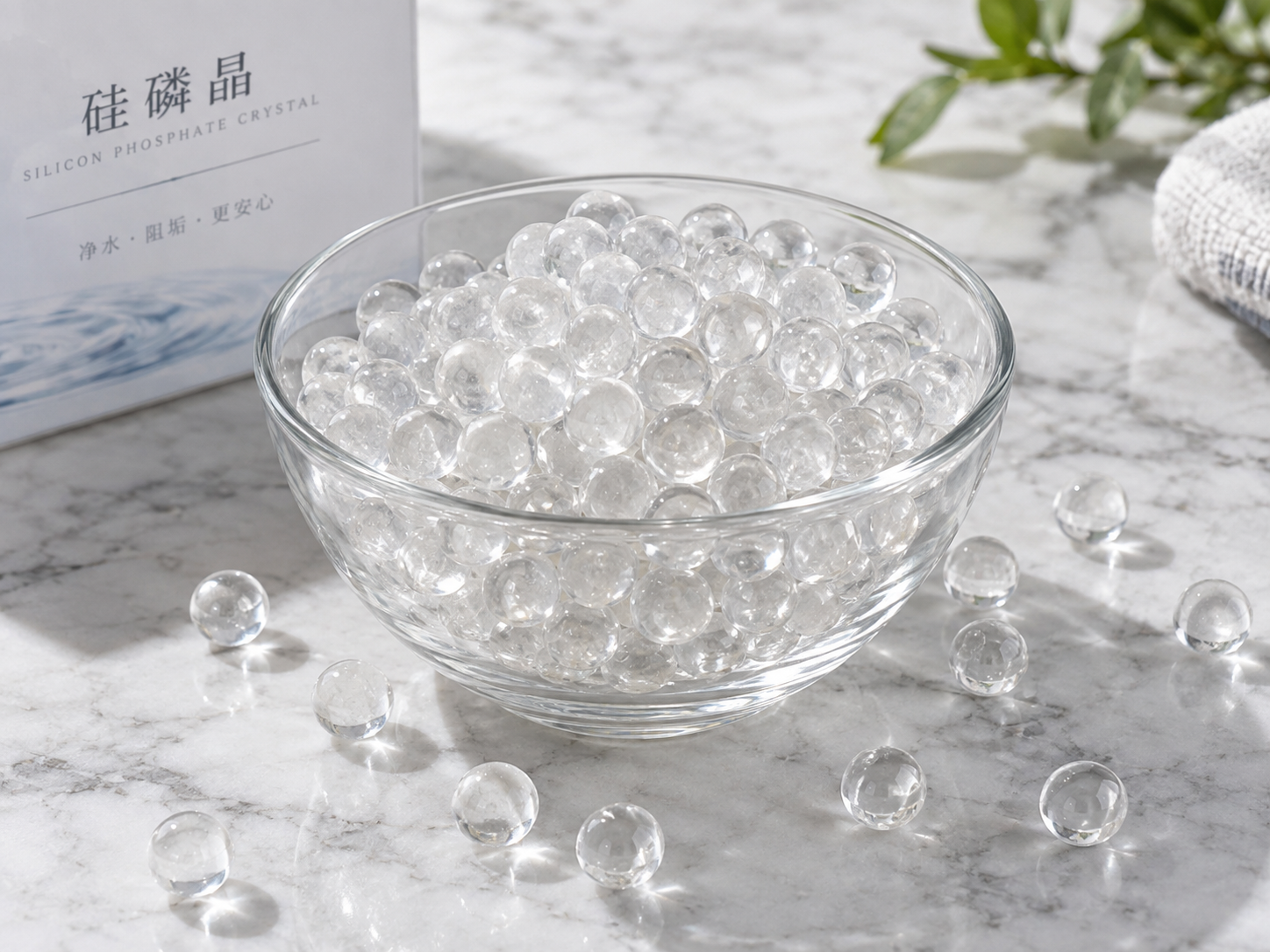
Polyphosphate consumption and filter clogging are two different failure modes, and they are usually confused because both end with the same complaint: “the unit stopped working.” Consumption is a consumable being used up — the polyphosphate crystal dissolves into the water as it treats it, so the media bed shrinks and eventually disappears. Clogging is a blockage — suspended solids, precipitated iron or scale, or biofilm accumulate in a filter cartridge or bed until flow is restricted and differential pressure rises. One is a slow chemical dissolution process; the other is a physical loading process. A single housing can suffer from both, which is exactly why the two get blamed for each other.
Why the two problems get mixed up
Three practical reasons cause the confusion.
- They share hardware. Point-of-entry and cartridge systems often place a polyphosphate medium and a sediment or carbon filter in the same housing or in the same sequence. The user sees one device and assumes one cause.
- They produce a similar end result. Scale returns, water quality drops, or flow weakens — regardless of which mechanism failed.
- “Consumption” sounds like dirt. Many end users assume the polyphosphate is “filling up with impurities” and being consumed by them. It is not. The crystal dissolves by design; that is how it delivers polyphosphate into the water.
It also helps to separate product identities. Siliphos is a brand name associated with a specific glassy polyphosphate material. Not every “polyphosphate crystal,” “phosphate crystal,” or “siliphos crystal” sold on the market is chemically or physically identical, and dissolution behavior can differ between grades, mesh sizes, and manufacturing processes. Treat trade names as a starting point, not a specification.
What polyphosphate consumption actually means
Polyphosphate media are sacrificial. As water passes through the bed, the glassy phosphate slowly dissolves and releases polyphosphate species into the water. Those species interfere with the formation of hard carbonate scale, help keep iron and manganese from precipitating as stains, and can support a thin protective film inside metal piping. This is scale inhibition and, in some cases, corrosion inhibition — not softening, not filtration, and not disinfection. Hardness minerals remain in the water.
What drives the dissolution rate
Consumption is not a fixed calendar interval. It responds to the conditions of use:
- Volume of water treated. The more water that passes the bed, the more phosphate is released.
- Flow rate and contact pattern. Flow that channels through part of the bed can exhaust one path before the rest of the media is used.
- Water temperature. Dissolution generally accelerates as temperature rises. This is also why polyphosphates are usually described as effective in cold-water applications: at higher temperatures, polyphosphates tend to hydrolyze toward orthophosphate, which is a far weaker scale inhibitor and can itself contribute to deposits.
- Water chemistry. pH, hardness, and dissolved solids influence how the material behaves.
- Media form. Crystal size, density, and the specific glassy composition change how quickly the bed gives up its phosphate.
What consumption looks like in practice
You will see the media level drop, a cavity or void form, or the crystals become visibly fewer and thinner. Flow and differential pressure often stay reasonably stable until the bed is nearly gone. The first symptom is usually a return of the problem the phosphate was controlling: scale on a heating element, brown staining, or a complaint that “the treatment stopped working.”
What filter clogging actually means
Clogging is a hydraulic problem. Material that should not pass through the filter collects in it: silt, sand, rust particles, precipitated iron, calcium carbonate scale, organic matter, or biofilm. As the pores or the bed void spaces fill, resistance to flow increases. The consequences are measurable:
- Differential pressure across the cartridge or bed rises.
- Flow rate at a given supply pressure falls.
- Channeling or bypass can develop, so some water passes untreated.
- Filter changes become more frequent than the schedule predicts.
Clogging is not consumption. A clogged filter still contains all of its filtration media. A consumed polyphosphate bed still contains its housing, but less — or none — of the phosphate crystal. Adding more polyphosphate will not clear a blockage, and replacing a blocked filter will not slow down dissolution.
Side-by-side comparison
| Aspect | Polyphosphate consumption | Filter clogging |
|---|---|---|
| Mechanism | Gradual dissolution of the phosphate medium into the water | Accumulation of solids and deposits in the filter medium |
| What depletes | The treatment medium itself | The open space and flow area inside the filter |
| Primary symptom | Loss of scale or corrosion control; visible reduction in the crystal bed | Rising differential pressure; falling flow; short filter runs |
| Best measurement | Media bed inspection, treated water volume, and phosphate residual if the supplier provides a target range | Pressure drop readings taken when new and in service |
| Typical triggers | High treated volume, high flow, elevated temperature, aggressive water chemistry, wrong grade for the application | High turbidity, iron or manganese precipitation, hardness scaling, biofilm, undersized cartridge or bed |
| Corrective action | Replenish or replace the phosphate medium; correct sizing and grade | Clean or replace the filter element; fix the source of solids; add appropriate pre-filtration |
| Does not help | Backwashing or flushing the phosphate bed | Adding more phosphate medium |
How to diagnose which one you have
Work through the system in order rather than guessing.
- Record baseline data. Note new-cartridge differential pressure, flow rate, and the water volume treated per day. Without a baseline, “high” pressure drop means nothing.
- Open the housing and look. A low or empty crystal bed points to consumption. A full but dark, coated, or compacted element points to clogging. Both can be present.
- Check the sequence. If the polyphosphate sits downstream of a filter that is loading up, the phosphate bed may be receiving less flow than intended — or seeing it unevenly.
- Test the water. Hardness, iron, manganese, turbidity, pH, and temperature explain most of what is happening. If the supplier specifies a phosphate residual range for the product, measuring it helps confirm whether the medium is still releasing phosphate.
- Compare service intervals. A bed that empties far earlier than expected relative to treated volume usually points to sizing, temperature, or grade. A filter that blocks far earlier than expected points to source-water solids or pre-filtration gaps.
How to explain it to an end user
A short, concrete explanation works better than a technical lecture:
“The polyphosphate crystals are meant to dissolve — they are a consumable, like a bar of soap in the water. When they are gone, we add more. The filter is meant to catch dirt — it fills up but does not dissolve. When it fills up, we clean or change it. So a shrinking crystal bed and a blocked filter are two different things, with two different fixes.”
Then show the two measurements that matter: the media level in the housing, and the pressure drop across the filter. Once a user tracks those two numbers, they rarely confuse the two problems again.
Frequently asked questions
Can a clogged filter make polyphosphate crystals dissolve faster?
Clogging changes hydraulics, not chemistry. A partially blocked element alters flow distribution and contact time, so the bed may appear to deplete faster or slower depending on how the water moves through it. It cannot chemically “consume” the crystal. Confirm the actual cause with the media supplier before changing the replacement interval.
Does polyphosphate crystal soften water?
No. It does not remove calcium or magnesium. Softening requires ion exchange or another removal process. Polyphosphate works by inhibiting scale formation and, in some conditions, supporting corrosion control. Hardness remains in the water and can still be measured.
Is every “siliphos crystal” the same material?
No. Siliphos is a brand designation. Different suppliers offer different glassy polyphosphate compositions, particle sizes, and dissolution characteristics. Ask for the material’s actual specification rather than relying on the trade name.
Why did my phosphate bed disappear in a few weeks?
There is no universal service life. Consumption depends on treated volume, flow rate, temperature, water chemistry, and the grade used. Compare the media consumption against the volume of water treated, not against the calendar, and ask the supplier to confirm the expected consumption range for the specific product under your conditions.
Do I need a sediment filter with a polyphosphate cartridge?
Often yes, because particulate matter can foul or bypass the phosphate bed, and the phosphate medium itself can release fines that are better captured downstream. The correct configuration, micron rating, and sequence depend on the source water and the equipment — confirm with the supplier rather than assuming.
What to confirm before ordering
Consumption rates, suitable temperature and pH windows, hardness limits, flow per cartridge, and replacement criteria must come from the manufacturer’s data for the exact product you intend to buy. Do not transfer specifications from one datasheet or one brand to another. If you are evaluating polyphosphate grades alongside filtration options, ENVO CHEMICAL can confirm the technical data and recommended operating conditions for the specific material it supplies.
If you would like help distinguishing consumption from clogging in your own system, send us the details that matter for that diagnosis: the equipment and housing type, current filter micron rating, source-water analysis (hardness, iron, manganese, turbidity, pH, and temperature), flow rate and daily treated volume, observed differential pressure readings, media bed condition, the specification you require, quantity, and destination market. With that information, we can respond on the material and configuration rather than on general assumptions.
