
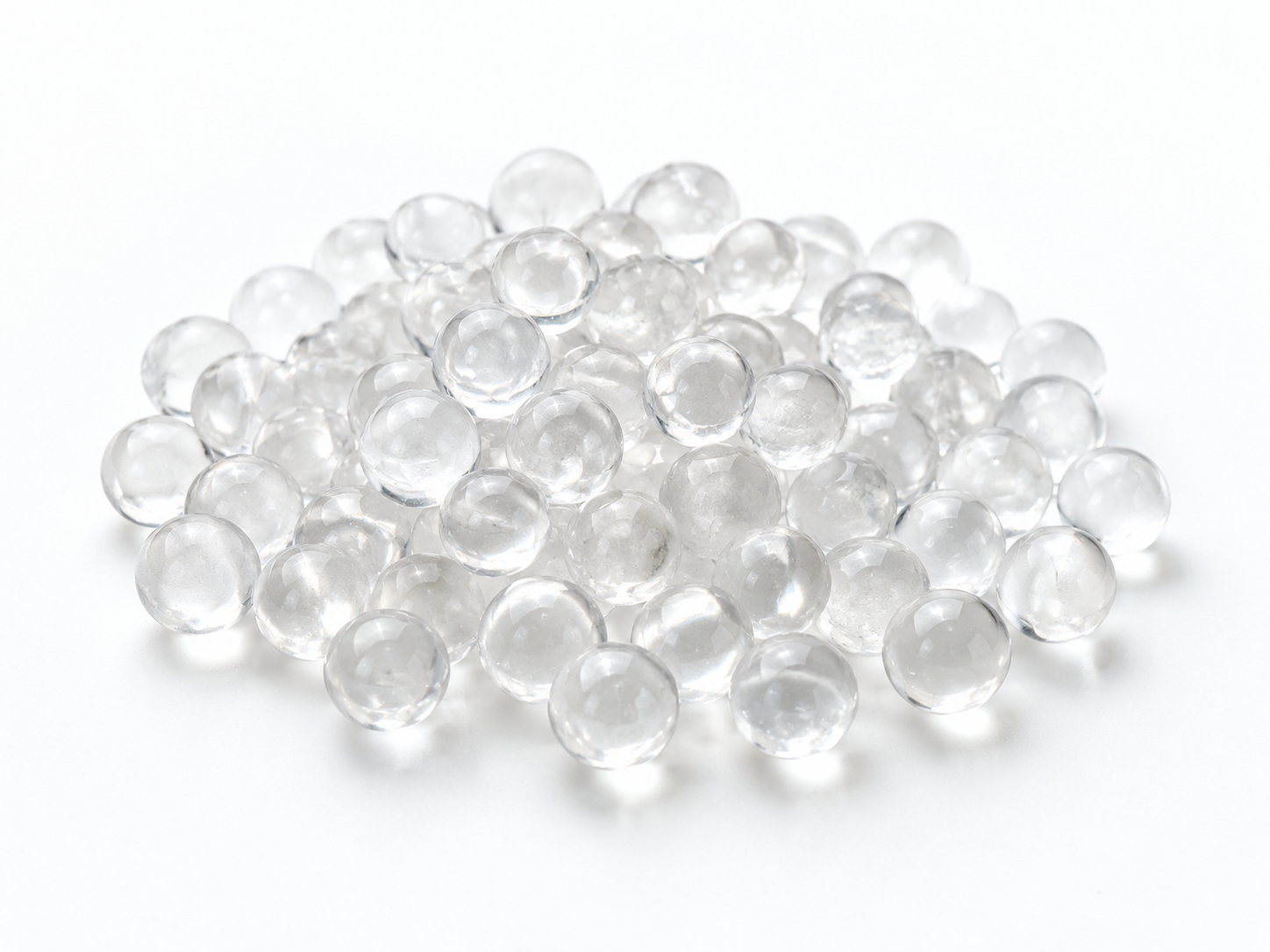
Do not approve or reject an alternate grade by email alone. Treat the request as a change-control event: confirm what is actually different, compare it against a written functional specification rather than the trade name, request documented evidence, and decide whether a lab test, a limited field trial, or a full requalification is required. If you cannot confirm equivalence on paper and in test data, the safest answer is to hold the original grade or accept the alternate only for a clearly bounded trial.
This applies whether you buy siliphos crystal, a phosphate-silicate glass media, sodium hexametaphosphate (SHMP), or another polyphosphate for scale and corrosion control. These materials are not automatically interchangeable, and a supplier’s statement that the alternate is “the same” is a starting point for verification, not a conclusion.
First, Establish What Kind of Change You Are Being Asked to Accept
“Alternate grade” can describe very different situations, and each carries a different level of risk:
- Same product, different production line or plant. The specification is nominally identical, but trace impurities, particle size distribution, or dissolution behavior may still shift.
- Same chemistry, different physical form. For example, a different particle size cut, a different crystal or glass form, or a change from granular to a finer or coarser fraction.
- Different formulation within the same product family. Different sodium-to-phosphate ratio, different silicate content, or a different degree of polymerization. These changes affect how fast the material dissolves and how it behaves in the water.
- A competitor’s “equivalent.” The supplier may be substituting another manufacturer’s material that meets a generic description but not your original specification.
Ask the supplier to state plainly which of these applies, in writing. The answer determines how much verification work you need.
Write Down What the Material Must Do Before You Compare Documents
Most purchasing disputes start because the buyer ordered a brand name and the supplier shipped to a generic description. Before evaluating the alternate, write a short functional specification covering:
- The technical objective: scale inhibition, corrosion control, sequestration of hardness ions, or a specific combination of these. These are different functions and are not interchangeable.
- Where the material sits in the system: cartridge, feeder, dosing pot, or bulk dosing, and the contact time and flow condition it experiences.
- The physical requirements the equipment imposes: particle size range, bulk density, and how the material dissolves or is released.
- Any regulatory constraints on the finished product, including the market where the treated water or equipment will be sold.
- The documentation you need for your own quality system.
With this in hand, you can compare the alternate against requirements instead of against a product name.
Documentation to Request From the Supplier
Request the following before agreeing to anything. A supplier that cannot supply these items is not in a position to demonstrate equivalence.
| Item | Why it matters | What to check |
|---|---|---|
| Technical data sheet for the alternate grade | Defines the claimed chemistry and physical form | Composition, form, particle size range, bulk density, intended application |
| Certificate of analysis for the offered batch | Shows actual values, not just specification limits | Measured phosphate content, moisture, particle size, impurities against your original material |
| Safety data sheet | Required for handling, storage, and transport | Hazard classification, incompatibilities, storage conditions |
| Declared oxide ratio or equivalent composition data | This drives dissolution behavior and film formation | Whether the ratio matches your qualified material, not just the product family |
| Particle size distribution (sieve analysis) | Affects dissolution rate, feeder performance, and dosing consistency | Whether the curve fits your equipment and your qualified range |
| Dissolution rate or solubility data | Determines service life and treatment performance | The test method used and whether it matches your application conditions |
| Heavy metals and impurity limits | Regulatory and product-safety relevance | Limits and analytical methods, with the batch result |
| Certifications or approvals claimed for the exact grade | Market access and application legality | Whether the certificate names the specific grade and the specific application |
| Packaging, storage, and shelf-life statement | Affects inventory planning and handling | Packaging type, net weight, storage conditions |
Ask for the documents for the exact grade code being offered. A certificate issued for a different grade or a different plant does not cover the material you are being asked to accept.
Comparing the Alternate Against Your Qualified Material
Build a side-by-side comparison and mark each line as “matches,” “different but acceptable,” or “must be tested.” The attributes that most often cause problems are:
- Base chemistry: SHMP, sodium tripolyphosphate (STPP), and phosphate-silicate glass media such as siliphos crystal are chemically distinct materials with different dissolution behavior and different effects on the water. They are not substitutes for one another without requalification.
- Silicate content, where applicable: this influences film formation in some corrosion-control applications and is not present in all polyphosphates.
- Particle size and form: a finer material generally dissolves faster; the same mass of media can therefore deliver a different phosphate concentration over time, and may behave differently in a feeder or cartridge.
- Moisture and hygroscopicity: affects caking, flow, and storage life.
- pH effect and residual behavior: relevant if your product has to meet a finished-water specification.
- Trace impurities: relevant for potable-water and food-contact applications.
Be explicit about which differences are acceptable. A difference in particle size may be tolerable in a bulk dosing system and unacceptable in a cartridge where contact time and release rate are fixed by design.
When a Lab Test or Field Trial Is Necessary
Testing is necessary whenever the change touches something your qualification was built on: base chemistry, oxide ratio, silicate content, particle size distribution, or dissolution rate. Paper comparison alone is usually sufficient only when the change is administrative — same grade, same specification, different plant or packaging — and the supplier provides batch data confirming it.
A workable sequence is:
- Confirm the change is documented and the specification has not moved.
- Request a representative sample of the alternate grade, with its batch number.
- Compare it to a retained sample of your current material: appearance, particle size, bulk density, and dissolution behavior under conditions that resemble your application.
- If bench results are acceptable, run a bounded field trial on a defined portion of the system, with agreed monitoring parameters and a defined end point.
- Record the result and either approve, approve with conditions, or reject.
Do not run a trial on live installations where a failure would be costly or difficult to reverse without a fallback plan and a defined monitoring period.
Regulatory and Application Limits You Cannot Trade Away
Some constraints are not commercial questions. If the treated water is intended for drinking, the material must be verified as suitable for that exact product, application, and destination market. Food-grade status alone does not establish drinking-water suitability; these are different assessments, and approvals are usually issued to a specific grade and sometimes to a specific use.
Similarly, do not accept a certificate that lists a product family rather than the grade code you are buying. Where a local approval is required, ask the supplier to confirm in writing that the alternate grade is covered, and verify with the certificate itself.
Handling the Commercial and Quality Side of the Request
Grade substitution is often proposed because of availability or price. Those are legitimate business factors, but they should be handled separately from the technical decision.
- Change notification: require the supplier to notify you in advance of any change to grade, plant, process, or raw material source, and to keep a record of approvals.
- Cost of requalification: if testing is required, decide in advance who pays and who carries the risk if the trial fails.
- Commercial terms: if the alternate is accepted, pricing, minimum order quantity, lead time, packaging, and batch traceability should be confirmed in writing for the approved grade.
- Reversibility: ask whether the original grade remains available if the alternate is rejected, and for how long.
- Documentation updates: if you accept the change, update your own specifications, labels, instructions, and any approvals that reference the material.
A price reduction rarely compensates for a failed trial, a warranty claim, or a regulatory problem in the destination market.
A Practical Decision Path
- Get the change in writing: what is different, and why.
- Check the alternate against your functional specification, not the trade name.
- Request TDS, COA, SDS, composition data, particle size data, and any approvals for the exact grade.
- Classify the change as administrative, minor, or significant.
- For significant changes, test a sample and, if acceptable, run a bounded trial.
- Get quality, regulatory, and production sign-off before releasing the change.
- Record the decision, the evidence, and the conditions of approval.
At ENVO CHEMICAL, grade and specification questions are usually answered with reference to the application, the source water, and the equipment the material will be used in, rather than from a generic data sheet alone.
Frequently Asked Questions
Is a different particle size an acceptable substitution?
Only if your equipment and dosing design tolerate it. Particle size affects dissolution rate and release consistency, so a substitution that is fine in a bulk feeder may not be fine in a cartridge or dosing pot. Verify against your qualified range rather than assuming.
Can food-grade polyphosphate be used in drinking water?
Not automatically. Food-grade status and drinking-water suitability are separate assessments. Confirm that the exact grade, the application, and the destination market are covered by the relevant approval, and obtain the supporting certificate.
The supplier says the alternate is chemically identical. Do I still need testing?
If the base chemistry, oxide ratio, silicate content, and particle size distribution are truly unchanged and the batch data confirms it, a full trial may not be necessary. If any of these differ, or if the supplier cannot document them, test before switching.
What if the alternate is the only grade available?
Treat it as a temporary, bounded substitution rather than a permanent change. Define the quantity or period covered, monitor performance against agreed parameters, and keep the original specification on file so you can return to it.
Who should approve the change internally?
Usually a combination of quality, technical or engineering, and procurement. Regulatory or product-safety input is also needed where the material affects a certified or regulated finished product.
Send the Details and We Will Help You Compare
If you are evaluating an alternate polyphosphate grade, send us the application, the equipment type and how the media is dosed, the source-water conditions, the specification you originally qualified against, the alternate grade code and its documentation, and the quantity and destination market. We can help you identify which differences matter for your application and which items still need to be confirmed before you approve the change.
