
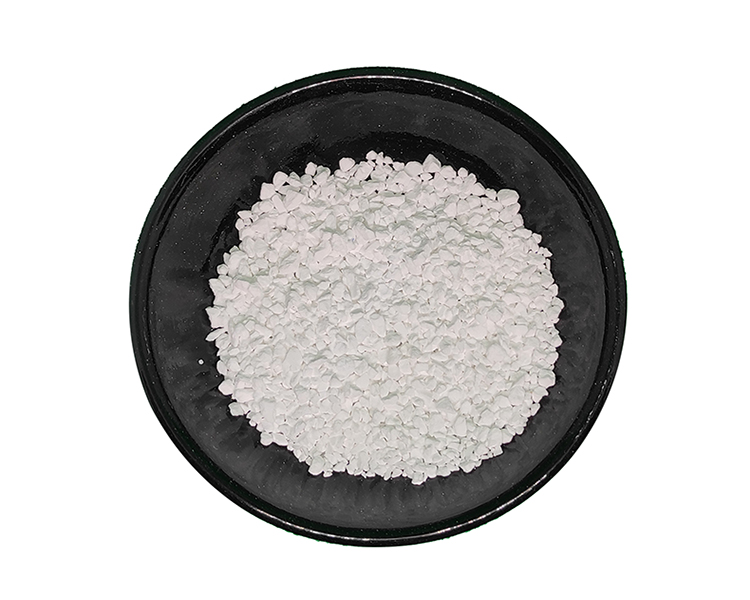
Short Answer: Match the Chemical Name and CAS Number Together
To identify SDIC, do not rely on only one identifier. Match the chemical name and the CAS Registry Number, then confirm the hydration form. SDIC is commonly named sodium dichloroisocyanurate, sodium dichloro-s-triazinetrione, or troclosene sodium. The anhydrous form is associated with CAS 2893-78-9. The dihydrate form is associated with CAS 51580-86-9.
If your specification or supplier document says “SDIC” but gives only an available chlorine percentage, a trade name, or a CAS number without the full chemical name, you do not yet have enough information to confirm the exact substance. Ask for the full name, the CAS number, and the hydration state.
SDIC Identifiers at a Glance
| Identifier | Anhydrous SDIC | SDIC Dihydrate |
|---|---|---|
| Common chemical name | Sodium dichloroisocyanurate; sodium dichloro-s-triazinetrione; troclosene sodium | Sodium dichloroisocyanurate dihydrate; sodium dichloro-s-triazinetrione dihydrate |
| Systematic-style name | 1,3,5-Triazine-2,4,6(1H,3H,5H)-trione, 1,3-dichloro-, sodium salt | 1,3,5-Triazine-2,4,6(1H,3H,5H)-trione, 1,3-dichloro-, sodium salt, dihydrate |
| CAS Registry Number | 2893-78-9 | 51580-86-9 |
| Common abbreviation | SDIC; NaDCC | SDIC dihydrate; NaDCC dihydrate |
| Molecular formula | C3Cl2N3NaO3 | C3Cl2N3NaO3·2H2O |
Some databases and supplier documents list CAS 2893-78-9 simply as “sodium dichloroisocyanurate” without stating hydration. That entry is generally used for the anhydrous form, but you should confirm the form when water content, weight-based dosing, or available chlorine specification matters.
Why the CAS Number Alone Is Not Enough
A CAS Registry Number identifies a specific chemical substance. It is not a product name, grade, purity statement, or formulation identifier. For SDIC, this creates several practical limits.
- Hydrates can have different CAS numbers. Anhydrous SDIC and SDIC dihydrate are related but not identical for specification purposes. CAS 2893-78-9 and CAS 51580-86-9 should not be treated as interchangeable when the hydration state affects the product.
- A product may be a mixture. A formulated chlorine product can contain SDIC plus other ingredients. The CAS number on the label may apply only to the SDIC component, not to the whole product.
- CAS does not establish purity. The same CAS number may appear on materials of different grades, particle sizes, or available chlorine contents.
- Similar chlorine donors have different CAS numbers. Dichloroisocyanuric acid, trichloroisocyanuric acid, and cyanuric acid are not SDIC and should not be substituted when a document specifically requires SDIC.
Chemical Names That Do and Do Not Mean SDIC
Names that identify SDIC
- Sodium dichloroisocyanurate
- Sodium dichloro-s-triazinetrione
- Troclosene sodium
- Sodium salt of dichloroisocyanuric acid
- 1,3,5-Triazine-2,4,6(1H,3H,5H)-trione, 1,3-dichloro-, sodium salt
Names that do not identify SDIC
- Dichloroisocyanuric acid — the acid form, not the sodium salt. Its CAS number is 118-57-0.
- Trichloroisocyanuric acid — also known as TCCA or symclosene. Its CAS number is 87-90-1. It is a different chlorinated isocyanurate.
- Cyanuric acid — CAS 108-80-5. It is a related compound and stabilizer, not SDIC.
- Bleaching powder, calcium hypochlorite, or sodium hypochlorite — different chlorine chemicals with different CAS numbers and handling requirements.
One source of confusion is the phrase “sodium salt of dichloroisocyanuric acid.” That phrase can correctly describe SDIC. By contrast, “dichloroisocyanuric acid” without “sodium salt” refers to the acid form and is not SDIC.
How to Verify a Name and CAS Pair
- Locate both identifiers. Check Section 1 and Section 3 of the safety data sheet, the certificate of analysis, and the product label. The chemical name and CAS number should appear together.
- Search the exact CAS number. Use an authoritative chemical database, such as CAS Common Chemistry or PubChem. Confirm that the name returned matches the SDIC synonyms above.
- Check the hydration state. If the document lists CAS 2893-78-9, confirm whether the material is anhydrous. If it lists CAS 51580-86-9, confirm that the dihydrate form is what you require.
- Determine whether the product is a mixture. If the product contains SDIC plus other ingredients, the CAS number identifies the SDIC component, not the complete formulation.
- Compare the identifiers with your specification. The name and CAS should match the form, grade, and intended use stated in your specification. Do not accept “available chlorine” alone as proof of identity.
- Request written confirmation when anything is unclear. Ask the supplier to state the full chemical name, CAS number, and hydration form in writing.
Common Identification Errors
- Treating available chlorine as the chemical name. Available chlorine is a performance-related specification, not an identity. Products with similar available chlorine values can contain different active substances.
- Assuming one CAS number covers every SDIC form. Anhydrous and dihydrate forms have separate CAS numbers and should be distinguished when the form matters.
- Confusing SDIC with dichloroisocyanuric acid. The acid form is not the sodium salt and has a different CAS number.
- Confusing SDIC with TCCA. Trichloroisocyanuric acid is a different product and should not be identified as SDIC.
- Using a trade name as the chemical name. A brand or product name is not enough. Ask for the chemical name and CAS number behind the trade name.
- Relying on a single database entry. Cross-check the name and CAS with the supplier’s SDS, COA, and specification. Database entries can omit hydration or grade information.
Quick Checklist for SDIC Identification
- Full chemical name includes “sodium dichloroisocyanurate,” “sodium dichloro-s-triazinetrione,” or “troclosene sodium.”
- CAS number is 2893-78-9 for the anhydrous form or 51580-86-9 for the dihydrate form.
- Hydration state is stated or can be confirmed from the specification.
- Product is identified as a substance or as a mixture containing SDIC.
- Available chlorine or purity is treated as a specification, not as the chemical identity.
- The name and CAS number match the exact form required for your application.
When to Ask for Written Confirmation
Ask for written confirmation when the document gives only a trade name, only an available chlorine value, only a CAS number without a chemical name, or a CAS number that could refer to more than one hydration form. Also ask when the product is a formulation rather than a single substance, because the CAS number may not describe the full product.
Identifying SDIC correctly does not by itself confirm suitability for a particular use. It confirms what the substance is. Handling, storage, compatibility, regulatory status, and dose must be checked separately against the safety data sheet and the requirements of the intended application. Never mix SDIC with incompatible chemicals or improvised handling procedures.
If you are comparing SDIC supplier documents and need to confirm whether a listed chemical name and CAS number match the SDIC form you require, send ENVO CHEMICAL the exact chemical name, CAS number, and hydration form from your specification.
