
Start with the Product’s Intended Use Classification
Before examining any technical data sheet, confirm that the NaDCC product is explicitly formulated or labeled for food-processing sanitation—and ideally for dairy environments. NaDCC (sodium dichloroisocyanurate) is a chlorine-releasing compound, but not every grade carries the same regulatory standing. A product sold for pool disinfection or general surface cleaning may lack the food-contact approvals, purity controls, or residual-chlorine limits required in a dairy plant. If the supplier cannot provide a clear statement of intended use in food-processing sanitation, treat the product as unverified for this application and seek clarification.
Check Available Chlorine Content and Purity Grades
The active sanitizing agent in NaDCC is the available chlorine released when the compound dissolves in water. Review the certificate of analysis (CoA) or technical data sheet for the available chlorine percentage—typically expressed as a percentage of the total product mass—and compare it against the purity grade of the raw material.
Two distinctions matter here:
- Available chlorine tells you how much oxidizing capacity the product delivers per unit mass once dissolved.
- Purity of the NaDCC dihydrate or anhydrous base tells you what fraction of the product is actually the active compound versus fillers, anti-caking agents, or moisture.
A dairy sanitation program typically requires a defined applied dose (for example, 50–200 ppm free chlorine depending on the step), so you must know both values to calculate how much product to weigh into solution. Ask the supplier for batch-specific CoAs rather than relying on a single generic specification, because available chlorine can drift between production lots.
Verify Solubility and Solution Stability Under Dairy Conditions
NaDCC dissolves readily in water, but the rate and completeness of dissolution affect how consistently you can prepare sanitizing solutions at the required concentration. Review whether the product data addresses:
- Dissolution time at typical preparation temperatures (cold water around 10–15 °C is common in dairy plants).
- Solution stability—how long the prepared solution maintains its target free-chlorine level before degradation becomes significant.
- pH of the working solution, because NaDCC solutions are mildly acidic (typically pH 5.5–6.5 at use concentrations), and this interacts with dairy soils and surface materials.
In a dairy environment, organic load from milk residues, fats, and proteins consumes free chlorine rapidly. A product that loses available chlorine within minutes of preparation forces frequent remake, increasing labor and chemical cost. Confirm with the supplier what shelf-life data exists for the prepared solution under realistic dairy-plant temperatures and organic load, or plan to validate this yourself.
Assess Compatibility with Dairy Plant Surfaces and Materials
Dairy equipment commonly includes stainless steel (304 and 316 grades), food-grade rubber gaskets, plastics such as HDPE and polypropylene, and occasionally elastomer seals. Chlorine-based sanitizers at appropriate concentrations are generally compatible with these materials, but concentrated NaDCC solutions or prolonged contact can cause pitting on lower-grade stainless steel or degrade certain elastomers over time.
When reviewing a NaDCC product for dairy use, ask for or look for:
- Material compatibility data specific to the recommended use concentration.
- Any caution statements about prolonged contact or high-temperature use (for example, in CIP—clean-in-place—circuits).
- Guidance on rinsing requirements after sanitizing, because residual chlorine in product contact zones must stay within regulatory limits for the specific dairy jurisdiction.
Do not assume that a product safe for stainless steel countertops is automatically safe for all dairy-plant components. Review each contact surface in your program separately.
Confirm Regulatory and Food-Safety Documentation
Dairy plants operate under food-safety frameworks that vary by region—HACCP, FSMA, EU hygiene regulations, Codex Alimentarius guidelines, or national dairy authority rules. A NaDCC product intended for this setting should be supported by documentation that addresses:
- Food-contact approval or notification in the relevant jurisdiction (for example, FDA food-contact substance notification in the United States, or EU Regulation 1935/2004 compliance).
- A safety data sheet (SDS) that lists hazards specific to the product form—dust inhalation for granules or tablets, skin and eye irritation from solutions—so your plant can complete its own risk assessment.
- Any third-party testing or certification for microbiological efficacy against dairy-relevant organisms, if the supplier offers it. Do not accept general “kills 99.9% of bacteria” claims without seeing the test conditions, because efficacy depends on concentration, contact time, temperature, and organic load.
If the supplier cannot produce these documents, the product has not been reviewed sufficiently for a dairy sanitation program regardless of its chemical performance.
Evaluate the Practical Format: Granules, Tablets, or Powder
NaDCC is available as granules, compressed tablets, or fine powder. The form you choose affects how you review the product for a dairy plant:
- Granules dissolve more slowly than powder but generate less dust—an advantage where airborne chlorine irritates workers near milking parlors or processing rooms.
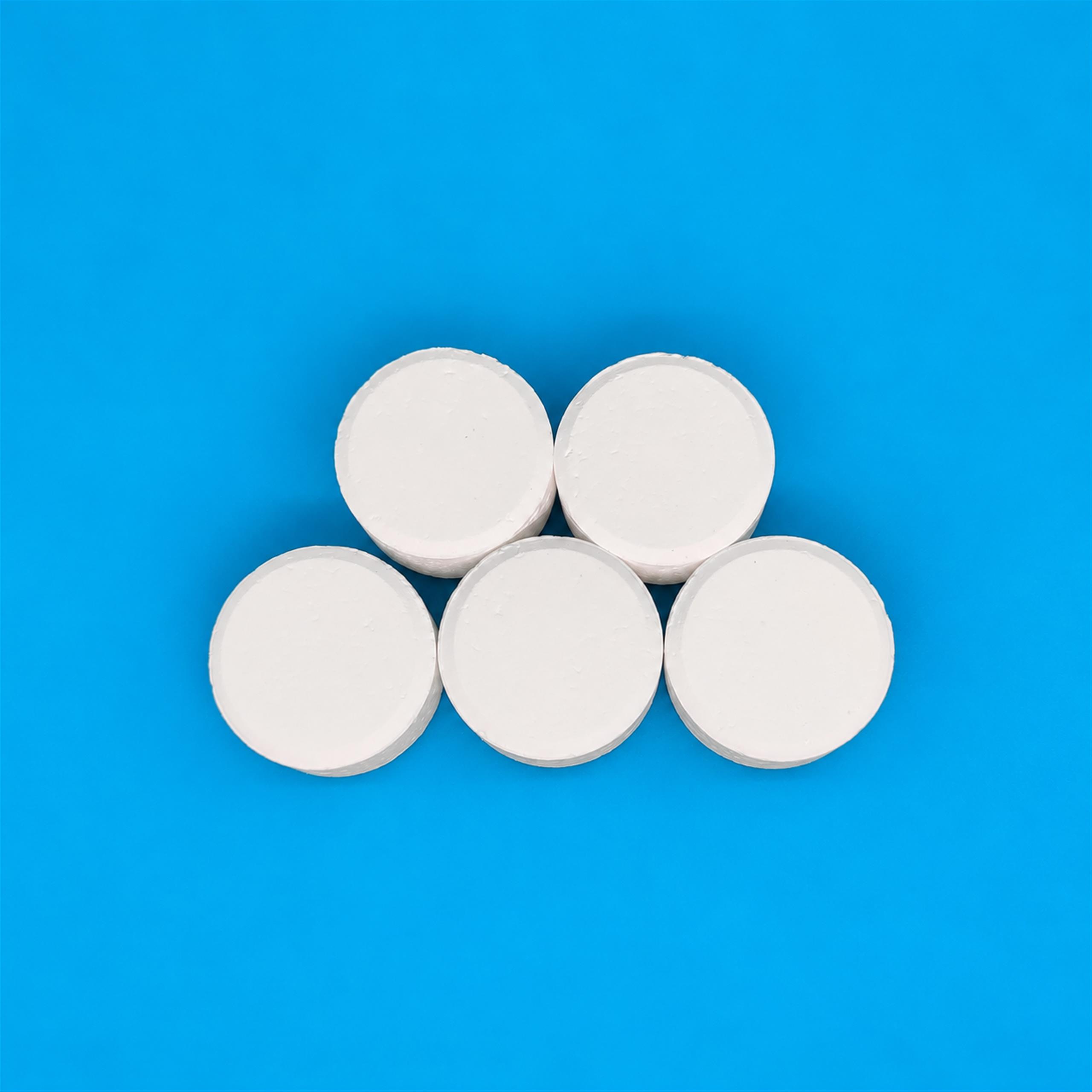
- Tablets offer convenient dosing but may contain binders that are not food-grade; verify the full ingredient list.
- Fine powder dissolves fastest but poses the highest inhalation risk and requires strict handling controls.
Review the product’s physical form against your plant’s existing dosing equipment, worker-safety protocols, and storage conditions. A product that is chemically suitable but impractical to dose safely in your facility does not belong in the sanitation program.
Plan for Validation Before Full Adoption
Reviewing a NaDCC product on paper is the first step; confirming it works in your specific dairy operation is the second. After narrowing candidates through the checks above, conduct a small-scale validation:
- Prepare the working solution at the recommended concentration using your actual water source and temperature.
- Measure free chlorine with a calibrated test kit or photometer at the point of use, not just at preparation.
- Apply to a representative surface with a realistic dairy soil load (milk film, fat residue) and verify the required contact time achieves the target microbial reduction.
- Rinse and test for residual chlorine to ensure it meets your plant’s specification for product-contact surfaces.
Document every result. If the product fails any step—dissolution, stability, material compatibility, or efficacy—return to the supplier with the specific data and ask for an alternative grade or a revised recommendation. A reputable NaDCC supplier for dairy sanitation will engage with this process rather than insist that the product works without verification.
Bring It Together: A Checklist Summary
| Review Item | What to Confirm |
|---|---|
| Intended use statement | Explicitly covers food-processing or dairy sanitation |
| Available chlorine and purity | Batch CoA provided; values match your dose calculations |
| Solubility and solution stability | Data at your plant’s water temperature; acceptable hold time |
| Material compatibility | Approved for stainless steel, gaskets, plastics at use concentration |
| Regulatory documentation | Food-contact approval, SDS, and efficacy data where available |
| Physical form | Compatible with dosing equipment and worker-safety controls |
| On-site validation | Confirmed free chlorine, contact time, and residual limits in practice |
If you are evaluating a specific NaDCC product for inclusion in your dairy plant’s sanitation program and need help interpreting the supplier’s technical data or planning the validation steps, contact ENVO CHEMICAL with your target use concentration, water temperature range, and the surfaces you intend to sanitize—we can discuss whether the product you are reviewing meets the parameters that matter for your operation.
