
The Core Verification a Sanitation Buyer Must Perform
Before purchasing sodium dichloroisocyanurate (NaDCC) for food-contact equipment sanitation, a buyer must verify that the product carries explicit regulatory or compliance approval for that specific use—not merely a general “food-grade” or “sanitizer” label. General food-grade classification does not, by itself, confirm that a given NaDCC product is authorized or tested for direct or indirect contact with food surfaces under the buyer’s applicable jurisdiction. Every other verification step—purity, available chlorine, formulation, documentation—follows from this baseline.
Regulatory and Compliance Status for Food-Contact Use
What “Food-Contact Approved” Actually Requires
NaDCC is a source of available chlorine used in disinfection. When the target is food-contact equipment—conveyors, slicers, tanks, cutting boards, filler nozzles—the buyer must confirm which regulatory framework governs the product in the country or region of use. In the European Union, for example, active substances used in food-hygiene disinfectants fall under the Biocidal Products Regulation (BPR, Regulation (EU) 528/2012) and, where applicable, the Food Hygiene Regulation (EC) No 852/2004. In the United States, the EPA registers antimicrobial pesticides under the Federal Insecticide, Fungicide, and Rodenticide Act (FIFRA), and the FDA oversees food-contact substances under 21 CFR. A buyer cannot assume that an NaDCC product registered for one of these pathways automatically satisfies the other.
The verification task is therefore: obtain the current product registration or authorization dossier and confirm that the approved use-sites explicitly include food-contact surfaces or food-processing equipment. If the dossier lists only drinking-water treatment, swimming pools, or general-surface disinfection, the product has not been verified for the buyer’s intended purpose.
Distinguishing Product Categories
NaDCC is sold as both raw material and as a formulated product (tablets, granules, pre-dissolved solutions, or blends with surfactants or builders). A buyer must verify which category the supplied product belongs to, because regulatory approval often applies to a specific formulation, not to the raw active substance alone. A raw NaDCC dihydrate powder with 56 % available chlorine, for instance, may be a listed active substance under a biocidal product authorization, but the end-user product that a sanitation buyer puts into a dosing system may require its own authorization if it contains additional ingredients.
Product Specifications That Directly Affect Sanitation Performance
Available Chlorine and Form of NaDCC
Once regulatory status is confirmed, the buyer must verify the declared available chlorine content and the physical form. NaDCC is commonly supplied as the dihydrate (molecular weight 255.98, theoretical available chlorine ≈ 56 %) or as the anhydrous form (theoretical available chlorine ≈ 64 %). The specification sheet or certificate of analysis must state which form is supplied and the measured available chlorine percentage. These numbers determine how much product to dose to achieve a target ppm of free chlorine in the sanitizing solution.
A buyer should also verify whether the product is a single-component NaDCC or a multi-component blend. Blends may include acids, sequestrants, or surfactants that alter the dissolution rate, pH of the working solution, or compatibility with specific equipment materials. Any added ingredient must itself be acceptable for food-contact environments under the relevant regulation.
Dissolution Behaviour and Solution Stability
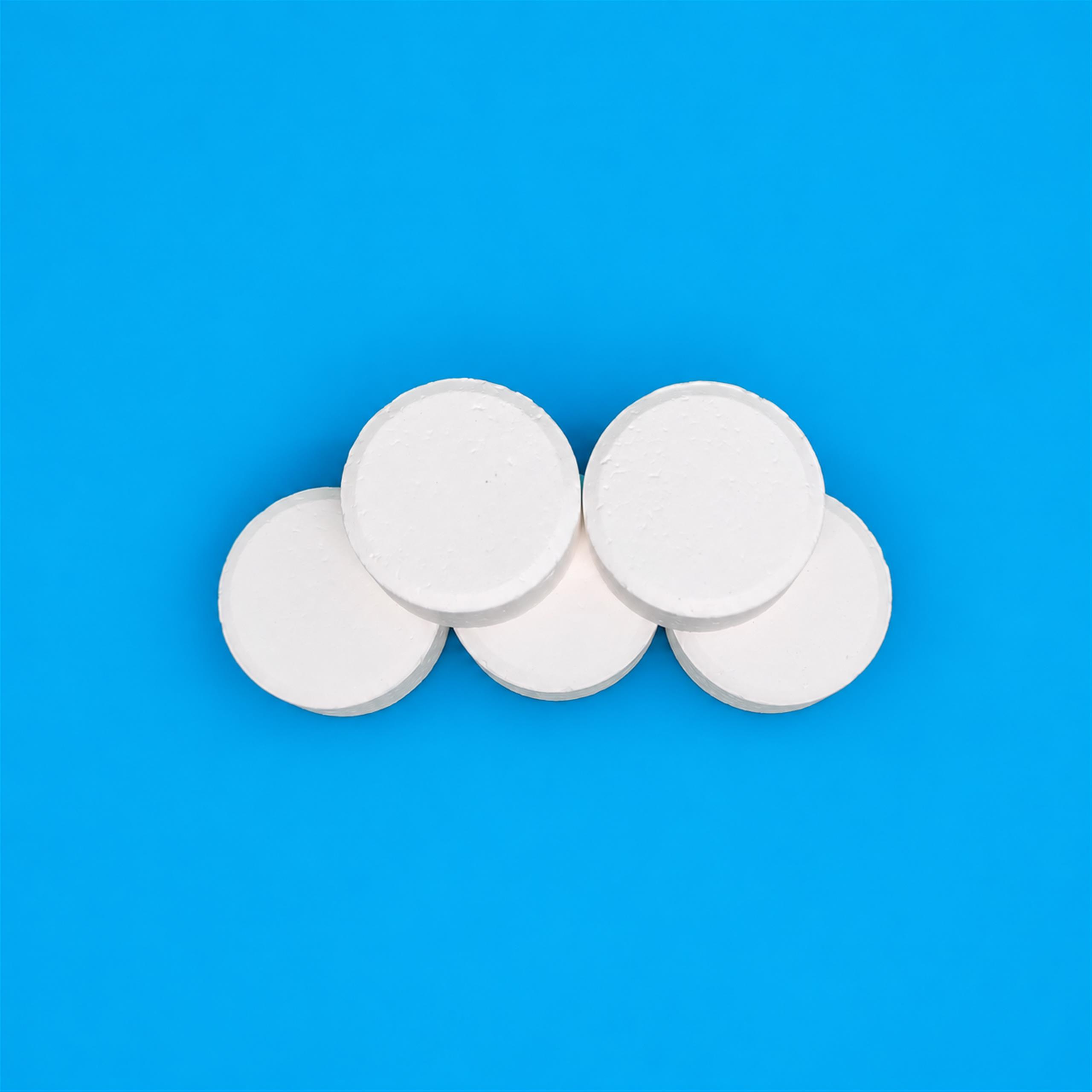
Food-contact equipment sanitation typically requires a prepared solution at a defined concentration, often between 50 and 200 ppm free chlorine depending on the protocol and jurisdiction. The buyer must verify that the NaDCC product dissolves reliably at the intended concentration and temperature, and that the solution retains adequate free chlorine over the required contact time. Tablet or granule forms can vary in hardness and dissolution speed; a product that clumps or dissolves incompletely will produce uneven dosing and unreliable sanitation.
If the buyer’s operation uses automated dosing or CIP (clean-in-place) systems, the product specification must confirm compatibility with the dosing equipment (e.g., no undissolved residue that blocks injectors or filters).
Documentation and Traceability Requirements
Safety Data and Handling Instructions
NaDCC is an oxidizing solid. A buyer must verify that the supplied Safety Data Sheet (SDS) reflects the correct product identity and hazard classification, and that it includes handling instructions relevant to food-processing environments—such as avoiding contact with acids (which liberate chlorine gas), avoiding mixing with incompatible detergents, and specifying personal protective equipment for the concentration being handled. The SDS must also confirm that the product is not classified in a way that would prohibit its use near food under the buyer’s local occupational or food-safety rules.
Batch Consistency and Certificate of Analysis
Each shipment or production lot should be accompanied by a certificate of analysis (CoA) that records available chlorine, moisture (for dihydrate), heavy-metal limits if applicable, and any microbiological or purity parameters required by the regulatory dossier. A buyer must verify that the CoA is issued against the same product name, CAS number, and batch identification as the purchase order. Inconsistent CoA parameters between batches signal a quality-control issue that can compromise both regulatory compliance and sanitizing efficacy.
Shelf Life and Storage Conditions
NaDCC degrades with moisture, heat, and prolonged storage. The buyer must verify the stated shelf life under the recommended storage conditions and confirm that the supplier’s packaging provides adequate moisture barrier. Using product past its verified shelf life introduces the risk of sub-therapeutic chlorine levels, which defeats the purpose of food-contact sanitation.
What a Buyer Should Not Assume
- “Food grade” on a label is not a regulatory approval. It may indicate that the manufacturer considers the product suitable for food environments, but without a cited regulation or registration number, it does not substitute for formal verification.
- One jurisdiction’s approval does not cover another. An NaDCC product authorized under EU BPR for food-hygiene use may not meet US EPA or other national requirements.
- Available chlorine percentage alone does not guarantee performance. Dissolution rate, solution stability, and compatibility with the specific equipment and cleaning protocol all affect the actual sanitizing outcome.
- NaDCC is a disinfectant, not a cleaner. It does not remove soils, proteins, or biofilms on its own. A buyer must verify that the pre-cleaning step in the sanitation protocol is adequate, because organic load will consume available chlorine and reduce efficacy.
Practical Verification Checklist for the Buyer
| Verification Item | What to Confirm |
|---|---|
| Regulatory authorization | Product is approved for food-contact surface disinfection under the applicable regulation, with a cited registration number |
| Product form and composition | Raw NaDCC or formulated; dihydrate or anhydrous; any co-ingredients listed and acceptable for food-contact use |
| Available chlorine specification | Measured % available chlorine matches the declared value on the CoA for the supplied batch |
| Dissolution and compatibility | Product dissolves cleanly at target concentration; compatible with dosing system and equipment materials |
| Safety documentation | Current SDS with correct hazards; handling instructions address food-plant conditions |
| Batch traceability | CoA issued per batch, with matching product identity and expiry or re-test date |
| Storage and shelf life | Packaging protects against moisture; expiry date verified against receipt date |
Why This Verification Sequence Matters
Skipping regulatory confirmation risks deploying a product that is not legally authorized for food-contact sanitation in the buyer’s jurisdiction, potentially leading to audit failures or product recalls. Skipping specification checks risks inconsistent dosing, wasted chemical, or surfaces that are not effectively disinfected. The verification steps above are not optional extras—they are the minimum due diligence a sanitation buyer must complete before committing to a NaDCC supply for food-contact equipment.
If any of the items above cannot be confirmed from the supplier’s documentation, the buyer should request clarification or seek an alternative product with a complete dossier before proceeding.
For a focused discussion on NaDCC specifications and compliance documentation relevant to your food-contact sanitation program, contact ENVO CHEMICAL with your target jurisdiction and equipment type so we can address the verification points that apply to your situation.
