
What You Should Actually Receive When You Pay for a Polyphosphate Development Sample
A paid polyphosphate development sample should deliver two things: a physical material that genuinely represents the grade you intend to buy, and a documentation package that lets you qualify it without guessing. At minimum, expect a traceable sample with a batch or lot identifier, a certificate of analysis tied to that identifier, a technical data sheet, a safety data sheet, a packaging and shelf-life statement, and written confirmation of what the supplier is still developing versus what is already fixed. If any of those are missing, you are paying for material without the information needed to use it.
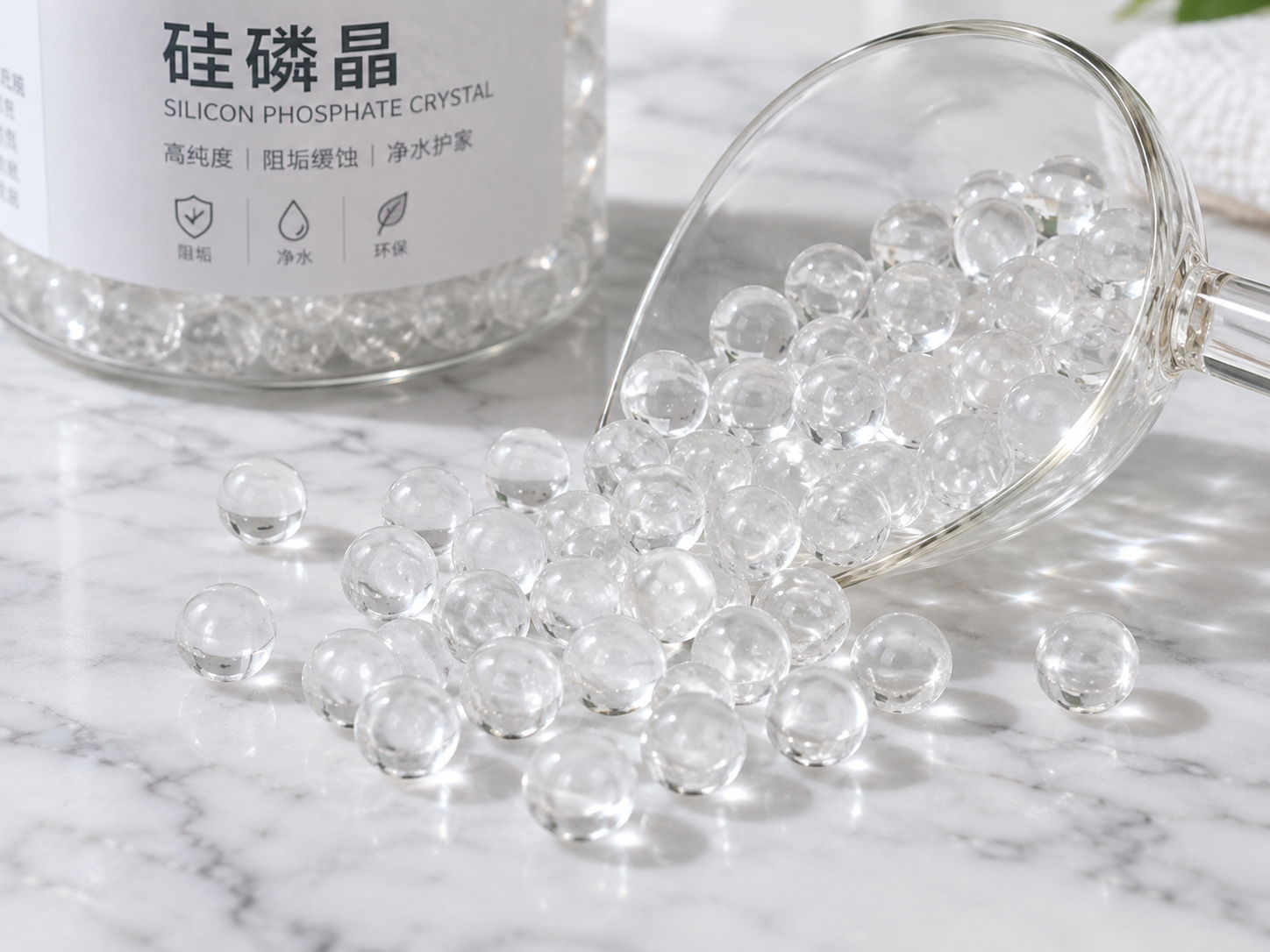
This matters most to filter and water-treatment equipment manufacturers, importers, and procurement teams who order polyphosphate media — often described as siliphos crystal, glassy phosphate, or phosphate crystal — and then discover the sample cannot be traced to a production batch, has no usable specification, or behaves differently from the first bulk shipment. Below is a practical breakdown of what belongs in a development sample package, what to confirm in writing, and where the real risks sit.
Start by Naming the Material Correctly
Before negotiating deliverables, agree on what the sample physically is. “Siliphos” is a trade-associated name, not a generic chemical classification, and it is not automatically interchangeable with every polyphosphate medium on the market. Products in this family may differ in:
- Phosphate chemistry — for example, glassy sodium polyphosphates such as sodium hexametaphosphate, tripolyphosphate-based compositions, or mixed phosphate glasses
- Physical form — spherical beads, irregular granules, briquettes, or cast blocks
- Dissolution behaviour — how quickly the material releases phosphate into the water stream
- Co-formulated additives, such as silicate components in products marketed for combined scale and corrosion treatment
The same distinction applies to function. Polyphosphate media used in this way generally work through threshold scale inhibition and crystal modification — a small dose interferes with calcium carbonate precipitation. That is not the same as water softening (which removes hardness ions through ion exchange), filtration (which removes suspended solids physically), disinfection, or verified corrosion inhibition. A single sample rarely does all of these, and the documentation package should state clearly which effect the supplier is claiming and on what basis.
Core Deliverables in a Paid Development Sample Package
1. A representative, traceable sample
Ask for a lot or batch number printed on the sample container, and a written statement that the sample was taken from a defined production or pilot batch. A development sample produced on laboratory glassware may be useful for chemistry work, but it will not tell you how the material behaves in an extruder, a cartridge, or a flow-through housing. Confirm whether the sample came from lab, pilot, or full-scale equipment, and ask whether the intended bulk manufacturing route will be the same.
Quantity should be enough for both bench work and a pilot run. If you plan to fill cartridges or test flow-through behaviour, a few grams is not a development sample — it is a curiosity. State your required quantity in the inquiry so the supplier can quote accordingly rather than shipping an unusable amount.
2. Certificate of Analysis (CoA) linked to the sample lot
The CoA is the single most valuable document in the package, because it converts the sample from a physical object into a defined material. A usable CoA typically includes:
- Product name and grade designation
- Lot or batch number matching the sample label
- Test parameters and the results for that lot
- The test method or standard referenced for each parameter
- Date of manufacture or date of analysis
- Name and signature of the releasing authority
Which parameters matter depends on your application, but common ones for polyphosphate media include phosphate content or P₂O₅ equivalent, moisture, bulk density, particle size distribution, and appearance. Where a parameter is not tested on every lot, ask whether historical data exists instead of assuming the value is guaranteed.
3. Technical Data Sheet with application conditions
A technical data sheet should describe the material and the conditions under which it is intended to work. Useful content includes recommended dosage range, working temperature range, pH range, contact time or flow guidance, and any known limitations. Treat any missing range as an open question rather than filling it with an assumed value: dosage, contact time, and service life are application-specific and depend on your source water, flow rate, temperature, and target effect.
For polyphosphate chemistry in particular, note that these materials hydrolyse toward orthophosphate over time, and the rate depends on the product form and water conditions. If residual phosphate matters for your discharge, downstream treatment, or local regulations, ask the supplier for data on this point rather than extrapolating from a general rule.
4. Safety Data Sheet (SDS)
You should receive an SDS in the format and language required by your destination market — for example, GHS-aligned classification and transport information. This is not optional paperwork. It is needed for warehouse handling, customs clearance, and worker safety communication. Confirm the SDS revision date and check that it matches the sample composition; an SDS copied from a different product in the supplier’s range is a warning sign.
5. Packaging, storage, and shelf-life statement
Polyphosphates are hygroscopic to varying degrees. A development sample should arrive in packaging that protects it from moisture pickup and contamination, with a written statement covering recommended storage conditions and an expected shelf life. If shelf life is not established for the development grade, the supplier should say so plainly — “not yet established” is a legitimate answer, whereas an invented number is not.
6. Regulatory and suitability documentation
If the final application touches drinking water, treat this section with care. A material described as “food grade” is not automatically suitable for potable water contact. Suitability depends on the exact product composition, the contact conditions, the dose, and the rules of the destination market. Ask the supplier which specific documents they can provide for the exact grade — and confirm independently that those documents cover your intended use and jurisdiction.
Deliverables Specific to Development Work
The items above describe a normal sample. A development sample carries additional obligations because the material is not yet a fixed catalogue product. The following are commonly overlooked.
| Deliverable | Why it matters | What to confirm in writing |
|---|---|---|
| Baseline comparison | Shows what was changed relative to the supplier’s existing grade | Which reference grade was used and what differs (chemistry, size, binder, thermal treatment) |
| Development scope statement | Distinguishes fixed properties from properties still under adjustment | Which parameters are locked and which may shift before bulk production |
| Iteration and revision policy | Determines how many further rounds are included in the fee | Number of included iterations, what triggers an additional charge, and typical turnaround |
| Suggested trial protocol | Reduces the risk that a valid material fails because of test design | Recommended dose range, water conditions, contact time, and analytical method for residual phosphate |
| Scale-up change notice | Prevents the classic sample-to-bulk mismatch | How you will be notified if the production route, raw material source, or equipment changes |
| Sample retention | Allows later comparison if a dispute arises | Whether the supplier retains a sealed reference sample and for how long |
Commercial and Legal Terms That Belong in the Package
Paying for a development sample is a small commercial transaction with larger consequences, so the terms should be clear before payment:
- What the fee covers. Is it material cost, engineering time, analytical work, or all three? A fee that includes formulation work should be described as such.
- Credit toward the first order. Many suppliers credit part or all of a development fee against a subsequent bulk purchase. Ask whether this applies and under what conditions.
- Confidentiality. If you share your application details, water chemistry, or equipment design, a mutual NDA is reasonable. Clarify who owns any formulation developed specifically for you.
- Exclusivity. If you are paying for custom development, ask whether the resulting grade can be sold to your competitors. The answer may be no — but you should know before you invest.
- Scale-up path. Confirm indicative bulk packaging, minimum order quantity structure, and lead time in writing if you need it for planning. Verbal estimates are not planning inputs.
How to Evaluate the Sample Once It Arrives
Documentation tells you what the material claims to be. Testing tells you whether it performs in your system. A practical first-round evaluation for polyphosphate media might cover:
- Identity and consistency: visual inspection, particle size check against the CoA, and comparison with any retained reference sample
- Dissolution behaviour: phosphate release over time under your target temperature, flow, and contact conditions
- Physical durability: whether beads or granules resist breakdown, which affects fines generation and pressure drop
- Scale inhibition performance: using your actual or representative hard water, with a defined analytical endpoint
- Downstream effects: residual phosphate, turbidity, and any effect on subsequent treatment stages
Agree the acceptance criteria before testing. A material that underperforms against undefined expectations is a dispute; a material that underperforms against agreed criteria is a data point that shapes the next iteration.
Red Flags in a Paid Sample Offer
- No lot number on the sample or on the CoA
- A CoA with parameters but no test methods
- An SDS that names a different product or an outdated revision
- Vague answers about whether the sample came from lab, pilot, or production equipment
- Refusal to state which properties are still under development
- Claims of drinking-water suitability supported only by the words “food grade”
- Performance figures quoted without any reference to water conditions or dose
Frequently Asked Questions
Should a supplier charge for a polyphosphate development sample?
Charging is reasonable when the sample involves custom formulation, non-standard particle size, or dedicated analytical work. It is less reasonable for a standard catalogue grade supplied in small quantity. In either case, the fee should correspond to a defined deliverable list, not to an undefined “sample handling” charge.
Is a certificate of analysis the same as a specification sheet?
No. A specification sheet states the limits a product is expected to meet. A certificate of analysis reports actual measured results for one specific lot. You need both: the specification to judge acceptability, and the CoA to verify the sample in your hands.
Can I skip the technical data sheet if I already know the product?
Not for a development sample. Recommended dose, temperature, pH, and contact conditions are the parameters most likely to change between a development grade and a final production grade, and they are exactly what the data sheet should address.
What if the supplier cannot provide a shelf-life figure?
That is acceptable during development, provided the supplier states the storage conditions they recommend and confirms that shelf life has not yet been established. What is not acceptable is a specific number presented without supporting stability data.
Bringing It Together
A paid development sample is a small project with defined outputs, not simply a shipment of material. Treat the deliverable list as part of the purchase: sample traceability, CoA, technical data sheet, SDS, packaging and storage guidance, development scope, iteration terms, and a documented scale-up path. When those are agreed up front, the sample becomes a reliable basis for qualification decisions instead of a source of uncertainty that resurfaces when the first bulk order arrives.
If you are sourcing siliphos-type crystal or another polyphosphate medium for a specific water-treatment application, ENVO CHEMICAL can review your requirements against the grade being considered. To make that review useful, include your application and equipment type, source-water conditions (hardness, pH, temperature, flow rate), the technical objective you are testing for, the specification or particle size you need, the quantity required for bench and pilot work, and your destination market along with any documentation that market requires.
