
Short answer: “salt-free” describes what a product does not use, not what it does
When a filter cartridge or point-of-entry device is sold as a “salt-free water softener,” the claim almost always means one narrow thing: the system does not regenerate with sodium chloride brine and does not produce a brine discharge. It says nothing definite about whether the device removes calcium and magnesium — the two minerals that actually make water hard. A polyphosphate or phosphate-crystal cartridge is a scale-inhibition product, and in many designs also a corrosion-control product. In typical use it leaves hardness minerals in the water and changes how those minerals behave; it does not take them out. That gap between the literal claim and the implied promise is where most buyer confusion, product returns, and advertising complaints start.
For filter manufacturers, water-treatment equipment builders, importers and distributors, the practical question is not “is salt-free good or bad.” It is: what can I honestly print on a label, on a product page, and in a quotation, given what the media inside the housing actually does?
Softening, scale inhibition, and the other functions that get blurred together
These terms describe different physical or chemical jobs, and a single cartridge rarely performs more than one or two of them. Mixing them up is the root cause of most misleading “salt-free softener” copy.
| Function | What it actually does | Common technologies | Does it remove calcium and magnesium? |
|---|---|---|---|
| Water softening | Removes hardness ions from the water, usually exchanging them for sodium or hydrogen ions | Ion-exchange resin regenerated with salt brine; sometimes membrane processes | Yes — this is the defining feature |
| Scale inhibition | Keeps hardness minerals dispersed in the water or interferes with crystal growth so deposits adhere less readily to surfaces | Polyphosphate and phosphate-crystal media, some polymeric dispersants | No — hardness stays in the water |
| Scale removal | Dissolves or breaks down deposits that have already formed | Acid or chelant-based cleaning chemicals, mechanical cleaning | No |
| Filtration | Captures suspended particles above a given size | Sediment cartridges, carbon block, membranes | No — dissolved minerals pass through most filters |
| Corrosion inhibition | Forms a thin protective film on metal surfaces or alters water chemistry to reduce metal loss | Polyphosphate, silicate and phosphate-silicate blends, pH adjustment | No |
| Disinfection | Inactivates or kills microorganisms | UV, chlorine, chlorine dioxide, ozone | No |
A cartridge marketed as a salt-free softener is therefore usually doing the second and sometimes the fifth job in that table. If a customer’s actual problem is hard-water spotting on glassware, white crust on a heating element, or soap that will not lather, scale inhibition may help with the crust but will not change the water’s hardness or the spotting behaviour in the way a true ion-exchange softener does.
Where phosphate-crystal and Siliphos-type media fit
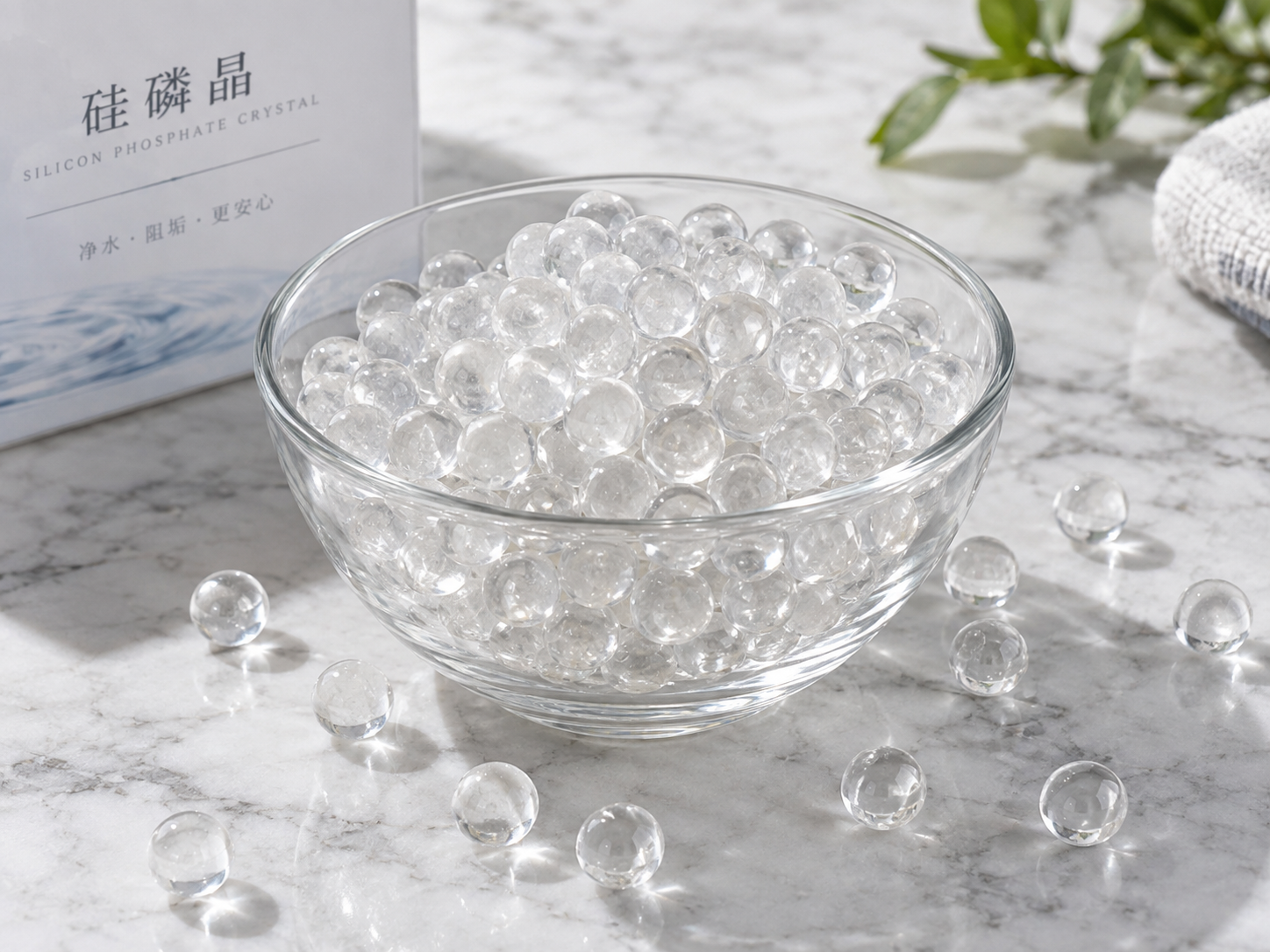
Products sold under the Siliphos name, and the many phosphate-crystal and polyphosphate media positioned against it, are generally described by their suppliers as slowly dissolving phosphate or phosphate-silicate materials held in a cartridge. Water passing through the bed picks up a small amount of the material, which then acts on calcium carbonate scale.
Two mechanisms are usually involved, and it is worth understanding both because they have different requirements:
- Threshold inhibition: very small amounts of phosphate interfere with the growth of scale crystals, so they stay small and are carried away instead of depositing.
- Sequestration and film formation: at higher concentrations, the phosphate holds hardness ions in a soluble form and can form a thin film on metal surfaces, which is why polyphosphates are also used for corrosion control in distribution systems.
Three consequences follow for anyone specifying or reselling this type of media:
- The media is consumed, not regenerated. Unlike ion-exchange resin, the bed dissolves into the water over time. Service life is therefore tied to water volume, temperature, and the amount of media in the housing, not to a regeneration cycle.
- Polyphosphates hydrolyse over time. They gradually convert toward orthophosphate, and the rate depends on temperature, pH and residence time in the system. That is one reason performance can drift across the life of a cartridge rather than staying flat.
- Dosing is a function of contact time and flow. Too little uptake gives no protection; too much raises phosphate in the treated water and can feed biological growth in downstream plumbing. Neither extreme is fixed by the label “salt-free.”
The terminology trap
Siliphos, siliphos crystal, phosphate crystal, polyphosphate media, and “scale inhibitor crystal” are not guaranteed to be technically identical. They may differ in phosphate form, whether silicate is present, dissolution rate, particle size, and the approvals the manufacturer holds. Treating them as interchangeable on a specification sheet is a common and expensive mistake. Ask for the material’s composition description and its approval documents rather than relying on the trade name.
What a “salt-free” claim is legally allowed to mean
Advertising rules differ by market, and several regulators and industry bodies have taken an interest in devices described as water softeners that do not remove hardness. In practice, the safe interpretation for a supplier is:
- You may state that a system does not use salt, does not regenerate, and does not produce brine wastewater, provided that is factually true of the product.
- You should avoid implying that the product softens water, removes hardness, or produces “soft water” unless it genuinely removes calcium and magnesium.
- Statements such as “food grade” or “food-contact material” describe a material classification. They are not the same as approval for use in drinking water, which must be verified for the exact product, the application conditions, and the destination country.
Before finalising packaging or a product listing, confirm what the target market permits and what evidence the media supplier can provide. Neither the phrase “salt-free” nor a food-grade description substitutes for a potable-water approval that names the actual product.
How to evaluate a salt-free polyphosphate filter before you buy or resell it
This checklist is written for equipment manufacturers, importers and distributors who need to compare offers from more than one media supplier.
- Define the problem being solved. Is it scale on a heater, corrosion in a metal loop, staining, or taste and odour? Different problems point to different products, and some point away from phosphate media entirely.
- Get the source-water profile. At minimum: hardness, pH, alkalinity, iron and manganese, temperature, and flow rate. Iron and manganese in particular can interfere with phosphate treatment and cause discolouration complaints.
- Confirm what the media is. Ask for the chemical description, not just the brand name, and whether silicate is part of the formulation.
- Ask for the approval scope. Which certification or national approval applies, to which exact product reference, and for which use conditions. A certificate for a different grade or a different housing does not cover your product.
- Ask how service life is calculated. The answer should reference volume treated at stated flow, temperature and hardness — not a single number of months.
- Check the discharge and residual question. Phosphate entering a drain or a septic system may be regulated in the destination market, and some markets limit phosphate in drinking water.
- Agree on a replacement indicator. Decide in advance whether the end user replaces on volume, on a test result, or on a visible change in the cartridge.
Questions worth putting in writing to the supplier
- What is the recommended maximum and minimum flow per cartridge, and what happens outside that range?
- How does performance change at the upper end of the temperature range the system will see?
- Is the media intended for potable water, and in which markets and under which approvals?
- What upstream filtration or pre-treatment is required or recommended?
- What is the phosphate contribution to the treated water at the rated dose, and how was it measured?
Realistic limits and common failure modes
Phosphate-crystal media have a narrower operating window than marketing often suggests, and the failure modes are predictable:
- Channeling. If the bed is loose or the flow is misdistributed, water bypasses the media and the cartridge appears to fail early.
- Under-dosing at high flow. Contact time falls, uptake drops, and scale protection disappears even though the cartridge is not empty.
- Over-dosing at low flow or long stagnation. Excess phosphate can promote biofilm in downstream pipework and may raise treated-water phosphate above what local rules allow.
- Interference from iron and manganese. These can consume the treatment and cause their own deposits.
- Misapplied expectations. A phosphate cartridge will not reduce water hardness, will not remove dissolved solids, and will not disinfect. Where a customer needs those outcomes, a different product is required.
Writing honest copy for a “salt-free” product
For distributors and OEMs, the commercially safest positioning is to describe the function rather than the absence of salt. Instead of “salt-free water softener,” consider language built around scale inhibition, no brine regeneration, no salt purchase for the end user, and no wastewater stream — each of which is defensible if it is true of the product. Then state plainly what the product does not do: it does not lower hardness, and it does not replace an ion-exchange softener where genuinely soft water is required. Buyers who receive that information up front return fewer cartridges and generate fewer complaints than buyers who discover it after installation.
FAQ
Does a salt-free polyphosphate filter remove hardness?
No. It changes the behaviour of hardness minerals so they are less likely to form deposits. The calcium and magnesium remain in the water.
Is it the same as a water softener?
Only in the sense that both are sold into the same household and light-commercial market. A softener removes hardness ions; a phosphate cartridge inhibits scale. The installed results differ noticeably, especially for soap lather and spotting.
Are Siliphos and polyphosphate crystal the same material?
Not necessarily. Trade names do not guarantee identical chemistry, dissolution behaviour or approvals. Confirm the actual composition and certification for the specific grade you are buying.
Can it be used for drinking water?
That depends on the exact product, the dose, the system design and the destination market’s rules. A food-grade description alone is not sufficient evidence. Ask the supplier for the approval document covering the specific product and use.
How often does the media need replacing?
There is no universal interval. Replacement depends on media mass, treated volume, flow, temperature, hardness and the target residual, so the calculation has to come from the media supplier’s data for your operating conditions.
Next step
If you are specifying or sourcing phosphate-crystal media for a salt-free scale-inhibition product, ENVO CHEMICAL can help you match the material to the application. To give you a useful answer rather than a generic catalogue page, please send the following: the application and equipment type, source-water analysis (hardness, pH, alkalinity, iron, manganese, temperature), design flow rate and typical daily volume, the technical objective (scale control, corrosion control, or both), the destination market and the approvals required there, and the specification and quantity you are planning to purchase.
