
What Polyphosphate Media Actually Does: Sequestration, Not Filtration
Polyphosphate media, including siliphos crystal and similar soluble polyphosphate products, operates by sequestering dissolved mineral ions in water. It does not filter, trap, or physically remove suspended particles. Confusing these two mechanisms leads to wrong product selection, undersized equipment, and failed water-treatment projects. If you are specifying or sourcing scale-control media for a plumbing, commercial, or industrial system, understanding this distinction is the first practical step.
Sequestration Versus Filtration: Why the Difference Matters in Practice
Water treatment relies on several distinct mechanisms. Two of the most commonly conflated are sequestration and filtration, yet they solve different problems and require different hardware.
| Characteristic | Polyphosphate Sequestration | Mechanical or Media Filtration |
|---|---|---|
| Primary action | Binds dissolved calcium, iron, manganese ions to keep them in solution | Physically traps suspended solids, sediment, or particulates |
| Target contaminants | Dissolved scale-forming minerals and some heavy metals | Turbidity, sand, rust flakes, organic debris |
| Media type | Soluble polyphosphate beads or crystals (e.g., siliphos crystal formulations) | Sand, anthracite, activated carbon, pleated cartridges, multimedia beds |
| By-product | No waste stream; minerals remain dissolved but non-adherent | Accumulated solids requiring backwashing or cartridge replacement |
| Typical vessel | Small contact chamber or in-line cartridge | Larger pressure vessel or open-tank filter |
When a buyer reads a product sheet that describes polyphosphate media as a “filter media,” the risk is real: a system may be installed that lacks actual particulate filtration, or a filtration spec may call for polyphosphate when the real need is sediment removal. Clarifying the mechanism up front avoids both errors.
How Polyphosphate Media Works at the Chemical Level
Polyphosphate is a chain-like molecule made of linked phosphate units. In water, these long chains wrap around free metal ions—principally calcium (Ca²⁺), but also iron (Fe²⁺/Fe³⁺) and manganese (Mn²⁺). The result is a soluble complex that resists forming hard crystalline deposits on pipe walls, heating elements, or appliance surfaces.
This is scale inhibition through sequestration, not scale removal. Existing limescale is not dissolved by polyphosphate; the media prevents new scale from nucleating and adhering. Over time, the polyphosphate chain slowly hydrolyzes (breaks down) into shorter orthophosphate units, which means the media has a finite capacity and must be replenished or replaced according to the specific formulation and water conditions.
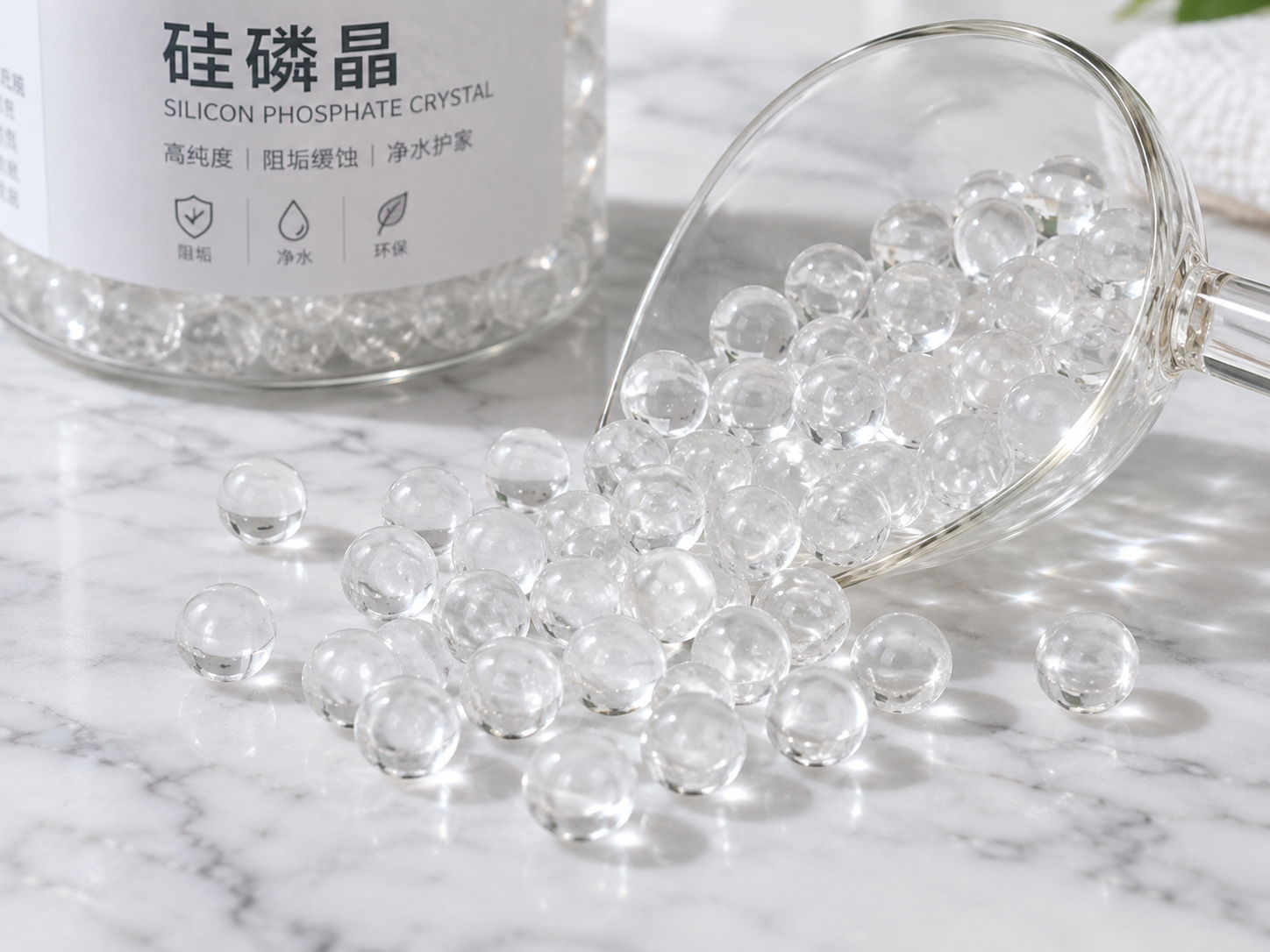
Siliphos crystal products fall within this category. They are typically supplied as small, glassy beads or granules that dissolve gradually, releasing polyphosphate into the flowing water. The exact composition—whether sodium hexametaphosphate, a blended glass polyphosphate, or another formulation—varies by manufacturer, so always confirm the active ingredient and its concentration before pairing the product with a given application.
Where Sequestration Fits in a Complete Treatment Train
Because polyphosphate media does not remove particles, it rarely works alone. A practical water-treatment system for scale-prone water often combines stages:
- Pre-filtration—a sediment or multimedia filter removes suspended matter that could foul downstream equipment.
- Polyphosphate contact—water passes through or over siliphos crystal or equivalent media, allowing sequestration of dissolved minerals.
- Post-treatment (if needed)—activated carbon for taste or chlorine removal, UV for disinfection, or a reverse-osmosis membrane for broader contaminant reduction.
If you skip step one and feed turbid water directly into a polyphosphate cartridge, you risk clogging the media bed and shortening its effective life. If you skip step two and rely only on a sand filter, dissolved calcium will still precipitate as scale once the water is heated or concentrated.
Common Misunderstandings That Lead to Poor Purchasing Decisions
“Polyphosphate media softens water.”
No. Water softening replaces calcium and magnesium ions with sodium (or potassium) through ion-exchange resin. Polyphosphate sequestration leaves the ions in the water but keeps them from forming scale. The water hardness number on a test report does not decrease after polyphosphate treatment. If true softening is required, a separate ion-exchange system is necessary.
“If it says ‘crystal media,’ it filters fine particles.”
Not necessarily. The word “crystal” in a product name describes physical form, not filtration function. A siliphos crystal bead may be 1–3 mm in diameter, but its purpose is chemical dosing, not particle capture. Always check whether the manufacturer specifies a micron rating or a filtration classification. If none is provided, treat the product as a sequestration agent, not a filter.
“One polyphosphate cartridge replaces a whole filter system.”
Only in very limited cases—for example, a point-of-use device on a single faucet where source water is already clear and the only concern is scale on the tap or coffee machine. In any system with visible turbidity, iron sediment, or biological growth, polyphosphate alone is insufficient.
Selecting the Right Polyphosphate Product for Your Application
When evaluating polyphosphate media such as siliphos crystal or comparable formulations, focus on factors that actually affect performance rather than marketing labels.
- Active ingredient and concentration. Confirm whether the product is sodium hexametaphosphate, a glass-based polyphosphate, or a proprietary blend. Different chemistries have different solubility rates and effective pH ranges.
- Water chemistry compatibility. Very low or very high pH, very high hardness, or the presence of certain oxidizers can reduce polyphosphate effectiveness. Verify suitability against your actual source-water analysis.
- Contact time and flow rate. Sequestration is a kinetic process. If water moves too quickly through the media bed, the polyphosphate may not fully complex the target ions. Manufacturer guidance on recommended flow rates is essential.
- Service life and replenishment method. Ask for the expected depletion interval under defined conditions, not a vague “lasts for months” claim. Some systems use cartridges that are swapped; others use refillable vessels.
- Certifications and regulatory status. If the application involves drinking water, confirm that the specific product—not just the raw material—has been tested and approved for that use in the destination market. “Food-grade” raw material does not automatically make a finished product suitable for potable water.
Troubleshooting: When Your Polyphosphate System Underperforms
If scale still appears after installing polyphosphate media, walk through these checks before assuming the product is defective:
- Verify that pre-filtration is functioning and that suspended solids are not bypassing the system.
- Confirm the flow rate is within the manufacturer’s recommended range for the media volume installed.
- Test the polyphosphate residual in the treated water; if it is near zero, the media may be exhausted or the water chemistry may be overwhelming the dose.
- Check source-water pH. Many polyphosphate formulations perform best in a neutral to slightly alkaline range. Acidic water can accelerate hydrolysis and reduce effective life.
- Ensure no incompatible chemicals (such as strong oxidizers or certain coagulants) are being introduced upstream.
Where to Go From Here
Understanding that polyphosphate media sequesters rather than filters is not a minor semantic point—it determines vessel sizing, system architecture, maintenance schedules, and compliance strategy. Once you are clear on the mechanism, selecting siliphos crystal or another polyphosphate product becomes a matter of matching chemistry, flow, and service expectations to your real water conditions.
If you are sourcing polyphosphate media for a specific project, ENVO CHEMICAL can help you match the right formulation to your application. Share your source-water parameters (hardness, pH, iron or manganese levels), the type of equipment or vessel you plan to use, the required flow rate, and your destination market, and we will work with you on a specification that fits.
