
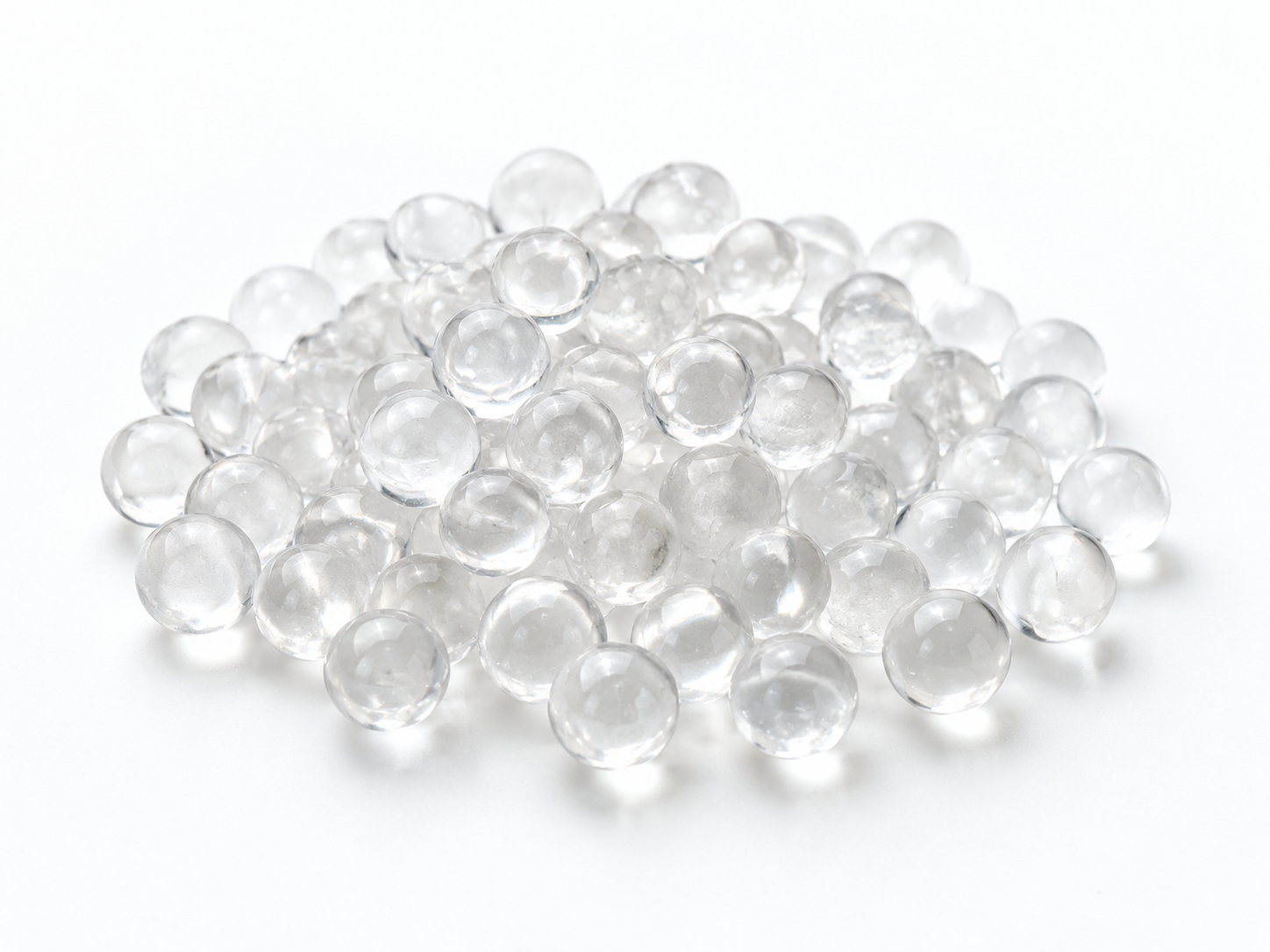
Ball Diameter and Cartridge Pore Size Are Two Separate Specifications in Polyphosphate Media
The diameter of individual polyphosphate balls or crystals and the pore size of the cartridge housing that contains them measure completely different things. Ball diameter describes the physical size of each media granule, while cartridge pore size describes the maximum opening in the filter housing wall that prevents granules from escaping. Confusing the two leads to wrong cartridge selections, premature media loss, and ineffective dosing. When you specify or compare polyphosphate media for a project, treat these as independent parameters and verify each one against your equipment design.
What Ball Diameter Actually Tells You
Polyphosphate media sold as balls, beads, or irregular crystals comes in a range of granule sizes. The stated ball diameter—often given as a range such as 2–4 mm or 4–6 mm—refers to the approximate size of each individual piece of media after manufacturing and before it dissolves in water.
This dimension matters for three practical reasons:
- Dissolution rate. Smaller granules present more surface area per unit mass, so they tend to release phosphate ions faster. Larger granules last longer before needing replacement but may dissolve more slowly at low flow rates.
- Bed packing and flow distribution. In a loose-fill vessel, uniform granule size promotes even water contact. A wide size distribution can create channeling, where water bypasses portions of the media bed.
- Compatibility with cartridge or vessel openings. The granule must be large enough that it does not slip through structural gaps in the housing, yet small enough to fit comfortably within the intended container volume.
Note that polyphosphate media is a scale inhibition material, not a filter medium in the mechanical-filtration sense. It works by slowly releasing orthophosphate and polyphosphate species into the water stream, which interfere with crystal nucleation of calcium carbonate and other scale-forming minerals. It does not physically trap particles, soften water by ion exchange, or disinfect. If your application requires particle removal, you need a separate filtration stage upstream or downstream of the polyphosphate dose point.
What Cartridge Pore Size Actually Tells You
Cartridge pore size is a property of the housing, not the media. It defines the largest particle that can pass through the filter wall, screen, or membrane of a cartridge-style or inline polyphosphate dosing unit. Common ratings include 5 microns, 10 microns, 25 microns, and 50 microns, depending on the manufacturer and application.
A cartridge with a 25-micron pore size will retain any polyphosphate granule larger than roughly 25 microns—which covers essentially all commercial polyphosphate balls, since even the finest granules are measured in millimeters. In practice, the pore size in a polyphosphate cartridge serves a different purpose than in a sediment filter:
- It keeps granules from escaping into the downstream plumbing.
- It may also block fine sediment or rust particles that could foul the media bed or reduce dissolution efficiency.
- It does not determine how much phosphate the media releases; that depends on water chemistry, flow rate, and contact time.
If you see a product listing that gives only one number and calls it “pore size” without clarifying whether it refers to granule diameter or housing filtration rating, ask the supplier to separate the two specifications. Reliable technical sheets list them distinctly.
Why the Confusion Happens on Product Pages
Many online listings for polyphosphate media bundle ball size and housing specifications into a single descriptive line or use ambiguous terms like “mesh size” or “filter grade” without definition. This creates three common mistakes:
- Selecting a cartridge with a pore size too large for the granules. If the housing openings exceed the granule size, media escapes into the water line, causing blockages and loss of treatment capacity.
- Selecting a cartridge with a pore size too small. An unnecessarily fine screen restricts flow, increases pressure drop across the unit, and may clog quickly with sediment that would otherwise pass harmlessly.
- Assuming ball diameter equals filtration capability. A 4-mm polyphosphate ball does not filter 4-mm particles. It is a dissolving chemical treatment medium, not a mechanical filter element.
How to Specify Both Parameters Correctly
When you are sourcing polyphosphate media for a specific installation, gather the following information before comparing products or requesting quotations:
- Your equipment type: inline cartridge, gravity-feed vessel, metering pump feed, or bulk storage silo.
- The granule size range your equipment can accommodate without bridging or excessive pressure drop.
- The housing or cartridge pore rating already built into your dosing unit, or the maximum pore size you can install if you are designing a new unit.
- Your source-water conditions: hardness, pH, temperature, and iron or manganese content, because these affect dissolution behavior and may dictate whether a pre-filter is needed.
- The target phosphate dose in milligrams per liter, which determines how much media you need and how often it must be replenished.
If any of these variables are unknown, confirm them before finalizing a purchase. Guessing at dose rates or media life leads to either under-treatment (scale still forms) or over-treatment (excess phosphate discharge, which may conflict with local discharge regulations).
Quick Comparison: Ball Diameter vs. Cartridge Pore Size
| Feature | Ball Diameter (Granule Size) | Cartridge Pore Size (Housing Rating) |
|---|---|---|
| What it measures | Physical size of each polyphosphate piece | Maximum opening in the cartridge wall or screen |
| Typical units | Millimeters (e.g., 2–4 mm) | Microns (e.g., 10 µm, 25 µm) |
| Primary function | Controls dissolution rate and bed behavior | Retains granules and may block sediment |
| Affects flow? | Indirectly, through bed packing | Directly, through pressure drop across the screen |
| Determines phosphate dose? | Partially, via surface-area-to-mass ratio | No |
| Can be the same number? | No—granules are orders of magnitude larger | No—pore sizes are orders of magnitude smaller |
Common Scenarios Where Getting Both Numbers Right Matters
Retrofitting an Existing Inline Dosing Cartridge
If you are replacing media inside a cartridge that already has a fixed housing, you must match the new granule size to the existing pore rating. A cartridge designed for 4–6 mm beads with a 50-micron screen will not work with sub-millimeter powder, even if the powder dissolves faster. Confirm the housing specification from the cartridge manufacturer, not from the media supplier alone.
Designing a New Bulk-Feed Vessel
In a gravity-feed or pressurized vessel without a fine cartridge screen, ball diameter still matters for flow distribution, but pore size is less of a concern because the vessel itself retains the media. However, you may still need an upstream sediment filter to protect the media bed from fouling. Do not assume that a vessel eliminates the need for pore-size considerations if you later add an inline dosing point downstream.
Evaluating Compatibility with Corrosion-Inhibition Systems
Polyphosphate treatment is sometimes combined with silicate or other corrosion inhibitors. The media granule size and the pore size of any inline housing must both be compatible with the combined chemistry. Some silicate-based blends can form gels or precipitates that clog fine screens. If your system uses a blend, verify that the housing pore rating can handle the expected particulate load without rapid fouling.
What You Still Need to Confirm
Even with correct ball-diameter and pore-size specifications, several application-specific questions remain open for any given project:
- Does the polyphosphate product meet the regulatory requirements for your destination market, particularly if the treated water is for human consumption? Food-grade labeling alone does not confirm drinking-water compliance in every jurisdiction; the specific product formulation and local standards both must align.
- What is the expected service life of the media under your actual flow and water-chemistry conditions? Published estimates vary widely and depend on factors you must measure on site.
- Is a pre-filtration stage required to protect the media from iron, sediment, or organic fouling?
These are not questions that a generic product page can answer. They require data from your installation or from testing under representative conditions.
Ready to Match Polyphosphate Media to Your System?
If you are specifying polyphosphate media for a new build, a cartridge refill, or a bulk-feed upgrade, the most efficient next step is to share your equipment type, the cartridge or vessel specifications you are working with, and your source-water profile. With that information, ENVO CHEMICAL can help you confirm whether the granule size and housing pore rating you need are available and what dosing parameters apply to your conditions. Provide the details above and we will respond with a focused recommendation.
