
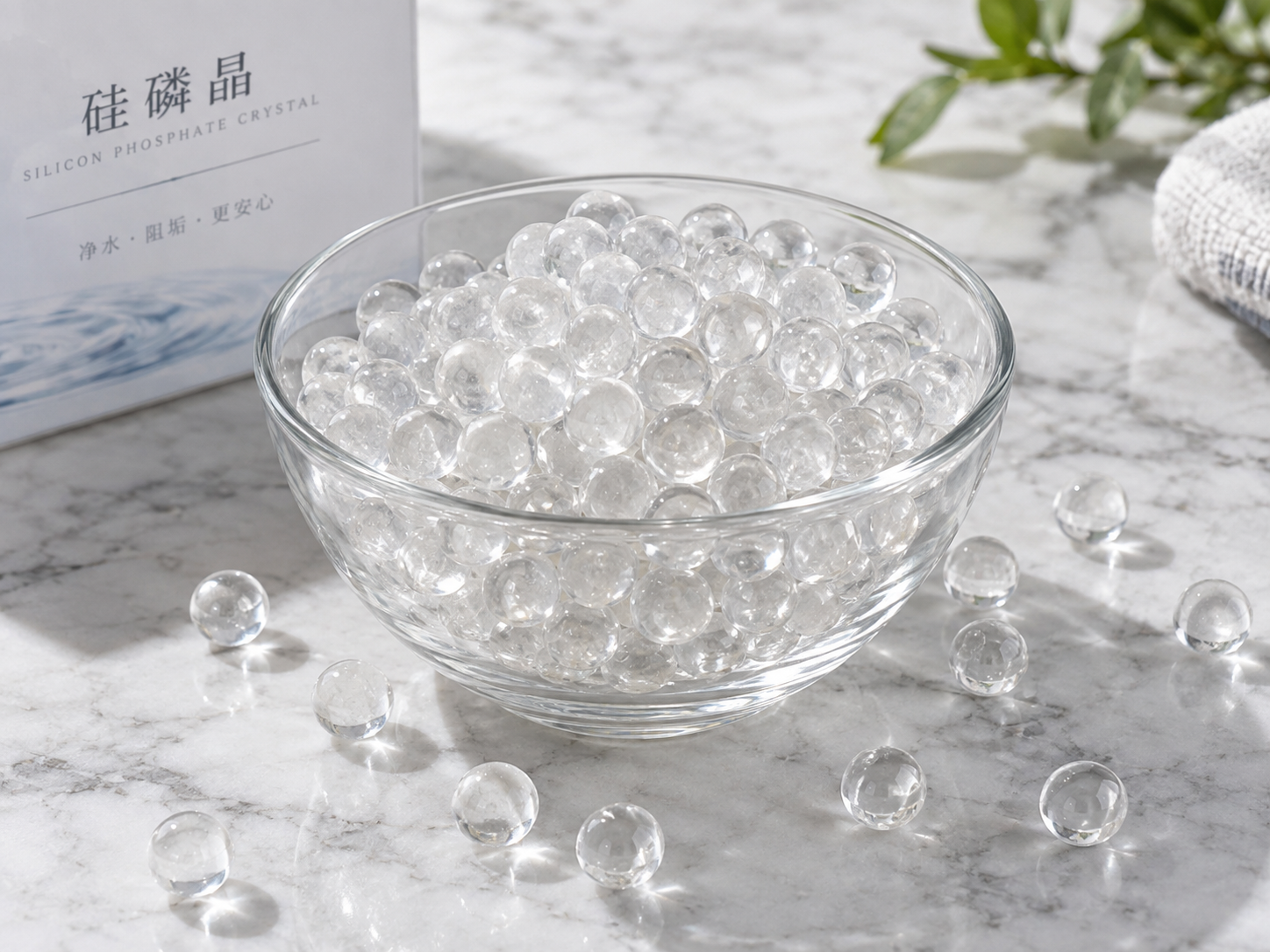
What Polyphosphate Media Actually Adds to Water — and What It Never Removes
Polyphosphate treatment media adds soluble phosphate compounds into the water stream to inhibit scale formation and reduce corrosion, but it does not remove hardness, existing scale, particulates, bacteria, or dissolved contaminants. If you are evaluating polyphosphate crystals or granules for a filtration or dosing system, the most important first step is separating what this technology achieves from what it cannot achieve, because confusing the two leads to undersized systems, failed performance expectations, and costly retrofits.
The Core Function: Sequestration and Threshold Inhibition
When polyphosphate media contacts water, it slowly dissolves and releases orthophosphate and long-chain polyphosphate species. These molecules perform two principal actions:
- Threshold inhibition. Polyphosphate interferes with the nucleation and crystal growth of calcium carbonate and other mineral scales. Even at concentrations far below stoichiometric equivalence, the phosphate species keep dissolved minerals in solution rather than allowing them to precipitate on pipe walls, heat exchangers, or appliance elements.
- Sequestration of metal ions. Polyphosphate can bind iron, manganese, and to a lesser extent calcium and magnesium, forming soluble complexes that remain suspended rather than depositing. This is why you sometimes see polyphosphate used upstream of iron-removal stages — it keeps iron in a dissolved, filterable form.
Neither action constitutes filtration or physical removal. The minerals and metals stay in the water; they are simply prevented from forming adherent deposits. For anyone designing a system around polyphosphate, this distinction is critical. You are managing chemistry, not extracting material.
What Polyphosphate Media Does Not Remove
Does polyphosphate soften water?
No. Traditional water softening uses ion-exchange resins that physically swap calcium and magnesium ions for sodium or potassium ions, thereby reducing total hardness. Polyphosphate does not exchange ions. It modifies the behavior of hardness minerals so they do not precipitate, but the total dissolved solids and hardness values in the water remain essentially unchanged. If your specification requires a measurable reduction in hardness ppm, polyphosphate alone will not meet it.
Does polyphosphate remove existing scale?
No. Polyphosphate cannot dissolve or detach scale that has already formed on surfaces. Once calcium carbonate or other mineral deposits have crystallized and adhered to a pipe or heating element, they require mechanical cleaning, acid descaling, or replacement. Polyphosphate only works on minerals that are still in solution. Some users mistakenly expect a polyphosphate dosing system to “clean” an existing scaled system — it will not.
Does polyphosphate filter out particles, sediment, or microorganisms?
No. Polyphosphate media is a chemical treatment product, not a mechanical filter medium. It does not trap sediment, reduce turbidity, or provide any disinfection. If your application requires particulate removal, you need a separate filtration stage such as sediment cartridge, multimedia filter, or membrane. If microbial control is required, polyphosphate offers no meaningful barrier. In fact, the phosphate it adds can serve as a nutrient source for certain bacteria if not managed within an overall treatment plan.
Does polyphosphate remove chlorine, organics, or specific chemical contaminants?
No. Polyphosphate does not adsorb or chemically neutralize chlorine, volatile organic compounds, pesticides, heavy metals beyond limited sequestration, or other specific contaminants. Any claim that a polyphosphate product alone provides broad-spectrum contaminant removal should be treated with skepticism. For those objectives, activated carbon, specialized adsorbents, oxidation systems, or reverse osmosis are the appropriate technologies.
How Polyphosphate Fits Inside a Multi-Stage Treatment Train
Because polyphosphate adds rather than removes, it is most effective when paired with other technologies that handle what it cannot. A typical arrangement for commercial or industrial applications might look like this:
| Stage | Function | What it handles |
|---|---|---|
| Sediment pre-filter | Mechanical trapping | Sand, rust, suspended solids |
| Activated carbon or specialized media | Adsorption | Chlorine, organics, taste/odor compounds |
| Polyphosphate dosing or contact vessel | Chemical inhibition | Scale prevention, metal sequestration, mild corrosion control |
| Post-treatment (optional) | Polishing or disinfection | Fine particulates, microbial control, final pH adjustment |
In this structure, polyphosphate occupies a specific niche: protecting downstream equipment and distribution lines from mineral deposition. It does the job it is designed for — and only that job — when the upstream stages have already removed what it cannot address.
Practical Conditions That Affect Polyphosphate Performance
Even within its intended role, polyphosphate performance is not unconditional. Several factors determine whether it will deliver reliable scale inhibition in your system:
- Water temperature. Higher temperatures accelerate both scale formation and polyphosphate dissolution. The dosing rate must be matched to the worst-case temperature your system will see. Cold water systems may need less polyphosphate but also dissolve it more slowly.
- pH range. Polyphosphate is generally stable across a wide pH range, but extreme pH values can affect the speciation of phosphate and its interaction with calcium. Confirm the operating pH of your specific application.
- Contact time. The water must remain in contact with the dissolved polyphosphate long enough for sequestration and inhibition to occur. A very high flow rate with minimal contact vessel volume reduces effectiveness.
- Residual phosphate level. Too little phosphate and scale inhibition fails; too much can cause downstream issues including interference with certain disinfectants or exceeding discharge limits in wastewater. The target residual must be set based on your water chemistry and regulatory context.
- Compatibility with other chemicals. If your system also uses chlorine, ozone, or other oxidants, verify that those chemicals do not degrade the polyphosphate faster than intended, which would shorten the effective treatment window.
None of these conditions can be generalized into a single number without knowing your specific water analysis and system design. Any product page that implies one-size-fits-all dosing without reference to water chemistry is oversimplifying the reality.
Evaluating Polyphosphate Product Listings: Questions to Ask
When you compare polyphosphate products from different suppliers, look beyond the headline claims. A useful checklist includes:
- Does the listing clearly state whether the product is intended for dosing/dissolution or for direct media contact in a filter vessel?
- Does it specify the form — crystals, granules, or pre-dissolved liquid — and the implications for dissolution rate and handling?
- Are the expected operating conditions (pH, temperature, flow range) stated, or must you infer them?
- Does the description distinguish between scale inhibition and actual contaminant removal, or does it blur the two?
- Is there any reference to compatibility with your existing treatment stages, or is the product presented as a standalone solution?
- Are regulatory or drinking-water suitability claims limited to what has been verified for the specific product and market, or are they vague?
A trustworthy product page will not promise that polyphosphate “purifies” water or “removes impurities.” It will explain the chemistry, state the intended function, and flag the limitations.
Common Misconceptions About Polyphosphate in Water Treatment
Two misunderstandings appear repeatedly in procurement discussions and should be addressed directly.
Misconception 1: “Polyphosphate replaces a water softener.” In residential or light-commercial settings where users want lower hardness readings on a test strip, polyphosphate will not produce those results. It prevents new scale but leaves the dissolved hardness intact. If your end user or specification demands reduced hardness, an ion-exchange softener or a reverse osmosis stage is still required.
Misconception 2: “If I add polyphosphate, I do not need filtration.” Polyphosphate does nothing to remove the particles already present in your water. Turbidity, sediment, and biological matter must still be handled by appropriate filtration or disinfection. Skipping these stages because you have dosed polyphosphate is a common source of system fouling and customer complaints.
Where ENVO CHEMICAL Fits Into Your Evaluation
ENVO CHEMICAL supplies polyphosphate-based water treatment materials, including siliphos-type crystal products, for scale inhibition and corrosion control applications. If your project requires a product that provides controlled phosphate release for threshold inhibition — rather than one that claims to filter, soften, or disinfect — reviewing the specific formulation and technical guidance ENVO CHEMICAL provides for your operating conditions is a practical next step. The key is matching the product to the chemistry of your water and the architecture of your treatment train.
Request a Targeted Product Match
If you are specifying polyphosphate media for a new installation or troubleshooting an existing dosing system, share the details that matter most: your source water analysis (hardness, pH, temperature, iron/manganese levels if present), the type of equipment or vessel where the media will be used, the flow rate range, whether you need to comply with a specific drinking-water or discharge standard, and the destination market. With that information, the right polyphosphate specification — and an honest assessment of what it will and will not do for your application — becomes straightforward to define.
