
Why Do Polyphosphate Media Manufacturers Offer So Many Ball Sizes?
The short answer is that ball size is not a marketing gimmick — it is a functional parameter tied to how the media performs inside a specific vessel, at a specific flow rate, and for a specific water chemistry. When dealers see five, seven, or even ten size options across a polyphosphate product range, the confusion is understandable. But each size exists because the hydraulic and dissolution behaviour of the media changes with diameter, and those changes matter for real installations.
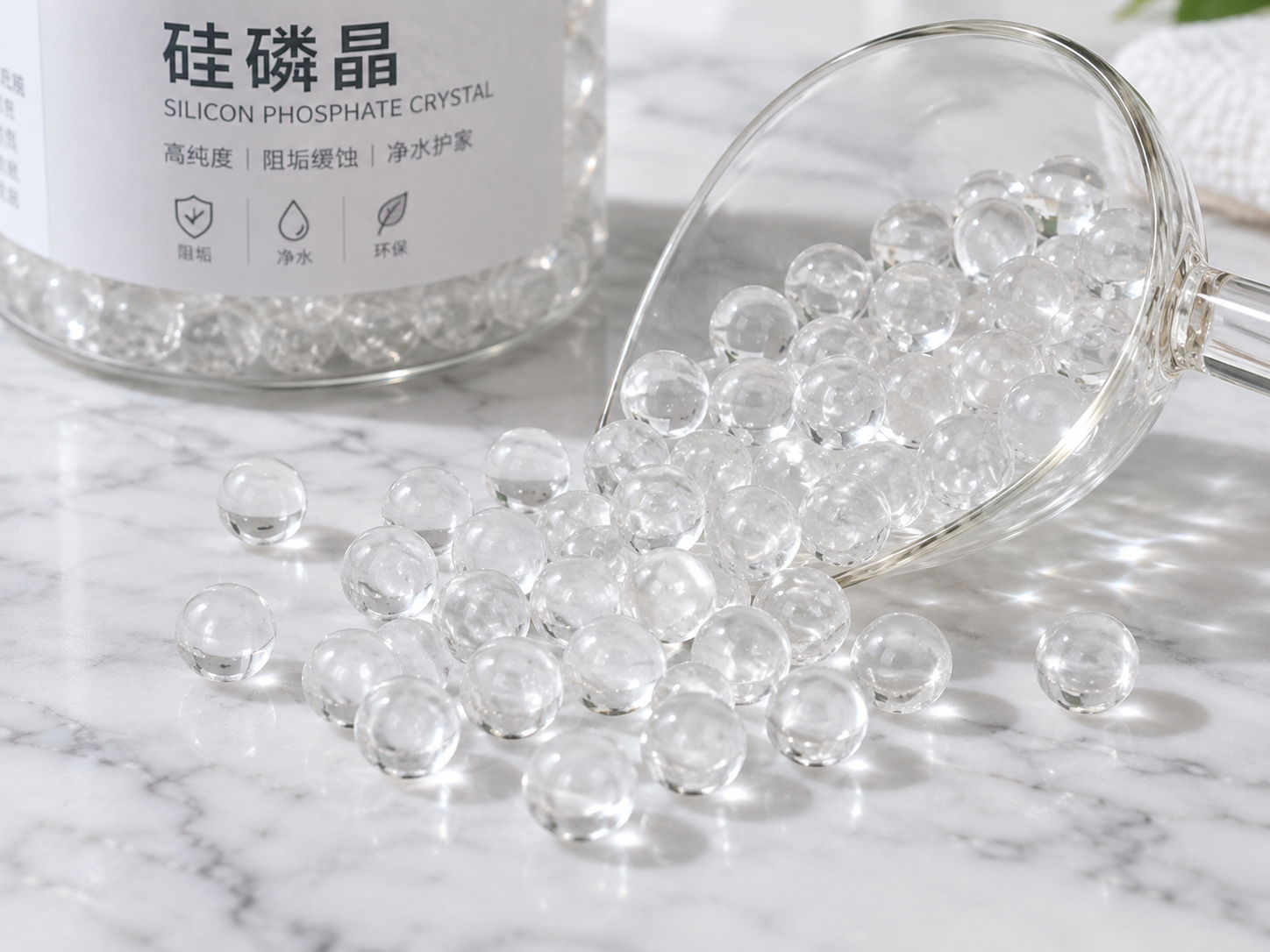
Polyphosphate media, including siliphos-type crystals supplied in spherical or bead form, works by slowly dissolving at the crystal surface and releasing orthophosphate and polyphosphate chains into the water. Those chains interfere with calcium carbonate and calcium sulfate crystal nucleation, reducing scale formation on pipes, heat exchangers, and appliances. This is scale inhibition, not water softening, not scale removal, and not disinfection. The distinction matters because a dealer recommending the wrong size for a given system can end up with under-dosing, channelling, or premature media exhaustion — all of which damage credibility.
What Actually Changes When Ball Size Changes
Surface-area-to-volume ratio controls dissolution rate
Smaller balls have a higher surface-area-to-volume ratio. That means, per gram of media, more crystal surface is exposed to the water, so the release rate of active polyphosphate is faster. Larger balls dissolve more slowly per unit mass. A dealer who stocks only one size and tries to apply it everywhere will either overdose small residential units or underdose large commercial systems.
Hydraulic packing and pressure drop
Vessel diameter and flow rate determine which ball size avoids two problems: channelling (water finding easy paths through the media bed) and excessive pressure drop (water struggling to push through). A general rule of thumb in packed-bed design is that the ball diameter should be at least one-tenth of the vessel diameter, and preferably one-fifth or more. If a dealer fills a 10-inch housing with 2 mm beads, the pressure drop can spike; fill it with 12 mm beads and the water may channel around them.
Bed depth and contact time
For a given flow rate, smaller beads allow a deeper bed in the same vessel, which increases contact time between water and media surface. Larger beads produce a shallower bed. Contact time influences how completely the polyphosphate dissolves before the water exits the vessel. In fast-flow commercial applications, too-large beads may not release enough active ingredient within the available contact time.
A Practical Decision Framework for Dealers
Rather than memorising every size in every manufacturer’s catalogue, dealers can use a short checklist to narrow down the right specification for each job.
- Identify the application class. Residential point-of-entry, small commercial, or large industrial? Each class has typical flow-rate ranges.
- Confirm the vessel or housing size. Measure the inner diameter of the cartridge or tank. This immediately rules out sizes that are too large or too small.
- Determine the target dosage. This depends on source-water hardness, pH, temperature, and the system’s tolerance for scale. Without water-test data, no responsible dealer should recommend a size — the dosage drives how much media surface is needed, which in turn drives size and quantity.
- Match ball size to vessel and flow. Use the one-tenth-to-one-fifth vessel-diameter guideline as a starting point, then confirm with the media supplier’s technical data for the specific product.
- Check compatibility. Ensure the media is suitable for the water chemistry. High-iron or high-manganese source waters, very low pH, or very high TDS conditions can affect performance. Verify what the supplier confirms for the exact grade you intend to stock.
Common Sources of Dealer Confusion — and How to Avoid Them
Assuming all “polyphosphate balls” are interchangeable
Not all polyphosphate media are the same. Siliphos-type crystals are a specific formulation of sodium hexametaphosphate glass that dissolves to release sequestering agents. Other products may use different phosphate blends, different binders, or different manufacturing processes that affect dissolution curve, mechanical strength, and purity. A 6 mm ball from one supplier may behave very differently from a 6 mm ball from another. Dealers should never assume cross-compatibility based on size alone.
Treating size as the only variable
Some dealers see a catalogue listing 3 mm, 5 mm, 8 mm, 10 mm, and 12 mm and think they just need to pick one. In reality, size interacts with media grade, bed depth, flow rate, and replacement interval. A 5 mm bead in a slow-flow system may last months; the same bead in a high-flow system may need replacement in weeks. The dealer who only thinks in sizes will miscalculate service intervals and disappoint end users.
Ignoring what the end user actually needs
A plumbing contractor installing a whole-house system on 15 gpg hard water needs a different media volume and possibly a different size than a laundromat treating 30 gpg water at 40 gpm. The dealer’s job is to bridge that gap — and that means asking for water test results, not just guessing from a product sheet.
When to Simplify Your Stock and When to Expand It
For dealers serving a narrow market — say, only residential point-of-entry in a region with similar water hardness — carrying two or three sizes may cover 90 % of jobs. For dealers serving mixed residential, commercial, and light-industrial accounts, a broader range becomes necessary but also more complex to manage.
The key is to stock sizes that correspond to the vessel formats your customers actually use. If 10-inch and 20-inch Big Blue housings dominate your market, then a selection of sizes that fit those housings efficiently (roughly 6–10 mm for 10-inch, 8–14 mm for 20-inch, as a starting point) makes more sense than carrying every available diameter.
| Typical Housing | Approximate Inner Diameter | Suggested Starting Ball-Size Range | Notes |
|---|---|---|---|
| 9.75 in (2.5 in port) cartridge | ~80 mm | 6–10 mm | Common in residential POE |
| 10 in Big Blue | ~95 mm | 8–12 mm | Widely used in residential and light commercial |
| 20 in Big Blue | ~190 mm | 10–16 mm | Commercial and small industrial |
| 30–48 in FRP tank | 250–500 mm+ | 12–20 mm or larger | Industrial; confirm with supplier engineering data |
These ranges are illustrative starting points. Exact selection must account for flow rate, required dosage, and the specific product’s certified performance data.
What Dealers Should Ask Before Placing a Polyphosphate Media Order
- What is the dissolution profile of this specific grade — how much active phosphate is released per gram per hour under defined conditions?
- What vessel sizes and flow rates has this size been tested or recommended for?
- Is there a published replacement-interval guide for common hardness and flow scenarios?
- Does this product carry any third-party testing or certification relevant to my target market (for example, NSF/ANSI 61 for drinking-water system components, if applicable and verified)?
- What is the recommended bed depth for each ball size at typical residential and commercial flow rates?
These questions protect the dealer from overpromising and help build trust with installers and end users. A supplier that cannot answer them clearly is not a reliable long-term partner.
Reducing Confusion Starts with Matching Product to Job, Not Catalogue to Shelf
The real problem behind “too many ball sizes” is not that manufacturers are being difficult — it is that the physics of packed-bed dissolution demands options. Dealers who understand why the options exist can turn a confusing catalogue into a confident recommendation. The goal is never to carry everything; it is to carry the right things for the jobs you actually encounter, and to know when to reach out to the supplier for technical backing rather than guessing.
ENVO CHEMICAL supplies siliphos crystal polyphosphate media in multiple bead sizes to support different system designs. If you are evaluating which specification fits your current or upcoming projects, share your application type, housing dimensions, source-water hardness, flow rate, and target market — and we can point you to the size and grade that align with those conditions.
