
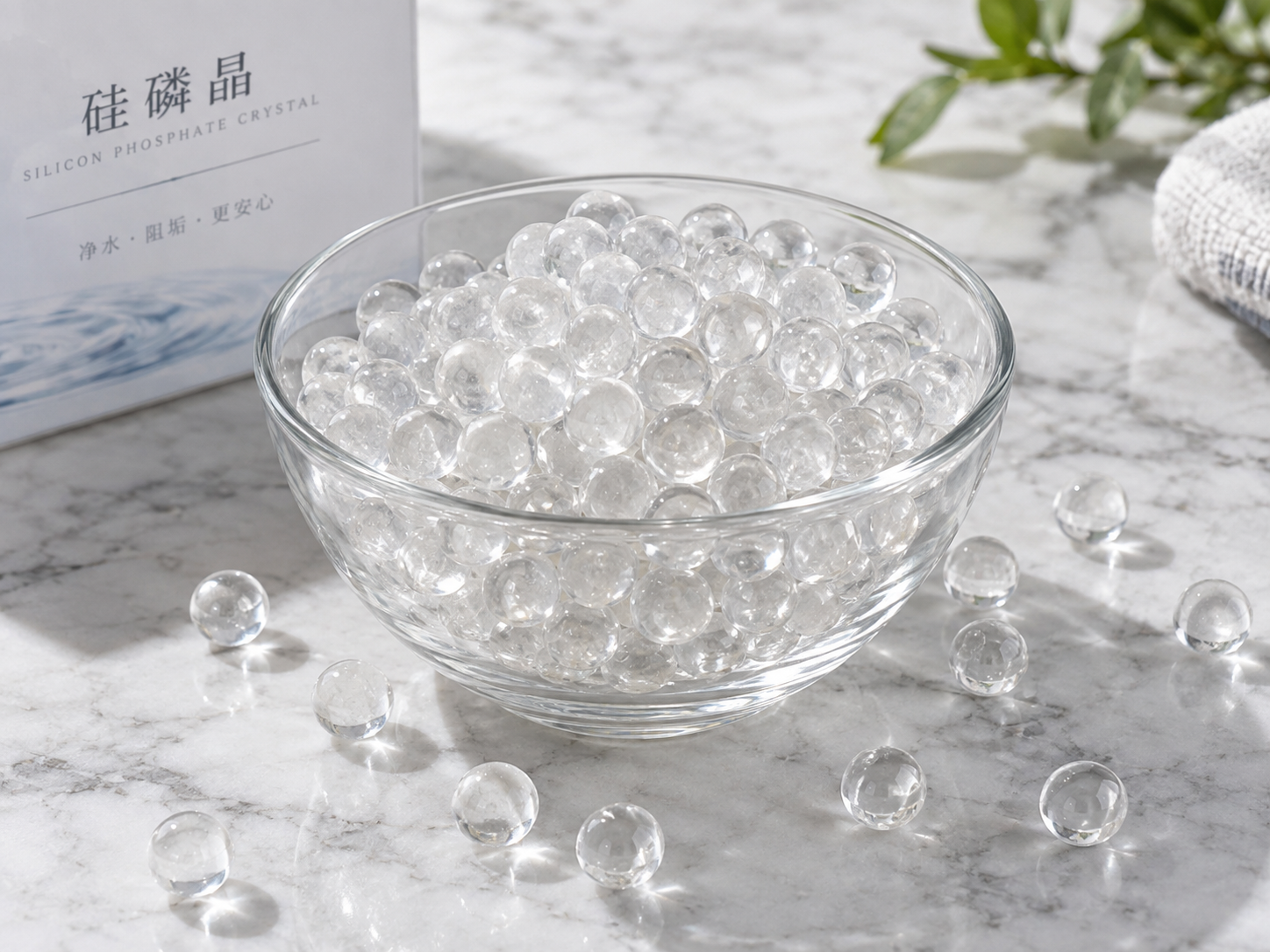
What “Ball Size” Actually Means in a Polyphosphate Quote
When a polyphosphate supplier quotes a ball size of, say, 3 to 5 mm, that figure can refer to an average diameter, a production range, or a guaranteed minimum — and the distinction changes how the material performs in your dosing or reactor system. Before you compare prices or place an order, confirm exactly what the number represents. A vague specification invites mismatched expectations, clogged feeders, or inconsistent dosing.
This article explains why ball-size ambiguity matters for siliphos crystal and related polyphosphate media, how to interpret common supplier language, and what questions to ask so your purchasing decision is based on real parameters rather than assumptions.
Why Ball Size Matters More Than It Looks
Polyphosphate products used for scale inhibition — including siliphos-type crystal formulations — are typically supplied as solid beads or irregular granules. Their physical size influences three operational factors:
- Dissolution rate. Smaller beads dissolve faster, which matters when you need quick release in a inline dosing setup. Larger beads dissolve more slowly, suiting slow-release or batch-type applications.
- Feeder compatibility. Screw feeders, belt feeders, and hopper systems each have minimum and maximum particle sizes they can handle without bridging or jamming.
- Surface area per unit mass. Finer material offers more contact area with water, potentially improving inhibition efficiency at a given dose — but it also increases dust generation and handling loss.
If you order based on a single number without knowing whether it is a mean value or a band, you may receive material outside your equipment’s tolerance. That is the core practical risk the title warns about.
Decoding Common Ways Suppliers Express Ball Size
Does “3–5 mm” mean a guaranteed range or an average with tolerance?
In most industrial supply contexts, a figure written as “3–5 mm” is intended to describe the production range — the majority of particles fall between those limits. However, some suppliers use the same notation to mean “nominal 4 mm, acceptable between 3 and 5.” The difference is subtle but important: the first interpretation allows a significant fraction of undersize or oversize particles; the second implies tighter control around the midpoint.
Always ask the supplier to specify:
- Whether the figure is a range (minimum and maximum) or a nominal/average value.
- What percentage of the batch must fall within the stated limits (commonly 80 % or 90 % by weight).
- Whether a sieve analysis report accompanies the shipment or is available on request.
What about single-number quotes like “4 mm”?
A single number without a qualifier usually signals a target or average. It does not tell you how much material is finer or coarser. Without a stated tolerance, you cannot predict dissolution behavior or feeder performance with confidence. Request the tolerance band or a particle-size distribution curve before committing.
How Siliphos Crystal Fits Into the Picture
Siliphos crystal is a specific type of polyphosphate-based scale inhibitor, often discussed in the context of residential and light-commercial water treatment. It typically appears as translucent or white crystalline beads. Like other polyphosphate media, its effectiveness depends on controlled release of orthophosphate or long-chain polyphosphate ions into the water stream — a process governed partly by bead size and partly by water chemistry (pH, temperature, hardness, flow rate).
It is worth noting that siliphos crystal is not interchangeable with every polyphosphate product on the market. Differences in composition, chain length, and crystal structure mean that two products both labeled “polyphosphate” can behave quite differently. When evaluating ball size for a siliphos-type crystal, treat the specification as product-specific rather than generic.
A Simple Checklist Before You Accept a Quote
Use this short list to verify that a polyphosphate ball-size specification is clear enough for your application:
- Confirm the figure is labeled as either “range,” “nominal,” or “average” — not left ambiguous.
- Ask for the sieve test method used (for example, ASTM or ISO mesh standards) and the pass/fail percentages.
- Match the size to your dosing equipment’s manufacturer recommendations for minimum and maximum particle diameter.
- Verify that the size specification applies to the specific product you intend to buy, not to a different grade in the supplier’s catalogue.
- If your application involves drinking water, confirm that the exact product — not just the raw material class — has been evaluated for suitability under your local regulations. A “food-grade” label on a raw polyphosphate does not automatically certify the finished bead product for potable use.
When Tighter Control Actually Pays Off
Not every application demands narrow size distribution. If you are filling a large bulk tank where dissolution happens over days, a wider range may be acceptable and even cheaper. If you are feeding through a precision screw feeder into a high-flow commercial system, tighter control reduces the risk of blockage and dose drift.
The key is to align the specification with your system, not to assume that “tighter is always better” or that “a range is always loose.” Context decides.
What to Ask When You Send an Inquiry
To get a useful response from a supplier — including ENVO CHEMICAL — frame your request around the parameters that matter for your setup. Provide:
- The intended application (scale inhibition, corrosion control, etc.) and whether it is for potable or non-potable water.
- Your source-water conditions where known: approximate hardness, pH, temperature, and flow rate.
- The type of dosing or reactor equipment you plan to use.
- The ball-size specification you need, stated as either a range or a nominal value with tolerance.
- Estimated quantity and destination market, so the supplier can confirm regulatory relevance.
With that information in hand, you will receive a quote that you can evaluate on real terms — not on a number that might mean three different things.
If you are sourcing siliphos crystal or polyphosphate media and want to confirm whether a quoted ball size is an average, a range, or something else, share your application details and target specification with us. We will help you match the right product grade to your system requirements.
