
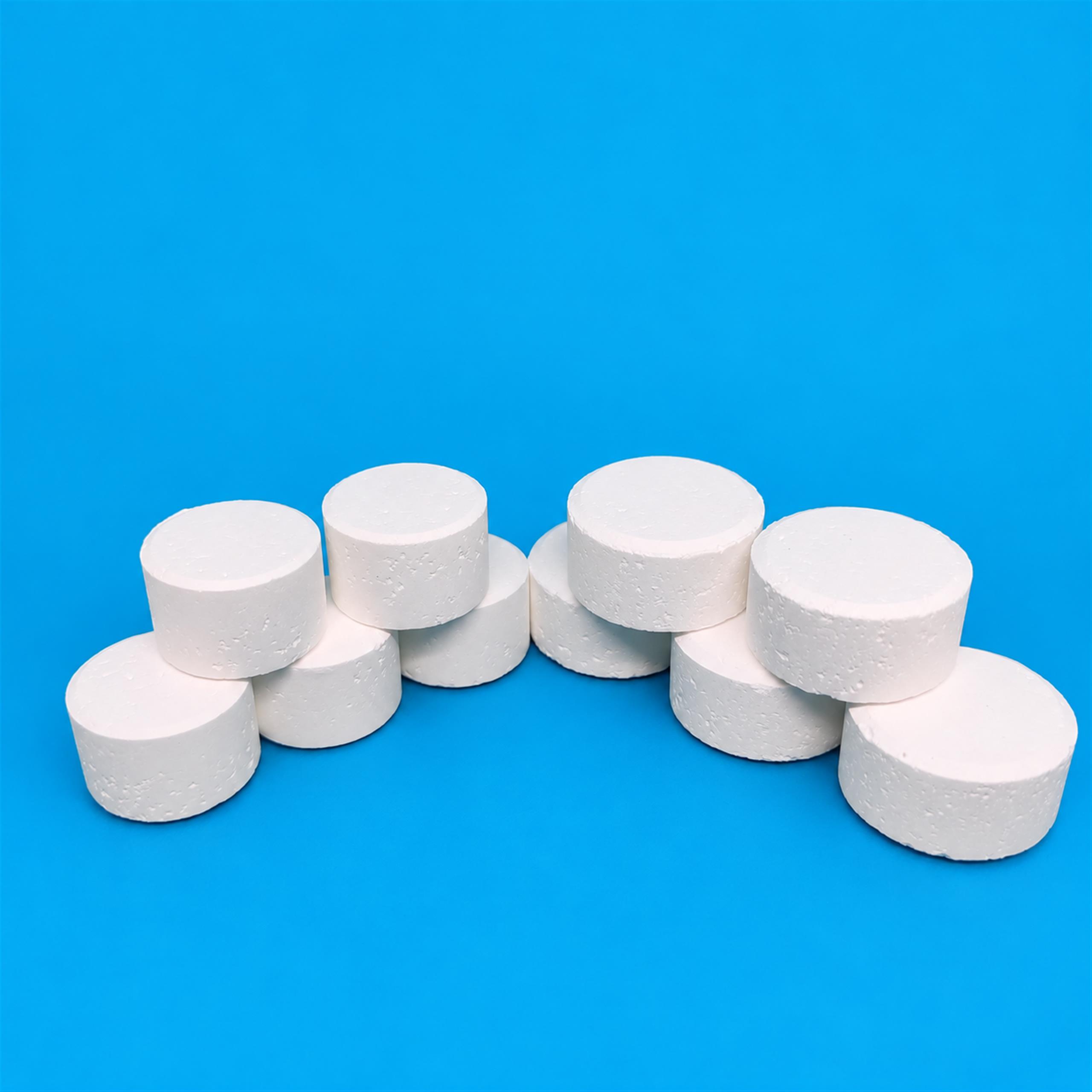
The Core Specifications R&D Teams Must Define When Sourcing SDIC for Effervescent Tablets
When sourcing sodium dichloroisocyanurate (SDIC) for effervescent tablet formulations, R&D teams should specify: available chlorine content (expressed as % w/w), anhydrous or dihydrate form, particle size distribution, moisture content, bulk density, and documented compatibility with the chosen acid–carbonate effervescent system. Without these defined parameters, a supplier cannot guarantee batch-to-batch consistency in dissolution rate, chlorine release, tablet hardness, or shelf stability.
The critical condition that changes this answer is the intended effervescent system itself. SDIC reacts with water and acids to release hypochlorous acid (HOCl). In an effervescent tablet, the acid source (commonly citric acid, tartaric acid, or sodium bisulfate) and the carbonate or bicarbonate source must be balanced so that SDIC does not degrade prematurely during manufacture or storage. Specifications that ignore this interaction will produce tablets that fizz too fast, too slowly, or lose active chlorine before use.
Available Chlorine and Chemical Form
Why the distinction between anhydrous and dihydrate matters
SDIC is commercially supplied in two principal forms: anhydrous (typically 55–60% available chlorine) and dihydrate (approximately 56% available chlorine by mass, but with two molecules of water of crystallization). For effervescent tablets, this distinction is not merely academic—it directly affects the mass of raw material needed per tablet, the water budget in the formulation, and the potential for premature reaction.
Anhydrous SDIC carries less water, which reduces the risk of activating the effervescent couple during compression or storage. Dihydrate SDIC introduces bound water that, depending on the humidity of the manufacturing environment, may initiate partial reaction with the acid component. R&D teams should specify which form is acceptable and, if dihydrate is chosen, require a moisture content limit low enough to prevent this.
Specifying available chlorine precisely
Available chlorine is the measure of oxidizing capacity, not total chlorine or total purity. R&D teams should request a certificate of analysis (CoA) that reports available chlorine on a dry-weight basis, with an acceptable range (for example, 55.0–60.0% for anhydrous material). Tolerances wider than ±2% can shift the dose per tablet enough to affect both efficacy and regulatory compliance in disinfection applications.
Do not rely on a generic “purity” figure. A material may be 99% pure by weight yet have only 54% available chlorine if the balance is inert filler or degradation products. Always ask for the available chlorine value, the titration method used (iodometric is standard), and the date of analysis relative to shipment.
Particle Size and Physical Properties
Particle size distribution controls dissolution and content uniformity
Effervescent tablets depend on rapid, complete disintegration once dropped into water. If SDIC particles are too coarse, dissolution lags and the tablet may not release its full chlorine payload within the target time. If particles are too fine, they can segregate during blending with excipients, cause dust hazards, or accelerate degradation through increased surface area.
R&D teams should specify a target particle size range—commonly 40–200 mesh (or equivalent in micrometres)—and request sieve analysis data on each shipment. A narrow distribution supports uniform content across tablets. Broad distributions increase the risk of content variation, especially in low-dose tablets where SDIC may represent only a fraction of the total mass.
Bulk density and flowability
Tablet manufacturing requires consistent die filling. Bulk density (typically 0.6–1.0 g/cm³ for granular SDIC, depending on form and particle size) must be specified so that the dosing equipment can be calibrated. Poor flowability leads to weight variation and rejects. If the supplier provides a granule grade rather than a powder, confirm that the granule size is compatible with the tablet press and with the other granular excipients in the formula.
Moisture Content and Stability Requirements
The moisture threshold that protects the effervescent system
Effervescent tablets are among the most moisture-sensitive oral dosage forms. SDIC itself is hygroscopic and releases chlorine when it contacts water. R&D teams must specify a maximum moisture content for the incoming SDIC—often below 0.5% for anhydrous grades—and confirm that the supplier can maintain this during packaging and transport.
This specification should be linked to the packaging requirement: moisture-barrier bags or drums with desiccant, sealed under inert atmosphere if possible. Without a defined moisture limit, the supplier has no obligation to control a parameter that directly determines whether the tablet will survive its shelf life.
Shelf-life expectations and accelerated stability data
Request that the supplier provide or support accelerated stability data for SDIC stored under the proposed packaging conditions. This does not mean the supplier must run a full tablet stability study—that is the formulator’s task—but they should be able to confirm that available chlorine loss remains within an acceptable range (commonly no more than 1–2% over 6 months at 40 °C / 75% RH) in the supplied material.
Compatibility with the Effervescent Couple
Acid source interaction is a formulation-level specification
The effervescent reaction in a tablet typically pairs an acid (citric acid, tartaric acid, or similar) with a carbonate or bicarbonate (sodium bicarbonate, sodium carbonate). SDIC must coexist with these components in the dry blend without reacting. R&D teams should specify which acid source they are using and ask the SDIC supplier to confirm that no adverse reaction occurs between the SDIC grade and that acid under dry conditions at the proposed storage temperature.
Some suppliers offer SDIC grades with anti-caking or flow-aid coatings. These coatings can alter reactivity and must be disclosed. R&D should request full ingredient declarations for any coated or treated SDIC product to evaluate compatibility before committing to a source.
pH behavior in the dissolved tablet
When the tablet dissolves, SDIC hydrolyzes to produce HOCl, and the solution pH typically falls in the range of 5.5–7.0 depending on the acid–base balance. R&D teams should specify the target pH range of the final solution, because this affects both the fraction of chlorine present as active HOCl versus hypochlorite ion (OCl⁻) and the stability of the dissolved product. The supplier does not control this directly, but knowing the available chlorine and the form of SDIC helps the formulator predict the outcome.
Documentation and Regulatory Alignment
What to request beyond the CoA
For effervescent tablets intended for disinfection, water treatment, or other regulated uses, R&D teams should ask the supplier for:
- Safety Data Sheet (SDS) current to the latest GHS revision
- Manufacturing process summary sufficient to identify potential impurities
- Heavy metals and residual solvent limits if the end product is subject to pharmacopeial or drinking-water standards
- Batch traceability so that any tablet failure can be linked back to a specific SDIC lot
Note that “food grade” or “pharma grade” labels alone do not confirm suitability for a specific regulatory framework. R&D must verify that the SDIC grade meets the actual limits required for the intended use and jurisdiction.
Putting the Specifications Together
A practical sourcing specification sheet for SDIC in effervescent tablets might read:
| Parameter | Typical Target | Why It Matters |
|---|---|---|
| Form | Anhydrous (or dihydrate with stated water) | Controls water budget and premature reaction risk |
| Available chlorine | 55.0–60.0% (dry basis) | Determines dose per tablet and efficacy |
| Moisture content | ≤ 0.5% | Prevents activation of effervescent system in storage |
| Particle size | 40–200 mesh (D50 specified) | Ensures dissolution rate and content uniformity |
| Bulk density | 0.6–1.0 g/cm³ | Enables consistent die filling |
| Coating/additives | None, or fully disclosed | Avoids unknown interactions with acid excipients |
R&D teams should circulate this specification to potential SDIC suppliers before requesting samples, so that quotations and technical data are directly comparable. Samples received without matching documentation should be treated as preliminary only.
When to Involve ENVO CHEMICAL
If your team is finalizing an effervescent tablet formulation and needs SDIC that meets a defined particle size, moisture limit, and available chlorine range, ENVO CHEMICAL can provide technical data sheets and batch-specific CoAs to support your evaluation. We do not formulate tablets, but we can confirm whether our SDIC grades align with the parameters your R&D team has specified.
To start that conversation, share your target available chlorine range, chosen acid–carbonate system, and any particle size or moisture limits you have set. We will confirm which material options fit before you commit to a trial batch.
