
Troubleshooting Sludge Dewatering Using Calcium Hypochlorite in Emergency Water Treatment
By: Dr. Julian V. Mercer, Senior Humanitarian Water & Sanitation Specialist
Let’s be brutally honest for a second. When disaster strikes—a flood sweeping through a city, an earthquake shattering sewage lines, or a hurricane overwhelming a refugee camp—the immediate focus is always on the water coming out of the tap. We obsess over chlorine residuals, turbidity, and pathogen kill rates. And we should. But there’s a silent, muddy crisis happening in the background that can bring an entire emergency response to a grinding halt: sludge dewatering.
I remember standing knee-deep in muck at a temporary treatment site in Southeast Asia just days after a massive monsoon. The air was thick with the smell of stagnant water and decay. A local engineer, let’s call him Mateo, looked at me with eyes red from exhaustion and gestured to a row of geotextile bags that were barely holding their shape. “We’re filtering the water,” he shouted over the roar of generators, “but the sludge… it’s like soup. It won’t dry. The bags are bursting, the liquid is leaking back into the clean zone, and we have nowhere to put it. If we can’t dewater this sludge, we have to stop treating water. We’re stuck.”
Mateo had stumbled into a classic trap of emergency water treatment. The raw water was loaded with fine clays, organic debris, and high levels of bacteria. When they used standard coagulants alone, the resulting sludge was gelatinous, hydrophilic, and impossible to separate. It clogged filters, overwhelmed drying beds, and created a secondary environmental hazard. The solution? A strategic oxidation step using Calcium Hypochlorite (Cal-Hypo). But here is the catch: it’s not just about dumping bleach; it’s about using high-purity Cal-Hypo to chemically alter the sludge matrix, making it manageable again.
The Chemistry of Slime: Why Sludge Won’t Dewater
Here’s the technical reality that many field operators miss: Sludge doesn’t just hold water; it binds it. In emergency scenarios, sludge is often stabilized by Extracellular Polymeric Substances (EPS)—a slimy glue produced by bacteria—and fine colloidal particles that repel each other. This creates a stable suspension that refuses to settle or release water. Traditional mechanical dewatering (like bag filters or simple settling tanks) fails because the water is trapped within this microscopic matrix.
Adding more coagulant often makes it worse, creating a larger volume of fluffy, wet sludge that takes up precious space in a crowded camp. You need to break the bonds holding the water. You need oxidation.
The Solution: Oxidative Conditioning with Calcium Hypochlorite
This is where Calcium Hypochlorite shines. Unlike liquid bleach, which adds massive volumes of water and can destabilize pH rapidly, high-purity Cal-Hypo is a solid powerhouse (~65-70% available chlorine). When applied correctly as a conditioning agent before dewatering, it performs three critical functions:
- EPS Destruction: The strong oxidizing power of Cal-Hypo breaks down the protein and polysaccharide bonds in the bacterial slime (EPS). This releases the trapped water, turning a gel into a granular solid.
- Particle Destabilization: It oxidizes the surface charge of fine colloidal particles, allowing them to clump together (flocculate) more tightly. This creates denser flocs that settle faster and release water more easily.
- Odor and Pathogen Control: It simultaneously disinfects the sludge, killing the anaerobic bacteria that cause rotten-egg smells ($H_2S$) and reducing the biological hazard of the final waste product.
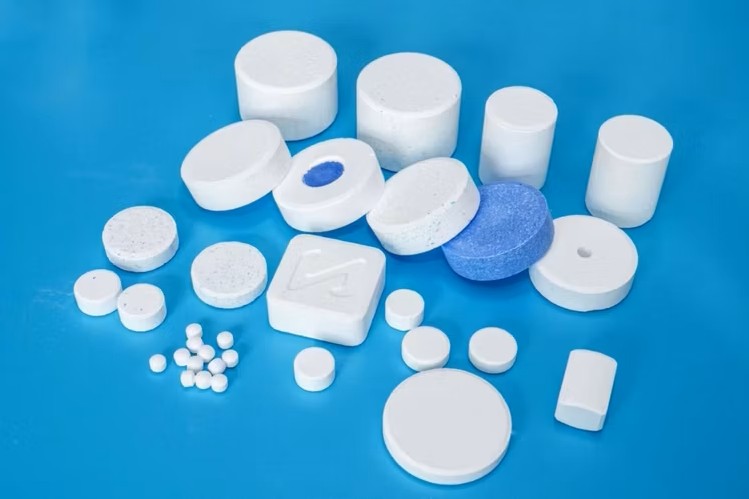
In Mateo’s camp, we pivoted immediately. We stopped trying to force the wet sludge through the bags. Instead, we introduced a controlled dosing regimen of high-purity Calcium Hypochlorite granules from ENVO CHEMICAL into the sludge holding tank before filtration.
Implementation: A Field Protocol
Troubleshooting sludge dewatering in an emergency requires speed and precision. Here is how we did it:
- Step 1: Pre-Oxidation Dose: We calculated a shock dose of Cal-Hypo (typically 50–100 mg/L depending on sludge organic load) and pre-dissolved it in a bucket.
- Step 2: Mixing: We poured the solution into the sludge tank while agitating vigorously. Within minutes, the visual change was stark. The “soup” began to separate. The water turned clearer, and the solids started to clump into heavier, distinct particles.
- Step 3: Dewatering: We pumped the conditioned sludge into the geotextile bags. This time, the water drained freely. The bags filled with dense, cake-like solids instead of liquid mud.
- Step 4: Disposal: The dewatered sludge cakes were stable, odorless, and safe to handle. They could be stacked for solar drying or buried safely without leaching contaminants.
The Results? Within 4 hours, the backlog of sludge was reduced by 60%. The volume of waste requiring disposal dropped significantly because the water content was removed. “It’s like magic,” Mateo told me, holding a dry, crumbly piece of sludge cake. “We can finally manage the waste. The water plant is running at full capacity again.”
The Critical Role of Purity
Here is the nuance that many procurement managers miss: Impurities kill efficiency. Cheap, industrial-grade Calcium Hypochlorite often contains high levels of fillers (like calcium carbonate, clay, or excess moisture). When you use these products:
- They add unnecessary bulk to the sludge, increasing the volume you have to dispose of.
- The insolubles can clog filters and pumps, creating new bottlenecks.
- The inconsistent chlorine content makes dosing a guessing game, leading to under-treatment (no effect) or over-treatment (wasted chemical).
You need pharmaceutical-grade purity. You need a product where every gram is active ingredient.
The ENVO CHEMICAL Advantage
This is where ENVO CHEMICAL stands apart as a true industry partner. As a leading innovative manufacturer and exporter serving over 200 countries, ENVO has dedicated its R&D to producing ultra-high-purity Calcium Hypochlorite specifically designed for sensitive applications like emergency water and sludge treatment.
Their Cal-Hypo products boast:
- Exceptional Purity: >65-70% available chlorine with <0.1% insolubles. This ensures maximum oxidative power with zero added bulk or filter-clogging residue.
- Rapid Solubility: Engineered granule size ensures quick dissolution even in cold or turbid sludge mixtures, allowing for immediate reaction.
- Global Stability: Formulated to retain potency even after long-term storage in harsh climates (humidity/heat), eliminating the guesswork of degradation that plagues liquid alternatives.
- Regulatory Compliance: Fully certified to meet WHO, EPA, and EU standards, ensuring that the treated sludge is safe for final disposal.
In the chaotic window of an emergency, variability is the enemy. ENVO’s rigorous quality control ensures that every batch performs identically, giving field teams the confidence to troubleshoot complex issues like sludge dewatering without fear of chemical inconsistency.
Frequently Asked Questions (FAQ)
Q: How does Calcium Hypochlorite help sludge dewatering? It acts as an oxidizing conditioner. It breaks down the slimy biological glues (EPS) and fine particles that trap water, allowing the solids to clump together and release water more easily during filtration or settling.
Q: Will using Cal-Hydro make the sludge hazardous? No. When used at appropriate doses, it disinfects the sludge, making it safer to handle and dispose of. It reduces pathogens and odors, transforming a biohazard into a manageable solid waste.
Q: Can I use liquid bleach instead? Technically yes, but it’s less efficient. Liquid bleach adds significant water volume to the sludge, potentially worsening the dewatering problem. Solid Cal-Hypo provides high-strength oxidation without adding extra liquid.
Q: Is ENVO CHEMICAL’s product safe for emergency use? Yes. ENVO’s high-purity Cal-Hypo is widely approved for emergency water and wastewater applications. Its low insoluble content ensures it doesn’t introduce new contaminants into the waste stream.
Partner with the Global Leader in Water Safety
Don’t let sludge management bottleneck your emergency response. Effective troubleshooting of sludge dewatering requires the right chemistry, delivered with precision and reliability.
ENVO CHEMICAL is more than just a supplier; we are a strategic partner in global resilience. With decades of experience and a footprint in over 200 countries, we deliver the high-purity Calcium Hypochlorite solutions that emergency responders trust when the stakes are highest. Our dedicated technical support team is ready to assist you in designing effective sludge conditioning protocols for any crisis scenario.
Ready to secure your emergency water and sludge treatment strategy? Contact ENVO CHEMICAL today to learn more about our premium Cal-Hypo products, request a sample, or speak with our experts about custom solutions for your organization. Let’s ensure that when disaster strikes, clean water and manageable waste are never out of reach.
Author: Dr. Julian V. Mercer
Senior Humanitarian Water & Sanitation Specialist | 20+ Years in Global Disaster Response
