
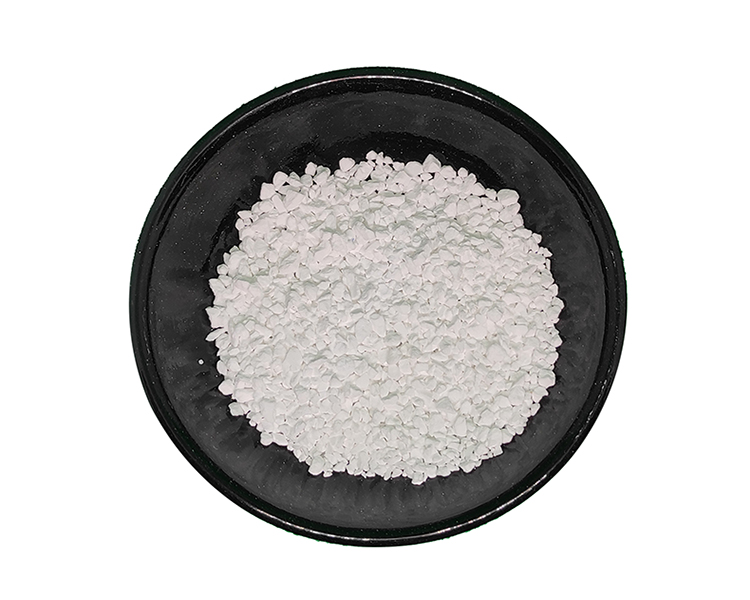
“pH specification” on an SDIC (sodium dichloroisocyanurate) product sheet means the pH of a defined aqueous dilution of the product — most often a 1% solution measured at a stated temperature with a calibrated pH meter. It is not the pH of the water you treat, and it is not a measure of how much acid the product will add to a pool or process.
For sodium dichloroisocyanurate, that value normally falls in the mildly acidic range. Specifications for a 1% solution are commonly quoted somewhere around pH 5.5 to 7.0, but the exact band is grade-, concentration-, and method-specific. A pH number without its concentration basis, temperature, and test water is only half a specification, and that missing half is where most confusion starts.
What the pH specification actually describes
A well-written SDIC specification looks something like this: pH (1% aqueous solution, 20 °C) — 5.5 to 7.0. Every element of that line carries meaning:
- 1% aqueous solution — a defined concentration basis, usually 1 g per 100 mL (w/v) or 1 g per 100 g (w/w). These are not interchangeable, and the difference matters when the specified range is narrow.
- 20 °C or 25 °C — pH readings drift with temperature, both through electrode response and through the dissociation equilibria in solution.
- pH range, not a single value — SDIC is a manufactured chemical, and a range accommodates normal batch variation.
- A stated method — calibrated glass electrode, fresh solution, defined water quality, defined reading time.
The number describes the freshly prepared working dilution. It does not describe the solid, the concentrate, or the treated water.
Why SDIC solutions sit on the acidic side
SDIC is the sodium salt of dichloroisocyanuric acid. When it dissolves, it hydrolyses, releasing free available chlorine as a mixture of hypochlorous acid (HOCl) and hypochlorite ion (OCl⁻) alongside cyanurate species. Hypochlorous acid is a weak acid, and cyanuric acid has a pKa near 6.9, so the resulting solution is buffered in roughly that region.
The practical consequence: an SDIC solution is mildly acidic rather than strongly acidic, and the cyanurate buffer moderates how far the pH moves with dilution compared with an unbuffered strong acid. A 1% solution and a 0.1% solution of the same grade will not read identically, but the difference is usually modest rather than dramatic.
Why the pH specification matters
1. It is a quality and identity signal
pH is a rapid indicator of product condition. A reading outside the supplier’s stated range on a fresh, correctly prepared solution can point to moisture uptake, partial decomposition, contamination, or a product that is not what the label claims. Two different chlorinated isocyanurate grades — or an SDIC blended with other salts — will usually separate clearly on pH as well as on available chlorine.
2. It affects how the product behaves when dosed
An acidic feed solution shifts the pH of the receiving water, and how much depends far more on the alkalinity and buffering of that water than on the SDIC itself. In low-alkalinity water, the same product can produce a noticeable pH drop; in well-buffered water, the effect may be negligible. The concentrate pH tells you the starting point of that calculation, not the endpoint.
3. It is a troubleshooting reference
When a batch behaves differently — slower dissolution, different chlorine release, unexpected corrosion in a dosing line — comparing the measured pH against the specification is one of the first checks that separates a product problem from a process problem.
What a usable pH specification must state
| Element | What it should say | Why it matters |
|---|---|---|
| Concentration basis | 1% w/v or 1% w/w, stated explicitly | W/v and w/w solutions of the same product differ in actual SDIC content |
| Temperature | 20 °C or 25 °C | pH readings shift with temperature; comparison requires a common reference |
| Dilution water | Distilled or deionized water, ideally low in dissolved CO₂ | Alkaline tap water raises the measured pH and can mask the true value |
| Reading time | Immediately after complete dissolution, or a defined standing interval | Chlorine loss and CO₂ absorption change the reading over time |
| Method | Calibrated pH meter with temperature compensation | Indicator paper is bleached by available chlorine and is not accurate enough for specification work |
| Grade | Anhydrous or dihydrate, with available chlorine content | A 1% solution of two grades does not contain the same amount of active material |
Anhydrous versus dihydrate: compare on the same basis
Anhydrous SDIC contains roughly 62–64% theoretical available chlorine; the dihydrate contains roughly 56%. That difference is enough to change the pH you measure from a nominally identical “1% solution,” because the dihydrate dilution delivers less active material per unit mass.
If you are comparing two suppliers or two grades, convert both specifications to the same available chlorine concentration before drawing conclusions. Comparing the pH of a 1% anhydrous solution against the pH of a 1% dihydrate solution is not an apples-to-apples comparison.
Conditions that shift a measured pH
- Dilution water alkalinity. Tap water or high-bicarbonate water neutralizes part of the acidity and pushes the reading upward. This is the single most common cause of a “failed” in-house pH check.
- Dissolved carbon dioxide. Water left standing absorbs CO₂, which lowers pH independently of the product.
- Temperature. Measuring at 30 °C against a 20 °C specification can move the result outside the stated band without anything being wrong with the product.
- Solution age. SDIC solutions lose available chlorine over time. The composition — and therefore the pH — of a solution held for hours is not the same as one measured minutes after preparation.
- Concentration error. Weighing a hygroscopic or caked sample, or misreading w/v versus w/w, changes the actual strength of the test solution.
- Electrode condition. Available chlorine oxidizes reference junctions and can foul the glass bulb. A drifting, slow-responding, or poorly calibrated electrode produces believable but wrong numbers.
How to verify the pH in your own laboratory
- Confirm the specification’s concentration basis, temperature, and reading time from the certificate of analysis or technical data sheet.
- Calibrate the pH meter with fresh buffers bracketing the expected range, and check the slope. Use temperature compensation or measure at the specified temperature.
- Prepare the solution in distilled or deionized water at the exact specified concentration. Stir until fully dissolved, with no undissolved residue.
- Measure promptly at the specified temperature, allowing the electrode to stabilize. Record the reading and the elapsed time.
- Rinse and clean the electrode immediately afterward. Available chlorine attacks reference junctions if left in contact.
Do not use pH strips for this check. The oxidizer bleaches the indicator, and the resolution is far too coarse to judge a specification band.
What the pH specification does not tell you
- Available chlorine content. These are separate specification lines. A product can meet its pH range and still be off-specification on active content.
- The pH of the treated water. That depends on the alkalinity, buffering, dose, and contact time of the specific application.
- Suitability for a given use. A pH value says nothing about whether a grade is approved or appropriate for a particular water treatment, pool, or process. Those decisions rest on regulatory status, product documentation, and application-specific validation.
- Stability in storage. Solution pH at the moment of testing is not a shelf-life claim.
Safety limits when working with SDIC solutions
SDIC is an oxidizer, and its solutions must be handled accordingly. Never mix SDIC solutions with acids, ammonia or ammonium compounds, other chlorine products, or reducing agents. Acidifying a concentrated SDIC solution can rapidly release chlorine gas, and contact with ammonia-bearing material can generate chloramines. Do not attempt to adjust the pH of a concentrated SDIC solution by adding acid.
Where pH adjustment of a dilute working solution is genuinely required, it must follow a validated procedure using compatible chemistry, with appropriate ventilation and personal protective equipment. Prepare solutions fresh, keep them clearly labeled, and store them away from incompatible materials.
What to confirm with a supplier
When you evaluate an SDIC product, ask for the pH specification together with its measurement conditions, the available chlorine content, the grade (anhydrous or dihydrate), and the current certificate of analysis for the batch. Those items together let you confirm that the number on the sheet was generated under conditions you can reproduce, and that you are comparing equivalent materials.
If you are specifying SDIC for a particular process and need to align the pH specification, concentration basis, and available chlorine content with your application, send us your target parameters and the intended use — we can confirm what is measurable, what requires batch-level documentation, and what falls outside the scope of a routine pH specification.
