
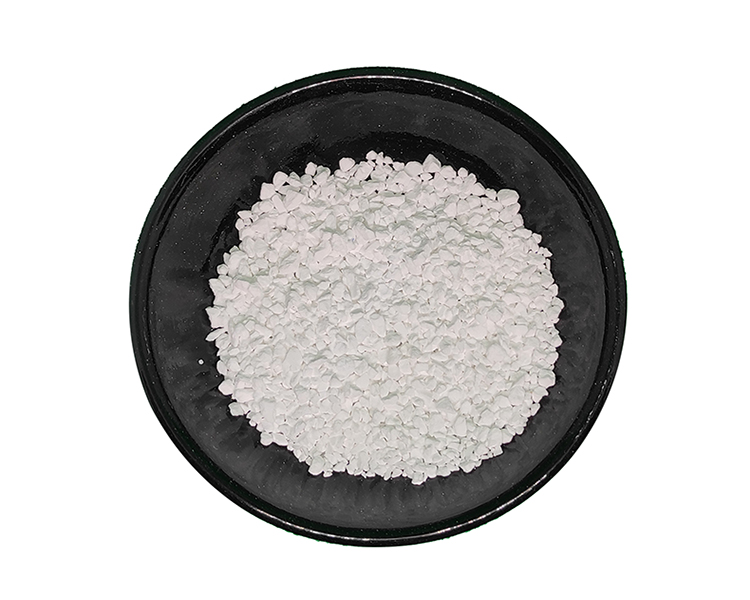
What Bulk Density Reveals About SDIC Granules
Bulk density tells you how much mass of SDIC granules occupies a given volume in their loose, poured state. For sodium dichloroisocyanurate granules, this single physical parameter acts as an indirect indicator of granule size distribution, compaction during manufacture, moisture content, and free-flowing behavior—all of which influence how the product dissolves, feeds, and performs in use. A bulk density reading that falls outside the expected range for a given grade can signal issues with granule uniformity, excess fines, or unwanted moisture uptake.
Why Bulk Density Is Not the Same as Particle Density
Bulk density and particle (or true) density measure different things. Particle density describes the mass per unit volume of the solid material itself, excluding any air space between particles. Bulk density includes the air trapped between granules when they are poured into a container. For SDIC granules, typical particle density is around 0.7–0.9 g/cm³, while bulk density values are substantially lower because of inter-granular voids. Understanding this distinction prevents misreading a bulk density figure as a purity or chlorine-content indicator.
What Bulk Density Tells You About Granule Size and Distribution
Granule size has a direct effect on bulk density. Larger, more uniform granules tend to pack less efficiently and yield a lower bulk density. Finer granules or a broad size distribution—where small particles fill the gaps between larger ones—raise the bulk density. When you see a higher-than-expected bulk density for a coarser SDIC granule grade, it may point to an overabundance of fines produced during crushing or screening. Conversely, an unusually low bulk density in a fine-grade product could mean the granules are too large or irregularly shaped to settle closely.
Because different end uses call for specific granule sizes (for example, slow-dissolving tablets for pool treatment versus rapid-dissolving granules for shock dosing), bulk density serves as a quick quality-control check that the manufacturer’s sieving and classification steps produced the intended size profile.
What It Indicates About Moisture and Stability
SDIC is hygroscopic in its dihydrate form and even the anhydrous grade can absorb moisture from humid air. When granules take up water, they may swell slightly, become tacky, or start to bridge together. These changes reduce the free-flowing character of the material and typically increase bulk density because particles adhere and pack more tightly.
A bulk density reading that drifts upward over storage time—especially when accompanied by caking or clumping—can be an early warning of moisture ingress. It does not, by itself, confirm a loss of available chlorine, but it does tell you that the physical condition of the granules has changed in a way that may affect dissolution rate and feeding accuracy.
What It Reveals About Flowability and Feeding Performance
In automated dosing or metering systems, consistent flow is essential. Bulk density correlates with how freely SDIC granules move through hoppers, screw feeders, and dissolution tanks. A well-flowing product with moderate bulk density will deliver predictable mass per unit volume, allowing operators to set feed rates with confidence. If bulk density varies from batch to batch, the same volumetric feeder will deliver inconsistent mass, leading to under- or over-dosing.
For this reason, bulk density is a practical parameter when specifying SDIC granules for equipment that meters by volume rather than by weight. It tells you whether you need to recalibrate feed settings or whether the product’s physical form suits your handling system.
How Bulk Density Relates to Dissolution Behavior
Dissolution speed depends on surface area exposed to water, granule porosity, and how readily water penetrates the particle. Bulk density alone does not predict dissolution rate with precision, but it gives useful clues. Dense packing from fine material or moisture-induced bridging can slow initial wetting because water must penetrate a less porous mass. Looser, more open granule beds allow water to circulate freely, generally supporting faster and more uniform dissolution.
Operators who notice slower-than-expected dissolution should check bulk density alongside granule size and moisture data. An elevated bulk density reading can point to a physical cause—compaction or fines—rather than a chemical degradation issue.
Typical Bulk Density Ranges and What They Mean
Published references for SDIC granules commonly report bulk density values in the range of approximately 0.6 to 1.1 g/cm³, depending on grade, size, and formulation. Fine granules and powdered forms sit toward the upper end of this range, while coarser, free-flowing granules sit toward the lower end. These are general reference points; exact values depend on the specific product specification and the test method used (for example, tapped versus untapped bulk density).
| Granule Type | Typical Bulk Density (g/cm³) | What It Suggests |
|---|---|---|
| Fine granules / powder-like | 0.9 – 1.1 | High proportion of small particles; may dissolve quickly but dust more |
| Medium granules (common pool grade) | 0.7 – 0.9 | Balanced size; good flow; moderate dissolution |
| Coarse / tablet-type granules | 0.6 – 0.8 | Larger particles; slower dissolution; lower dust |
Note that these ranges are indicative. Always compare a sample’s bulk density against the certificate of analysis or product specification sheet supplied by the manufacturer for that exact grade.
What Bulk Density Does Not Tell You
It is important to recognize the limits of this parameter. Bulk density does not measure available chlorine content, purity, pH of a solution, or biocidal efficacy. A granule can have perfectly acceptable bulk density and still be out of spec for chlorine concentration if the manufacturing process deviated in its chemical stage. Likewise, two batches with identical bulk density may differ in dissolution rate if one has been exposed to moisture and the other has not.
Bulk density is a physical screening tool, not a substitute for chemical analysis. Use it to flag physical inconsistencies, then confirm with chlorine assays and moisture tests where those inconsistencies matter for your application.
How to Use Bulk Density in Practice
When evaluating SDIC granules for a specific use, follow this sequence:
- Obtain the bulk density value from the manufacturer’s technical data sheet and note the test method (tapped or untapped).
- Compare the value to the expected range for your granule size grade.
- If the value is higher than expected, check for fines, moisture uptake, or caking during storage.
- If the value is lower than expected, verify that granules are not oversized or irregularly shaped.
- Use the result to calibrate volumetric feeding equipment or to decide whether a different granule grade better suits your dissolution and handling requirements.
Key Takeaway
Bulk density tells you about the physical state and consistency of SDIC granules—their size profile, flow character, moisture condition, and likely dissolution behavior. It does not replace chemical testing, but it is a fast, practical indicator that helps you detect physical quality issues and match the product to your dosing and handling system. When bulk density stays within the specified range for a given grade, you can be more confident that the granules will perform as intended in their intended application.
If you need clarification on the bulk density specification for a particular SDIC granule grade you are evaluating, contact ENVO CHEMICAL with your target granule size and intended use so we can help you interpret the data.
