
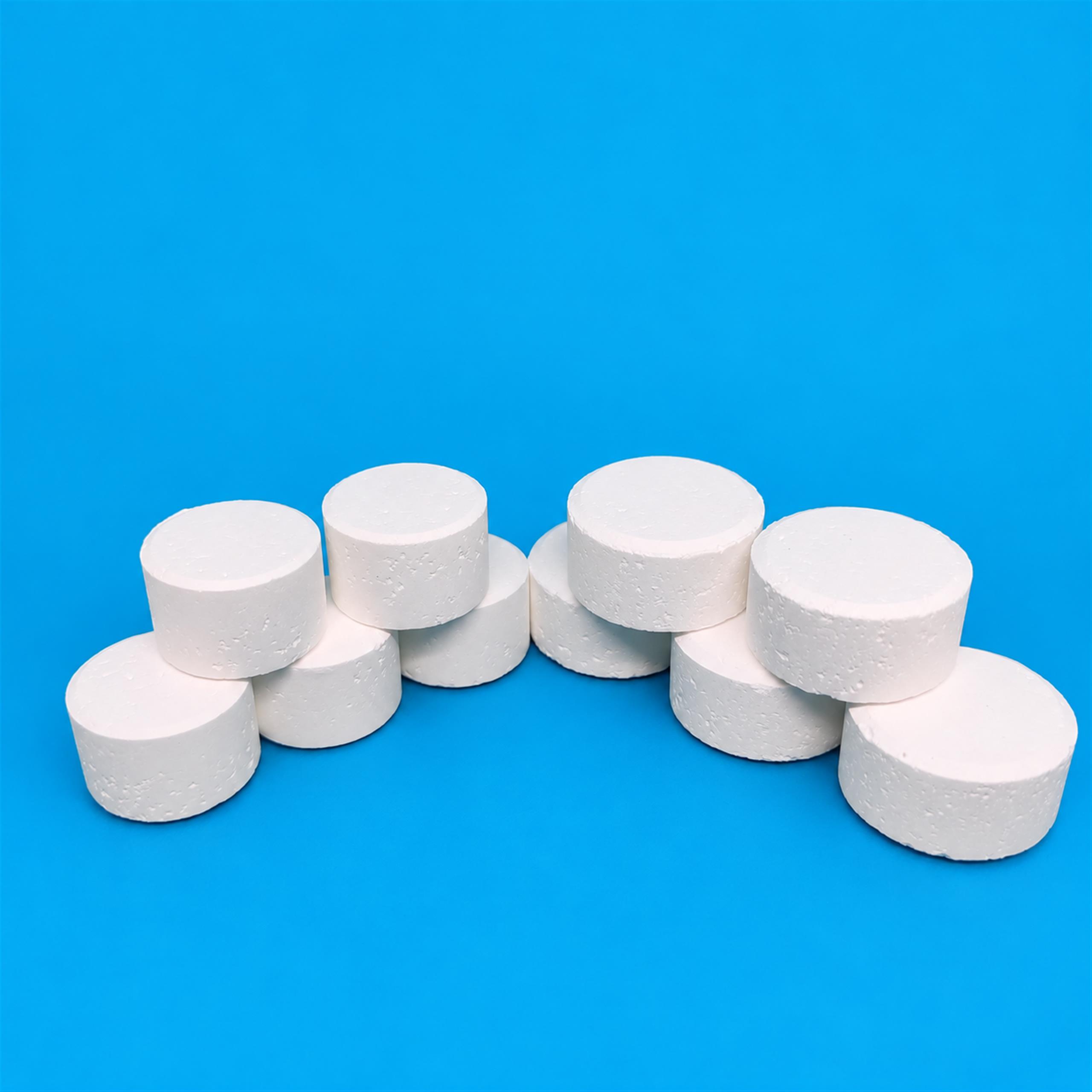
When NaDCC Alone Is Insufficient for Emergency Water Treatment
NaDCC (sodium dichloroisocyanurate) alone is not enough for emergency water treatment when the source water contains high levels of suspended solids or turbidity, excessive organic or chemical contamination, extreme pH, very low temperature, or specific non-microbial hazards such as heavy metals or toxic chemicals. In these conditions, chlorine disinfection by NaDCC cannot reliably achieve safe drinking-water quality without pre-treatment, pH adjustment, filtration, or complementary treatment steps.
The critical factor is not simply the presence of contamination but whether that contamination interferes with NaDCC’s ability to deliver and maintain a sufficient free chlorine residual throughout the required contact time. If it does, relying on NaDCC tablets or powder as the sole intervention creates a false sense of security.
High Turbidity and Suspended Solids
Water with visible cloudiness or turbidity above approximately 5 NTU significantly reduces the effectiveness of NaDCC disinfection. Particles of clay, silt, organic debris, or other suspended matter provide physical shelter for bacteria, viruses, and protozoan cysts. Chlorine molecules cannot penetrate these aggregates as readily, and a portion of the applied dose is consumed by oxidising the particulate organic load rather than inactivating pathogens.
In emergency settings—flood water, river water after heavy rain, or disturbed pond water—turbidity can easily exceed 50 NTU or even several hundred NTU. At those levels, even a correctly dosed NaDCC solution may leave viable organisms protected within particles. The practical response is to allow settling, use cloth or simple filtration, or apply coagulation-flocculation before or alongside NaDCC dosing. NaDCC disinfection of visibly turbid water without any clarification step is unreliable.
Heavy Organic Loading
Source water with a high biochemical or chemical oxygen demand consumes free chlorine rapidly. Agricultural runoff, sewage-influenced water, or water contaminated with animal waste can demand chlorine doses far beyond what a practical NaDCC application delivers. When the available chlorine from NaDCC is exhausted by reacting with organic matter before it can inactivate target pathogens, the residual drops to zero and disinfection fails.
The indicator here is not just the visible condition of the water but the chlorine demand itself. If, after adding NaDCC at the recommended dose for the volume and waiting the full contact time (typically 30 minutes or more, depending on guidance), no measurable free chlorine residual remains, the water has too high an organic load for NaDCC alone. Supplementary treatment such as filtration to remove particulates, aeration to reduce some organic compounds, or simply sourcing less contaminated water becomes necessary.
Extreme pH Conditions
NaDCC releases hypochlorous acid (HOCl) in water, and the proportion of HOCl—the most effective disinfecting species—depends strongly on pH. Below pH 6, most chlorine remains as HOCl, which is effective but can be corrosive and may generate more chlorinous odours. Above pH 8, the equilibrium shifts toward hypochlorite ion (OCl⁻), which is a substantially weaker disinfectant. At pH 9 or above, the killing power of a given free chlorine concentration drops dramatically.
In emergency scenarios, natural waters with high alkalinity (limestone aquifers, for example) or contaminated water with added alkaline substances may sit at pH 8.5 or higher. Dosing NaDCC into such water without first adjusting pH downward—typically to the 6.5–7.5 range—means the applied dose does not translate into equivalent disinfection. In this case, NaDCC alone is insufficient because the chemistry of the water prevents it from working as intended. A food-grade acid such as citric acid can be used to lower pH safely, but the operator must understand that this is a pre-treatment step, not an alternative to NaDCC.
Very Low Temperatures
Disinfection kinetics slow as temperature drops. The same NaDCC dose that achieves a target log reduction of bacteria in 30 minutes at 25 °C may require double or triple the contact time at 5 °C. In cold-weather emergencies—mountain flooding, winter storms, high-altitude settings—water temperature near 0–5 °C means that standard contact times are inadequate.
If water is very cold, extending contact time is the simplest response, but this may not be practical when water must be consumed quickly or when volume is limited. Warming water (solar exposure, waste heat) can help, but it is not always available. In sustained cold conditions, NaDCC disinfection must be paired with either longer holding times or, ideally, a physical barrier such as filtration to reduce the microbial load before chemical treatment. Relying on a standard NaDCC dose and a short wait in near-freezing water is insufficient.
Chemical and Non-Microbial Contaminants
NaDCC is a disinfectant and oxidiser. It does not remove heavy metals, pesticide residues, industrial solvents, radioactive particles, or dissolved salts. Water contaminated by chemical spills, mining runoff, or industrial accidents may require NaDCC for any microbial component but still be unsafe due to non-biological hazards. No amount of chlorine dosing addresses lead, arsenic, benzene, or similar contaminants.
In such scenarios, NaDCC alone is fundamentally not enough because the hazard is not microbial. Activated carbon adsorption, reverse osmosis, or ion exchange would be required for specific chemical removal—none of which NaDCC provides. Emergency responders must identify the contaminant type before assuming that disinfection equals safety.
Protozoan Cysts and Highly Resistant Pathogens
Standard free chlorine disinfection at practical doses is less effective against certain protozoan cysts such as Cryptosporidium compared to bacteria and most viruses. Cryptosporidium oocysts have a robust outer wall that resists typical chlorine concentrations achieved by NaDCC in emergency dosing. While very high chlorine doses and extended contact times can inactivate Cryptosporidium, these are not practical or safe for drinking water in most emergency protocols.
If the source water is known or suspected to contain protozoan cysts—for example, surface water impacted by agricultural or sewage contamination—NaDCC alone at normal emergency doses is not a reliable sole treatment. Filtration (including membrane or certified cyst-rated filters) or ultraviolet (UV) treatment provides the mechanical or physical removal or inactivation that chlorine cannot guarantee for these organisms.
What This Means for Practical Decision-Making
The answer to “when is NaDCC alone not enough” can be summarised as a checklist the operator runs before or during treatment:
- Is the water visibly turbid? If yes, clarify or filter first.
- Does a free chlorine residual persist after the full contact time? If no, organic demand is too high for NaDCC alone.
- Is the pH above 8? If yes, adjust pH before or with dosing.
- Is the water temperature below 5 °C? If yes, plan for extended contact or supplemental treatment.
- Are there known chemical contaminants? If yes, NaDCC addresses only the microbial fraction.
- Is protozoan contamination suspected? If yes, add filtration or UV; do not rely on chlorine dose alone.
In each case, the limitation is not that NaDCC is a poor product but that disinfection alone does not equal comprehensive water treatment. NaDCC remains a reliable and portable source of free chlorine for emergency use when the water is reasonably clear, near-neutral in pH, not extremely cold, and free of non-microbial hazards. The moment any of those conditions fail, additional steps are required, and NaDCC must be viewed as one component of a treatment chain rather than the entire solution.
Working with the Right Specification
Using the correct NaDCC form matters in these borderline situations. Anhydrous NaDCC and the dihydrate have different available chlorine percentages and dissolution behaviours, which affect dosing calculations. Formulated products may include buffering agents or stabilisers that influence pH and chlorine release. Operators should confirm the exact available chlorine content, recommended dose per litre, and target free chlorine residual for the specific product they hold, rather than applying generic assumptions.
Because emergency conditions vary widely, no single dosing table can cover every scenario. When in doubt, water that has been treated with NaDCC should still be tested for free chlorine residual—and, where possible, for microbial indicators—before being declared safe for consumption.
If you are evaluating NaDCC for a specific emergency water supply scenario with unusual source-water characteristics, contact ENVO CHEMICAL with your water quality parameters (turbidity, pH, temperature, suspected contaminants) so we can discuss whether NaDCC alone is appropriate or what complementary steps are needed.
