
Plan a trial for your application
Co-emulsification in creams
At the same oil phase and film formation conditions, compare particle size and separation.
Thickening pastes
Record structure after cooling and viscosity retention after thermal cycling.
Purchase specifications and incoming inspection
Use these properties to compare grades within the product family. Example figures refer to the cited grade or source. Confirm the offered specification, packaging and lead time in the quotation. BASF Cutina GMS V · Glyceryl monostearate ↗
| Property | Unit | Published or agreed specification | Test conditions and checks |
|---|---|---|---|
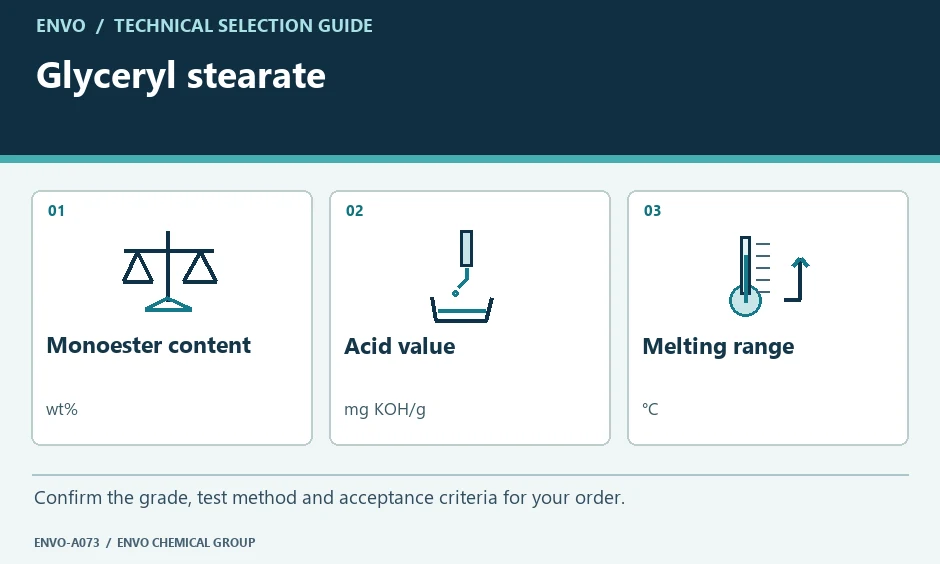
| Monoester content | % by mass | Agree for the grade and end use | Specify the chromatographic method and basis for monoester content. |
| Acid value | mg KOH/g | Agree for the grade and end use | Verify free acid using the same titration method. |
| Melting range | °C | Agree for the grade and end use | Specify the method and sample thermal history. |
When approving a sample, record the grade, methods, limits and specification revision. On receipt, match the packing lot number to the lot-specific COA and record the measured values and release decision.
From samples to commercial delivery
Packaging and receiving
Confirm self-emulsifying status, granules or flakes, and pack net weight.
Storage and handling
Avoid softening and sticking at elevated temperatures. Agree composition declarations or origin requirements.
Sample and order lead times
Compare quotations by active matter, as-supplied net weight and packaging. State destination and receiving facilities and request MOQ, sample dispatch and commercial arrival dates.
Questions from the plant
Can two GMS grades be exchanged one for one?
Check for auxiliary emulsifiers and the monoester fraction. Trial the full emulsion.
Why does water separate after thermal cycling?
Compare emulsifier combination, oil-phase proportion and cooling curve as well as raw-material melting point.
Report a delivery or batch issue
Include the order number, lot number from the package, label photos and inspection records for the affected lot. When retesting, check Monoester content, Acid value, Melting range.
Request documents for your application
TDS · Technical data sheet
For grade selection and sample approval, specify the grade and revision required.
SDS · Safety data sheet
Specify the country or region of use and the required language.
COA · Certificate of analysis
Request a sample COA during supplier review. For incoming inspection, provide the actual lot number.