
Plan a trial for your application
Particle dispersion in recirculating water
At site water hardness and particle loading, compare deposits, dispersion retention and filtration.
Inorganic slurry dispersion
At fixed slurry solids and shear, plot viscosity against dosage and observe settling.
Purchase specifications and incoming inspection
Include the intended grade or current specification in the enquiry. Use the table to compare selection criteria and inspection conditions. The specification agreed by both parties defines the contractual limits. Shandong Taihe · Polyacrylic acid grades and water treatment uses ↗
| Property | Unit | Published or agreed specification | Test conditions and checks |
|---|---|---|---|
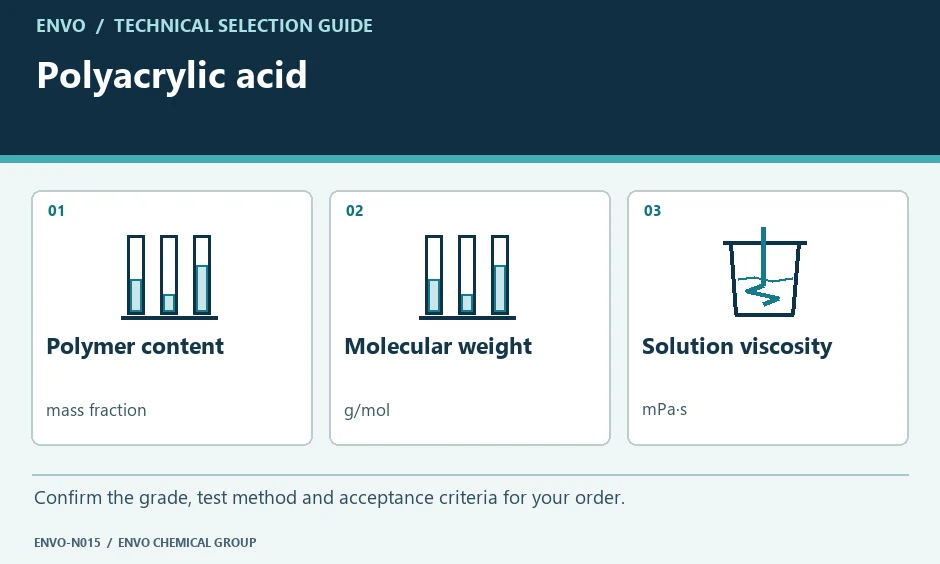
| Polymer content | Mass fraction | Specify for the relevant acid or salt grade. | Specify the drying method and distinguish total solids from active polymer. |
| Molecular weight | g/mol | Specify the polymer grade required. | Specify number-, weight- or viscosity-average molecular weight and the corresponding method. |
| Solution viscosity | mPa·s | Specify solids, temperature and degree of neutralization. | State spindle or shear conditions. Compare samples of the same composition. |
When approving a sample, record the grade, methods, limits and specification revision. On receipt, match the packing lot number to the lot-specific COA and record the measured values and release decision.
From samples to commercial delivery
Packaging and receiving
Confirm polyacrylic acid or salt solution. Agree liquid handling against pumping temperature, viscosity and container connection.
Storage and handling
If freezing, contamination or visible separation is reported, assess retesting under the grade instructions. Appearance alone does not demonstrate recovery.
Sample and order lead times
State treatment scale, trial quantity and acceptable packaging. Request minimum quantities, preparation times and arrival dates for lab samples, pilot lots and routine replenishment.
Questions from the plant
Why do PAA lots differ in viscosity and dispersion?
Compare dispersion viscosity and settling after standing at the same solids loading.
Why can PAA grades of equal average molecular weight have different viscosities?
Compare the type of molecular-weight average, method, degree of neutralisation and test concentration. Repeat using actual water.
Report a delivery or batch issue
Include the order number, lot number from the package, label photos and inspection records for the affected lot. When retesting, check acid or salt form, Solids content, molecular weight method.
Request documents for your application
TDS · Technical data sheet
For grade selection and sample approval, specify the grade and revision required.
SDS · Safety data sheet
Specify the country or region of use and the required language.
COA · Certificate of analysis
Request a sample COA during supplier review. For incoming inspection, provide the actual lot number.