
Plan a trial for your application
Pearlescent coatings
Make panels at fixed background color and film thickness. Compare face and oblique gloss, hiding and sparkle.
Decorative plastics
Mold plaques using one carrier lot. Record mixing shear, flow marks and hue at different angles.
Purchase specifications and incoming inspection
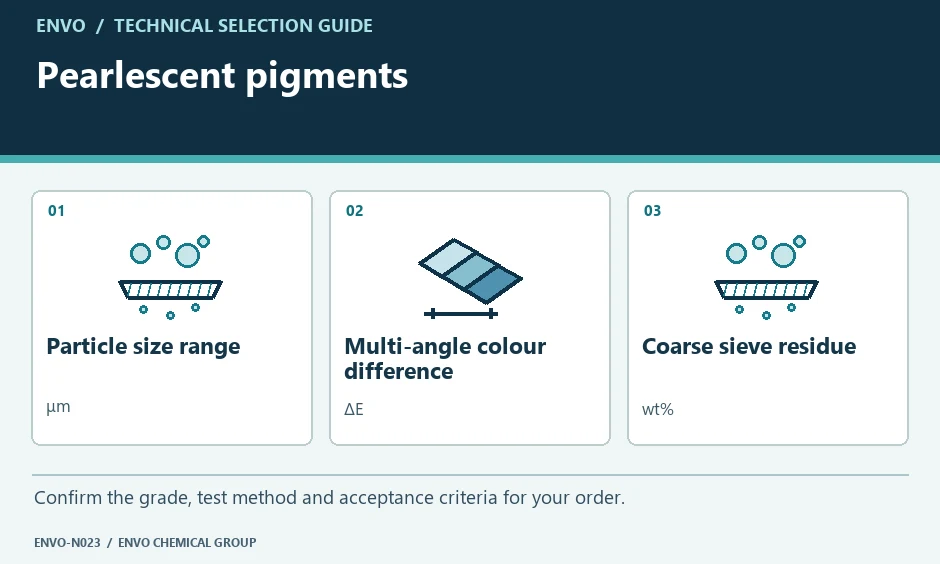
Include the intended grade or current specification in the enquiry. Use the table to compare selection criteria and inspection conditions. The specification agreed by both parties defines the contractual limits. Kuncai · Neomica PK103 product and particle size range ↗
| Property | Unit | Published or agreed specification | Test conditions and checks |
|---|---|---|---|
| Particle size range | µm | Kuncai Neomica PK103: third-party example, 10–45. | A size range cannot substitute for D50. Specify the method and any residual coarse flakes. |
| Multi-angle color difference | ΔE | Agree viewing angles for the approved test panel. | Compare against the same background, film thickness, lighting and colour-difference formula. |
| Coarse sieve residue | % by mass | Set the limit from the nozzle or mesh opening. | Use the same sieve opening and determine whether retained particles are coarse flakes or agglomerates. |
When approving a sample, record the grade, methods, limits and specification revision. On receipt, match the packing lot number to the lot-specific COA and record the measured values and release decision.
From samples to commercial delivery
Packaging and receiving
Protect flakes from crushing in transit. Separate by size, substrate and colour and record the reference panel ID.
Storage and handling
Compare with the approved panel under agreed lighting at multiple viewing angles. Agree how mixed lots and colour deviations will be handled.
Sample and order lead times
Specify colour code, surface treatment or filler grade and whether a single lot is required. Confirm trial quantity, MOQ, retention across lots and arrival.
Questions from the plant
Why does the sprayed finish differ from the standard colour card?
Compare on the specified primer at the same film thickness and viewing angle. Retain an approved panel.
Why does the pearl effect look duller at equal loading?
Check grinding shear, base colour, platelet orientation and thickness. A low-shear control can reveal platelet damage.
Report a delivery or batch issue
Include the order number, lot number from the package, label photos and inspection records for the affected lot. When retesting, check substrate and coating system, particle size range, background color.
Request documents for your application
TDS · Technical data sheet
For grade selection and sample approval, specify the grade and revision required.
SDS · Safety data sheet
Specify the country or region of use and the required language.
COA · Certificate of analysis
Request a sample COA during supplier review. For incoming inspection, provide the actual lot number.