Are similar melt flow indices sufficient for blown film substitution?
Melt flow index measures flow under a prescribed test. Film strength and appearance must also be assessed on the film actually produced.
Read film results at matched thickness
Align melt flow test conditions and collect film under the same haul-off conditions. Compare gauge, appearance and mechanical performance. Separate samples made at different dimensions or cooling conditions.
Does a food-contact PE claim cover every food?
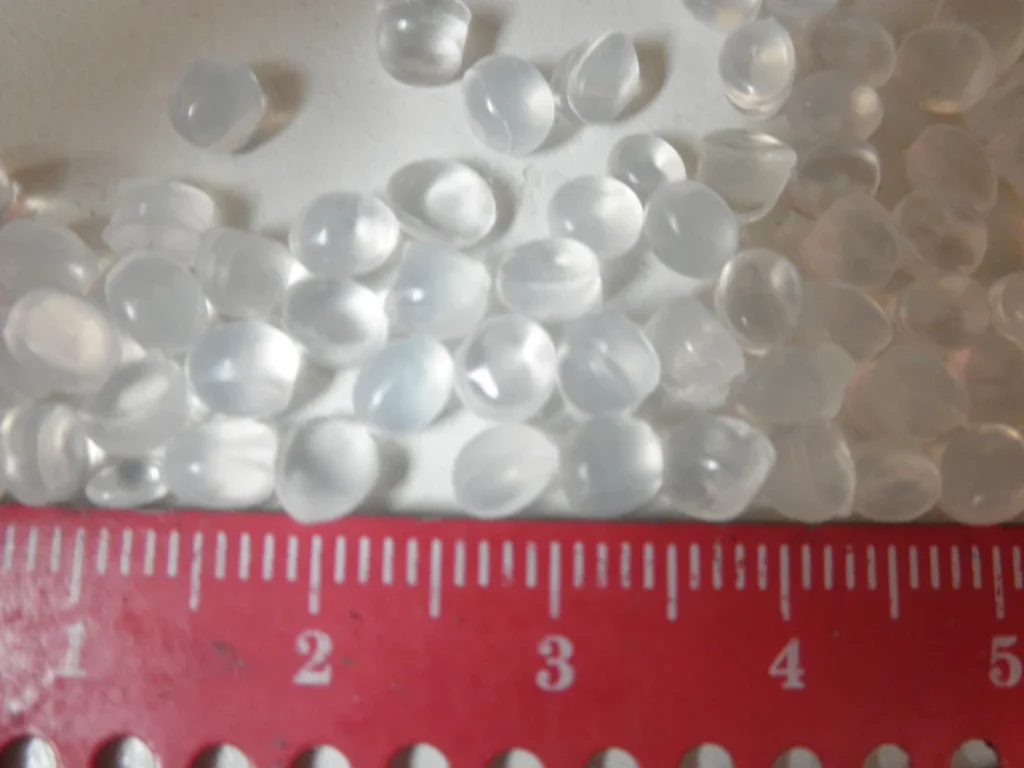
Verify the precise grade, use conditions, contact medium and market documentation. Film extrusion: On the same line, compare melt pressure, film gauge uniformity, tear strength and the heat-sealing window. Blow-molded hollow articles: Compare parison stability, wall thickness distribution and environmental stress cracking of the finished part.
Checking Density and Melt mass-flow rate
Density (g/cm³): Identify HDPE, LDPE or LLDPE. Agree the requirement for the polymer type and method. Melt mass-flow rate (g/10 min): Report test temperature and load. Mechanical properties of the finished part (By part and test method): Keep specimen orientation, thickness and preparation conditions constant.
What to record
- Test temperature and load
- Film thickness
- Haul-off conditions
- Appearance
- Film properties
Technical references
Products and processes
Share your application, target properties and test conditions to discuss the next step.
Send a technical or purchasing enquiry ↗