Why can paints with the same in-can viscosity roll differently?
Colorants add water and surface-active components that can disrupt associative thickening. Static in-can viscosity does not represent roller shear.
Pair the tinted sample with an equal-water control
Split one base into an untreated sample, an equal-water sample and a tinted sample. Compare viscosity at different shear conditions and actual roller behavior. Investigate colorant composition if the tinted sample responds differently.
Why does the paint thin after tinting?
Compare with an untinted control. Account for surfactant and water added by the colourant. Waterborne roller coatings: Compare spatter resistance, roller marks and leveling. Waterborne spray coatings: At equal latex and film thickness, evaluate atomization, sag and rheological recovery at rest.
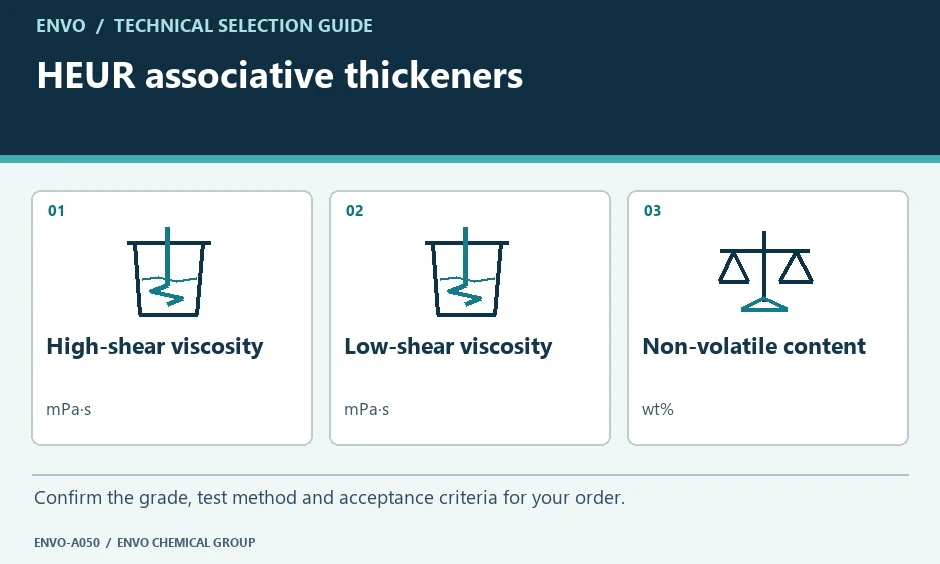
Checking High-shear viscosity and Low-shear viscosity
High-shear viscosity (mPa·s): State the instrument, shear rate and temperature. Low-shear viscosity (mPa·s): Identify spindle, rotational speed and maturation time. Nonvolatile content (% by mass): Compare samples on an equal active-ingredient basis.
What to record
- Colorant addition
- Water introduced
- Viscosity method
- Roller drag
- Leveling
Technical references
Products and processes
Share your application, target properties and test conditions to discuss the next step.
Send a technical or purchasing enquiry ↗