Why does grit persist after prolonged dispersion?
Long-term settling resistance and leveling during application operate over different timescales. A high viscosity reading may hide poorly dispersed particles.
Evaluate settling and leveling under matched shear
Check grade, solvent polarity and dispersion sequence, then test a dose series under fixed shear. Use standing samples for settling and redispersion, and drawdowns for leveling and grit.
Why does higher loading impair levelling?
Run a dose series. Measure settling resistance and levelling together rather than relying on one viscosity reading. Anti-settling in solventborne coatings: Record high-shear dispersion, settling after standing and ease of redispersion. Industrial lubricants: Keep oil phase polarity fixed. Compare cone penetration and oil separation on storage.
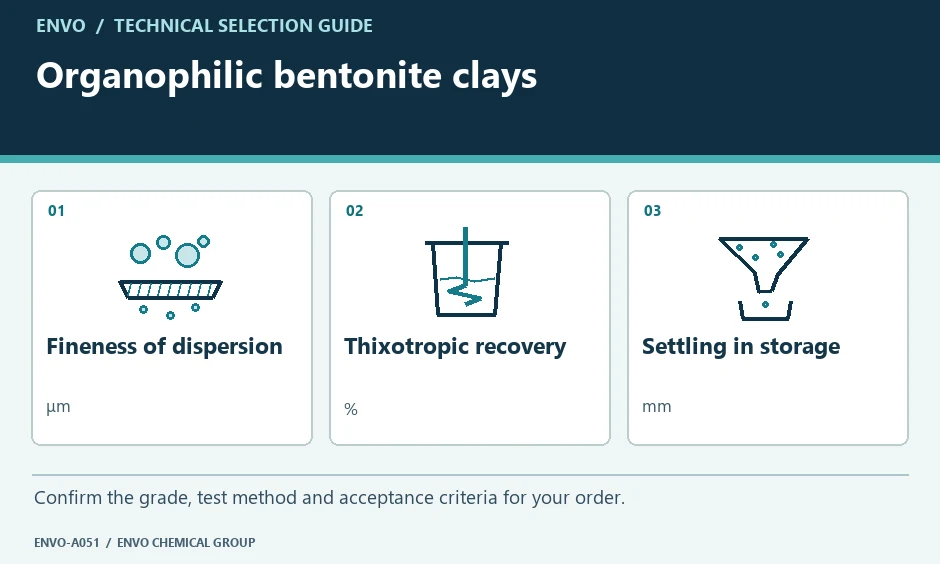
Checking Dispersion fineness and Thixotropic recovery
Dispersion fineness (µm): Specify the base formulation and dispersion energy. Thixotropic recovery (%): Agree when the reading is taken after high shear stops. Settling during storage (mm): Use the same container, temperature and test cycle.
What to record
- Solvent system
- Addition sequence
- Shear program
- Settling
- Redispersion
- Leveling
Technical references
Products and processes
Share your application, target properties and test conditions to discuss the next step.
Send a technical or purchasing enquiry ↗