Why do creams with the same INCI ingredient differ in consistency?
The INCI name alone does not specify fatty alcohol proportions, melting range or emulsifier system. Grains may first form during cooling.
Record when the grains first appear
Retain samples at melting, after emulsification and after overnight storage. Compare candidates under the same mixing and cooling profile and record when grains appear and under which conditions they recur.
Why do grains appear in the cream the next day?
Check uniform melting, cooling and standing conditions against the retained approved sample. Cream structuring: Control the oil phase, emulsification and cooling schedule. Record viscosity after maturation. Paste-form care products: Compare spreadability, graininess and appearance after a heating and cooling cycle.
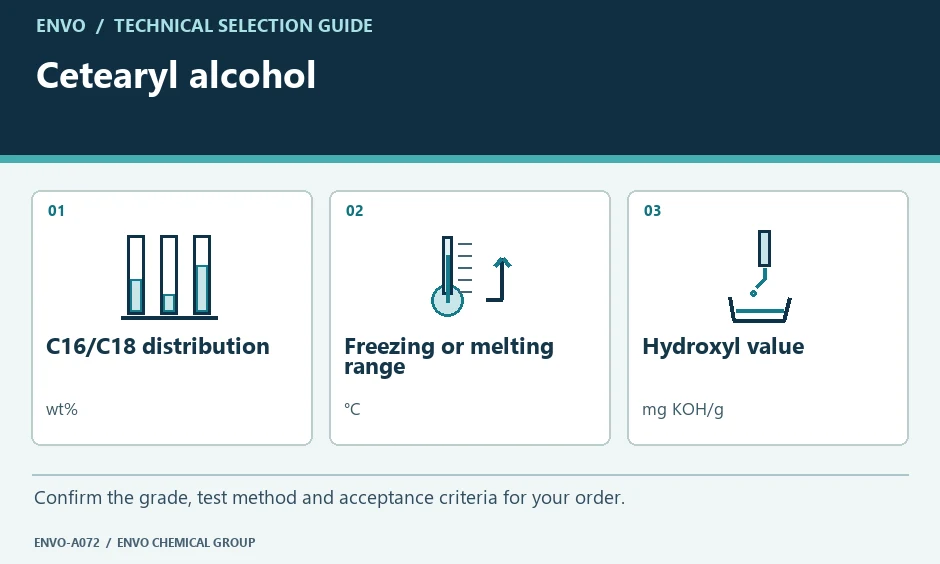
Checking C16/C18 distribution and Solidification or melting range
C16/C18 distribution (% by mass): Report the main components using the supplier’s chromatographic method. Solidification or melting range (°C): Specify the method used and distinguish the result from a dropping point. Hydroxyl value (mg KOH/g): Check the titration conditions and specific grade.
What to record
- Composition
- Molten condition
- Cooling curve
- Standing time
- Grains and consistency
Technical references
Products and processes
Share your application, target properties and test conditions to discuss the next step.
Send a technical or purchasing enquiry ↗