What causes oil to float on the finishing bath?
Softness and yellowing require separate evaluation. Differences in amine value, active addition and curing temperature can confound the comparison.
Compare fabric before and after curing under one illuminant
Apply the current finish, candidate and blank to the same white fabric. Retain pre- and post-cure swatches. Measure color under fixed illumination and independently assess handle and bath stability.
Why does white fabric yellow despite an acceptable handle?
Compare amine value, active dose and actual curing conditions on the same fabric. Softening dark fabrics: At equal wet pickup, assess handle in a blinded comparison and record shade change and rubbing fastness. Finishing light fabrics: Use the actual drying cycle. Record whiteness, hydrophilicity and yellowing.
Checking Amino value and Nonvolatile content
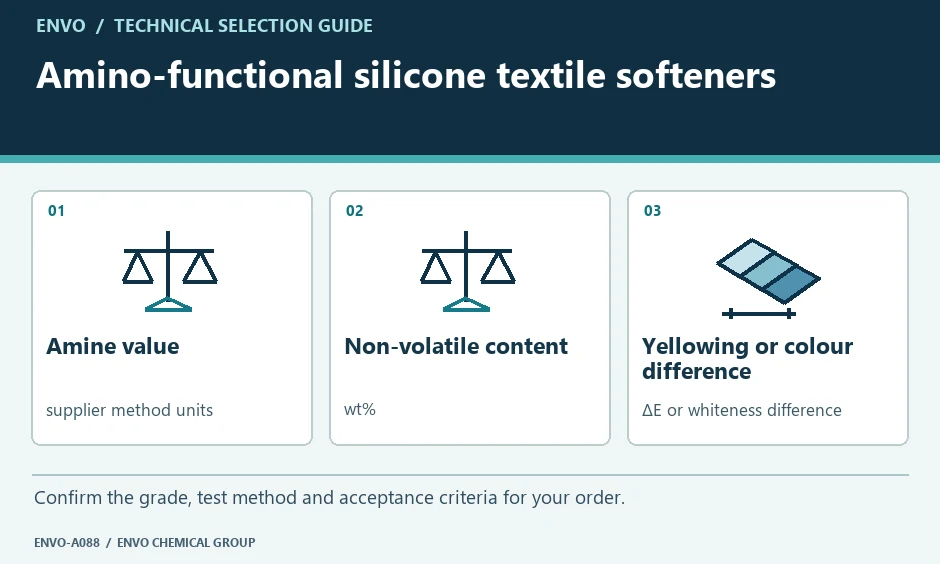
Amino value (Supplier method units): State whether the value refers to the neat oil or the commercial emulsion. Nonvolatile content (% by mass): Record drying conditions. Emulsion solids and neat silicone oil content are distinct measurements. Yellowing or color difference (ΔE or difference in whiteness): Keep the finishing bath, fabric and drying conditions constant.
What to record
- Amino value
- Active quantity
- Actual curing temperature
- Color difference
- Fabric handle
Technical references
Products and processes
Share your application, target properties and test conditions to discuss the next step.
Send a technical or purchasing enquiry ↗