Can a lot be released if two branched-chain amino acid peaks overlap?
Total nitrogen can pass even when chromatographic separation is insufficient. Approval requires clear analyte identity, stereochemistry and method.
Check peak resolution before release
Use a matrix blank, reference standard and method information to verify discrimination. If isoleucine is not resolved from an adjacent peak, retest before setting a dose from the assay.
Should a replacement use the same number of kilograms?
Convert using measured isoleucine, then verify blend uniformity on the intended equipment. Low-protein diet evaluation: Under the same dietary constraints, evaluate the L-isoleucine contribution and recheck other branched-chain amino acids. Lot substitution: Verify that the method resolves isoleucine from leucine. Then compare particle size and as-received assay.
Checking L-Isoleucine and Stereochemistry
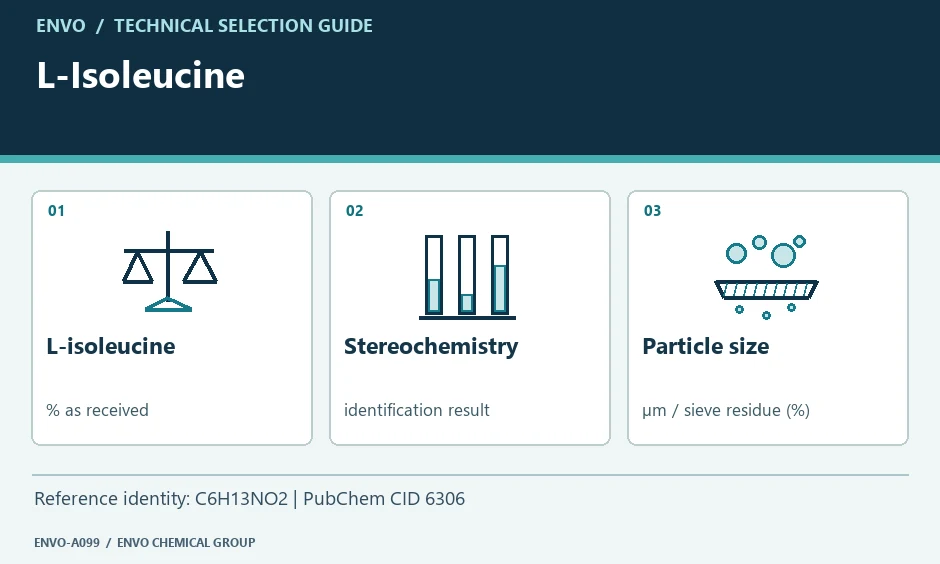
L-Isoleucine (% as received): Use an analytical method specific to the L-amino acid. State whether the result is expressed as free base, salt or as-received product. Stereochemistry (Identification result): Request identity evidence for the L configuration or the specified optical rotation conditions, matched to the sample lot. Particle size (µm / % sieve residue): Report sieve apertures and percentage passing. Make a composite sample from different bag positions and distinguish lumps from primary particles.
What to record
- Target compound
- Stereochemistry
- Reference standard
- Peak resolution
- Isoleucine assay
Technical references
- CJ BIO BestAmino: feed-grade L-amino acid range ↗
- PubChem · Chemical identity; verify the commercial grade separately ↗
Products and processes
Share your application, target properties and test conditions to discuss the next step.
Send a technical or purchasing enquiry ↗