Does total nitrogen on a COA establish L-tryptophan content?
Total nitrogen cannot distinguish the target amino acid from other nitrogen-containing material. Uneven distribution also affects finished-product readings.
Compare a composite incoming sample with location samples from the blend
Test representative raw material by a method suitable for L-tryptophan. Then compare positions in the mixer and relate each result to weighing, carrier particle size and mixing conditions.
How can we trace variability in bulk mixing?
Check lot particle size and premix sequence. Compare tryptophan at several positions against a retained sample. Dietary amino acid balance: Have the nutrition team calculate requirements for the species and basal diet and assess effects of substitution on other amino acids. Low-inclusion premixes: Prepare a staged dilution first. Take samples at different discharge positions and assay actual content.
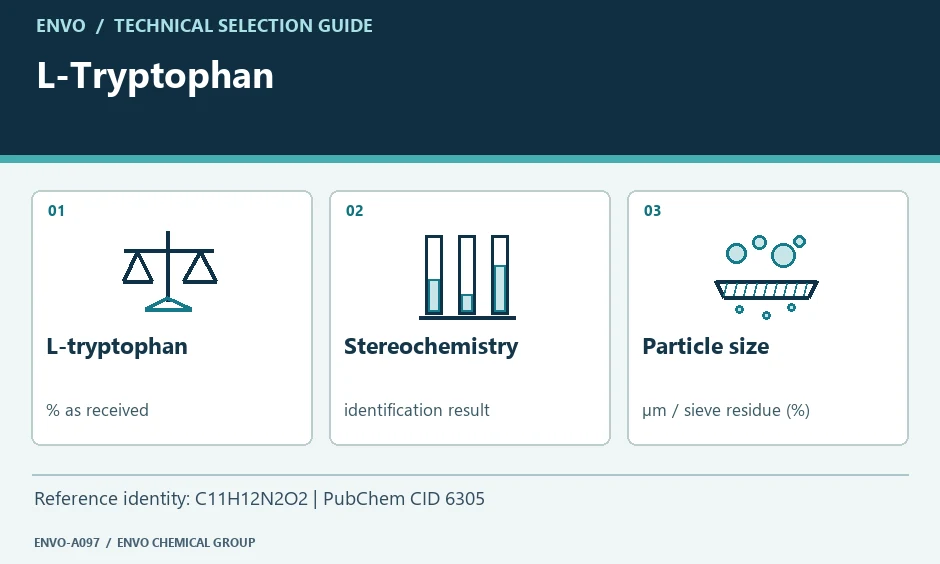
Checking L-Tryptophan and Stereochemistry
L-Tryptophan (% as received): Use an analytical method specific to the L-amino acid. State whether the result is expressed as free base, salt or as-received product. Stereochemistry (Identification result): Request identity evidence for the L configuration or the specified optical rotation conditions, matched to the sample lot. Particle size (µm / % sieve residue): Report sieve apertures and percentage passing. Make a composite sample from different bag positions and distinguish lumps from primary particles.
What to record
- L-tryptophan method
- Actual addition weight
- Carrier particle size
- Mixer sampling position
- Analytical result
Technical references
- CJ BIO BestAmino: feed-grade L-amino acid range ↗
- PubChem · Chemical identity; verify the commercial grade separately ↗
Products and processes
Share your application, target properties and test conditions to discuss the next step.
Send a technical or purchasing enquiry ↗