Does the E471 designation specify monoglyceride content?
E471 covers mixtures of mono- and diglycerides of fatty acids. Monoglyceride proportion and fatty acid composition affect melting and dispersion.
Compare cooled structure in the same oil-water system
Use the same fat and aqueous phase and record the actual heating, emulsification and cooling curves. Evaluate finished-product separation and texture rather than relying on raw-material appearance.
Why does the same emulsifier destabilise in a new recipe?
Check fat composition, dispersion and temperature history. Compare with the current product using the same process. Crumb structure in baked goods: Using the same batter, whipping and baking cycles, compare volume, crumb structure and shrinkage on cooling. Fat emulsification: Fix fat composition and the cooling cycle. Compare emulsion stability and texture after crystallization.
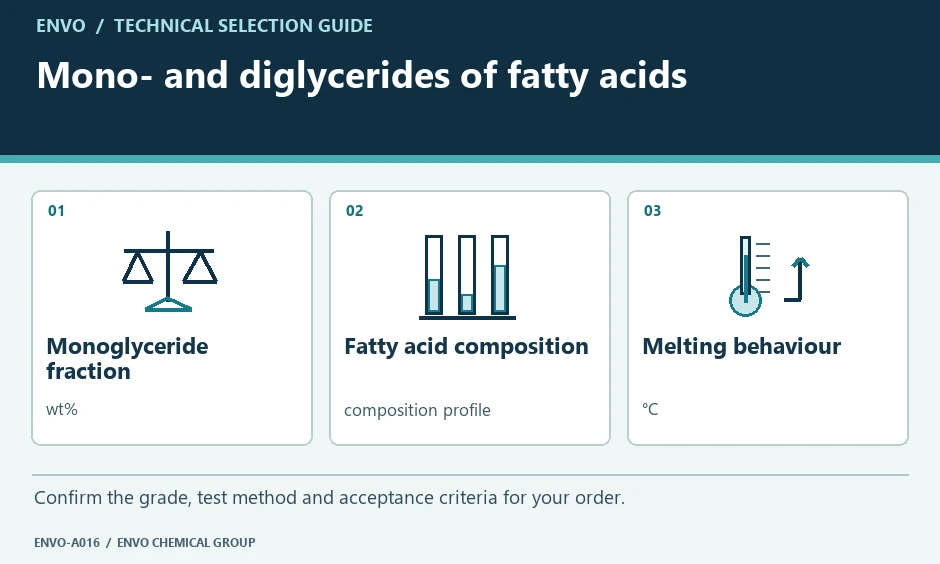
Checking Monoglyceride fraction and Fatty acid composition
Monoglyceride fraction (% by mass): Identify whether the product is distilled or a blend. Fatty acid composition (Component distribution): Verify fatty-chain origin and degree of saturation. Melting behavior (°C): Report the grade and test method. Verify using the actual melting and dispersion procedure.
What to record
- Monoglyceride fraction
- Oil phase
- Emulsification temperature
- Cooling method
- Phase separation
Technical references
- WHO JECFA: identity of mono- and diglycerides of fatty acids ↗
- Ingredients UK 12603-K: mono- and diglyceride specification ↗
Products and processes
Share your application, target properties and test conditions to discuss the next step.
Send a technical or purchasing enquiry ↗